
City and Tabletop
Course
- Bachelor of Architectural Design Semester 2, 2019
Studio leaders
- Tobias Horrocks
The site as design generator, across two scales and two projects: architecture and product
Parallel projects, each informed and formed by their respective contexts: one a city block for a mixed-use high-rise, the other a dining table for a pair of salt and pepper shakers. ‘Site analysis’ will be undertaken of an urban context and the aftermath of a dinner party.
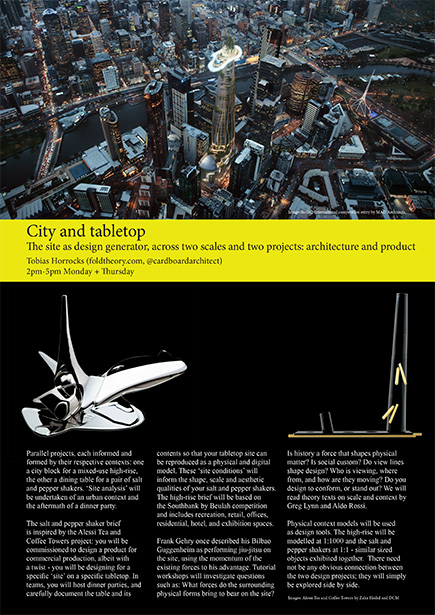
The salt and pepper shaker brief is inspired by the Alessi Tea and Coffee Towers project: you will be commissioned to design a product for commercial production, albeit with a twist - you will be designing for a specific ‘site’ on a specific tabletop. In teams, you will host dinner parties, and carefully document the table and its contents so that your tabletop site can be reproduced as a physical and digital model. These ‘site conditions’ will inform the shape, scale and aesthetic qualities of your salt and pepper shakers. The high-rise brief will be based on the Southbank by Beulah competition and includes recreation, retail, offices, residential, hotel, and exhibition spaces.
Frank Gehry once described his Bilbao Guggenheim as performing jiu-jitsu on the site, using the momentum of the existing forces to his advantage. Tutorial workshops will investigate questions such as: What forces do the surrounding physical forms bring to bear on the site? Is history a force that shapes physical matter? Is social custom? Do view lines shape design? Who is viewing, where from, and how are they moving? Do you design to conform, or stand out? We will read theory texts on scale and context by Greg Lynn and Aldo Rossi.
Physical context models will be used as design tools. The high-rise will be modelled at 1:1000 and the salt and pepper shakers at 1:1 - similar sized objects exhibited together. There need not be any obvious connection between the two design projects; they will simply be explored side by side.