
Civic Necklace
Course
- Bachelor of Architectural Design Semester 2, 2019
Studio leaders
- Monash Art, Design and Architecture
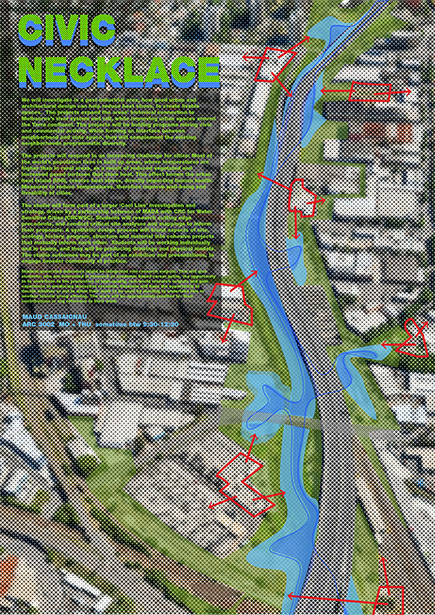
We will investigate in a post-industrial area, how good urban and architectural design can help reduce heat stress, to create livable spaces. The projects expand the areas’ historical connection to Melbourne’s river system and rail, while improving urban spaces around the Yarra confluent. The projects will be holding programs mixing civic and commercial activity. While forming an interface between neighborhood and civic space, they will complement the existing neighborhoods programmatic diversity.
The projects will respond to an increasing challenge for cities: Most of the world’s population lives in built up areas, where temperatures are higher than in rural areas, as a result of reduced vegetated and increased paved surfaces that store heat. This effect known the urban heat island (UHI), creates heat stress, directly impacting human health. Measures to reduce temperatures, therefore improve well-being and liveability of cities.
The studio will form part of a larger ‘Cool Line’ investigation and strategy, driven by a partnership between of MADA with CRC for Water Sensitive Cities (CRCWSC). Students will research cutting edge precedents, and conduct critical site analyses and mappings to inform their proposals. A synthetic design process will blend aspects of site, ecology, history, program, structure and material into cohesive projects that mutually inform each other. Students will be working individually and in teams, and they will be producing drawings and physical models. The studio outcomes may be part of an exhibition and presentations, to engage broader community of practice.
Student-generated outcomes might be integrated into research outputs. This will give students, who are interested in research or academic based career paths, the opportunity to to contribute to the production of high-quality, real-world research outputs and gain experience in producing innovative research. Students will have the opportunity to decide whether or not to allow their work to be used by electing to undertake this or another tutorial group offering. The work will be appropriately credited for their contributions or any reference to their work.

Civic Necklace
recreating indigenous estuary waterscapes in the Monee Ponds Creek near Docklands

Civic Necklace
mapping historic indigenous plants and practices

Civic Necklace
diagram explaining the reintroduction of damming practices to recreate saline and sweet water ecologies

Civic Necklace
sections across the re-created landscapes

Civic Necklace
detail impression

Civic Necklace
visitor centre, bird observation platforms and bridges suspended from existing elevated highway