
mankind
Course
- Bachelor of Architectural Design Semester 2, 2019
Studio leaders
- Darius Le
The destruction of the 850 year-old Notre-Dame Cathedral and the impending demolition of the 800 year old sacred birthing trees on Djap Wurrung country brings into sharp focus the intersection of preservation and post-colonial discourse. Students will be asked to navigate the dif cult conceptual terrain of critiquing the very mechanisms that privilege particular modes of operating over another. Why does one deserve international outcry and why do the protests of another fall on deaf ears?
“We are a people of builders. We have so much to rebuild and we will rebuild – we will make it even more beautiful than before. And I want it done within the next ve years,” stated French President Emanuel Macron following the devastating re that took place at Notre-Dame Cathedral on April 17, 2019. With two thirds of the roof damaged, conversations around its restoration shift between two pendulums; one that insists the outcome of the restoration should be exactly the way that it was or a re-design that contemplates its presence and resilience in the 21st century.
Conversely, the 800-year-old sacred trees on Djab Wurrung country have been marked for removal to make way for the upgrade of a stretch of the highway connecting Adelaide and Melbourne - the busiest highway in Victoria. Developers insist removing a 12km section of the trees is necessary for the upgrades. Major Road Projects Victoria, says this stretch of highway is deadly and the bypass would decrease the number of trucks on the road.
The studio is interested in the values that dictate our comprehension of the built environment. We will observe and critique authorities that de ne the value of our environment, from UNESCO World Heritage to the ICOMOS Burra Charter, which is currently celebrating forty years since its inception, a departure from the Venice Heritage Charter which emerged in 1964.
Consequently, the studio is interested in developing propositions that subvert ideas around adaptive re-use and diversifying strategies and methodologies for conservation and architectural production.
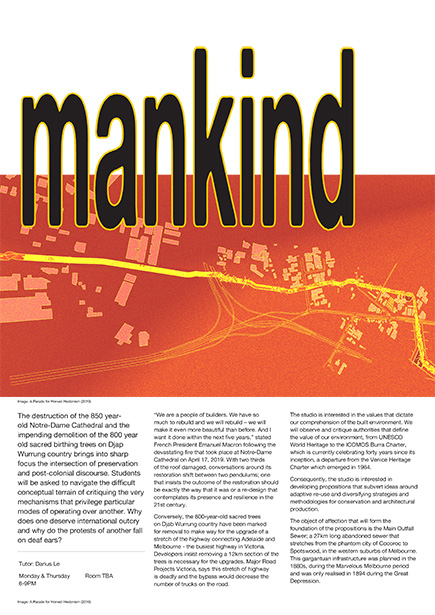
The object of affection that will form the foundation of the propositions is the Main Outfall Sewer; a 27km long abandoned sewer that stretches from the phantom city of Cocoroc to Spotswood, in the western suburbs of Melbourne. This gargantuan infrastructure was planned in the 1880s, during the Marvelous Melbourne period and was only realised in 1894 during the Great Depression.