
Housing+ in Braybrook
Course
- Master of Architecture Semester 1, 2020
Studio leaders
- Lee-Anne Khor
- Dr Elizabeth Taylor Monash Art, Design and Architecture
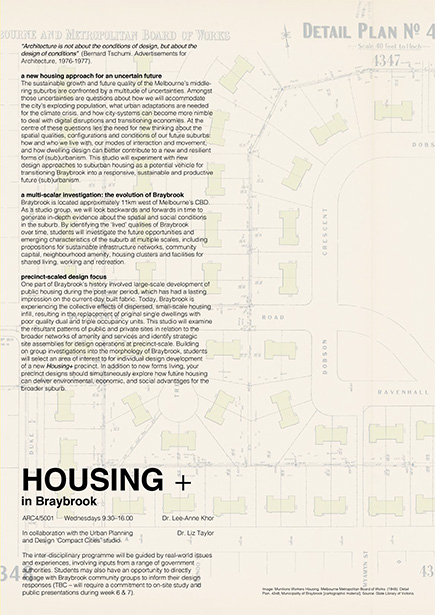
“Architecture is not about the conditions of design, but about the design of conditions” (Bernard Tschumi. Advertisements for Architecture, 1976-1977).
A new housing approach for an uncertain future
The sustainable growth and future quality of the Melbourne’s middlering suburbs are confronted by a multitude of uncertainties. Amongst those uncertainties are questions about how we will accommodate the city’s exploding population, what urban adaptations are needed for the climate crisis, and how city-systems can become more nimble to deal with digital disruptions and transitioning economies. At the centre of these questions lies the need for new thinking about the spatial qualities, configurations and conditions of our future suburbs: how and who we live with, our modes of interaction and movement, and how dwelling design can better contribute to a new and resilient forms of (sub)urbanism. This studio will experiment with new design approaches to suburban housing as a potential vehicle for transitioning Braybrook into a responsive, sustainable and productive future (sub)urbanism.
A multi-scalar investigation: the evolution of Braybrook
Braybrook is located approximately 11km west of Melbourne’s CBD. As a studio group, we will look backwards and forwards in time to generate in-depth evidence about the spatial and social conditions in the suburb. By identifying the ‘lived’ qualities of Braybrook over time, students will investigate the future opportunities and emerging characteristics of the suburb at multiple scales, including propositions for sustainable infrastructure networks, community capital, neighbourhood amenity, housing clusters and facilities for shared living, working and recreation.
Precinct-scaled design focus
One part of Braybrook’s history involved large-scale development of public housing during the post-war period, which has had a lasting impression on the current-day built fabric. Today, Braybrook is experiencing the collective effects of dispersed, small-scale housing infill, resulting in the replacement of original single dwellings with poor quality dual and triple occupancy units. This studio will examine the resultant patterns of public and private sites in relation to the broader networks of amenity and services and identify strategic site assemblies for design operations at precinct-scale. Building on group investigations into the morphology of Braybrook, students will select an area of interest to for individual design development of a new Housing+ precinct. In addition to new forms living, your precinct designs should simultaneously explore how future housing can deliver environmental, economic, and social advantages for the broader suburb.
The inter-disciplinary programme will be guided by real-world issues and experiences, involving inputs from a range of government authorities. Students may also have an opportunity to directly engage with Braybrook community groups to inform their design responses (TBC – will require a commitment to on-site study and public presentations during week 6 & 7).