Insert, Augment, Rehabilitate
Course
- Master of Architecture Semester 2, 2020
Studio leaders
- William Orr
Studio concept
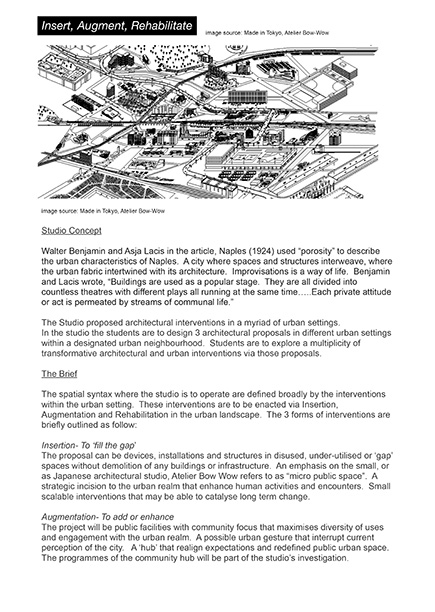
Walter Benjamin and Asja Lacis in the article, Naples (1924) used “porosity” to describe the urban characteristics of Naples. A city where spaces and structures interweave, where the urban fabric intertwined with its architecture. Improvisations is a way of life. Benjamin and Lacis wrote, “Buildings are used as a popular stage. They are all divided into countless theatres with different plays all running at the same time.....Each private attitude or act is permeated by streams of communal life.”
The Studio proposed architectural interventions in a myriad of urban settings. In the studio the students are to design 3 architectural proposals in different urban settings within a designated urban neighbourhood. Students are to explore a multiplicity of transformative architectural and urban interventions via those proposals.
The brief
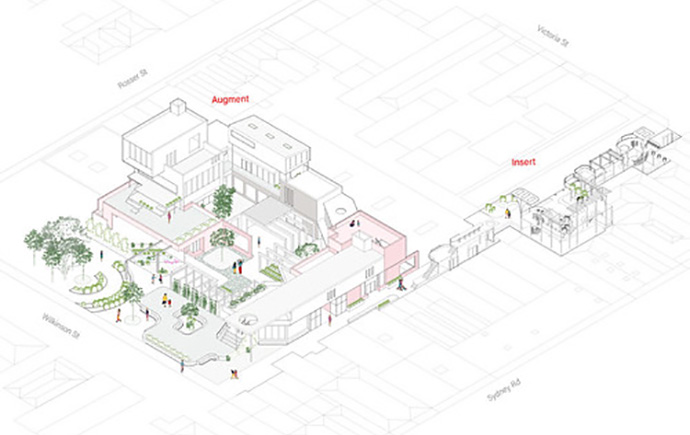
The spatial syntax where the studio is to operate are defined broadly by the interventions within the urban setting. These interventions are to be enacted via Insertion, Augmentation and Rehabilitation in the urban landscape. The 3 forms of interventions are briefly outlined as follow:
Insertion- To ‘fill the gap’
The proposal can be devices, installations and structures in disused, under-utilised or ‘gap’ spaces without demolition of any buildings or infrastructure. An emphasis on the small, or as Japanese architectural studio, Atelier Bow Wow refers to as “micro public space”. A strategic incision to the urban realm that enhance human activities and encounters. Small scalable interventions that may be able to catalyse long term change.
Augmentation- To add or enhance
The project will be public facilities with community focus that maximises diversity of uses and engagement with the urban realm. A possible urban gesture that interrupt current perception of the city. A ‘hub’ that realign expectations and redefined public urban space. The programmes of the community hub will be part of the studio’s investigation.
Rehabilitation- To renew and adapt
The proposal is adaptive reuse of an existing building or disused infrastructure. The objective is to repurpose and reimagine new usage and animation for such facility. An example will be repurpose of multi level car parking structure to a mixed use facilities. The architectural proposals are to be based on thoughtful and scholarly analysis of the urban conditions. These series of interventions proposed by each student are interdependent on each other and form an overall urban strategy.
Outcome
The scope of the proposals, building types and programs are part of students’ initial research. The students are expected to develop at least 2 out of 3 proposals well beyond the conceptual stage to detail architectural resolution.
These interventions disrupt routine, redefine ways of seeing, using, and occupying urban space. They are to improve accessibility, diversity, inclusiveness and engagement of the urban realm.
The myriad of proposals by the students in the studio form a collective response, cumulative outcome that may inform tactical manoeuvre in the intervention of urban neighbourhood. The dynamics of the city is often not driven by formal proposition but a series of informal creative interventions, gestures that can be subtle or direct, gentle or
radical, but always transformative. The studios’ propositions are to explore some of these possibilities. The focus is not on an ‘image’ of architecture but an architectural presence that animate the urban realm.
Students are expected to work in groups in early part of the studio to investigate urban conditions as well as develop urban design strategy. Each group of students are to investigate and develop urban interventions based on above criteria within an urban neighbourhood. The architectural proposals, from each student, borne out of the urban design strategy will have interdependent relationship with each other and form an integrated urban strategy. The outcome of the studio should epitomise collective actions from the cohort and demonstrate possibilities of urban transformations through accumulative ideas, gestures and actions.
Note that Urban Analysis and Urban Design Strategy will be group work. The 2-3 Architectural Proposals will be individual student’s work. Detail submission requirements, studio output and timetable will be provided at the
commencement of the semester.
Selected references
- Benjamin, Walter and Lacis, Asja 1924/1978, Naples in Benjamin, Walter, Reflections: essays, aphorisms, autobiographical writings. Translated by Edmund Jephcott and edited by Peter Demetz. NY/London.
- Gehl, Jan 2011 edition, Life Between Buildings, using public Space, translated by Jo Koch, Island Press
- Sim, David 2019, Soft City, Building density for everyday life, island press
- Sorkin, Michael 2009, Twenty Minutes in Manhattan, Reaktion Book
- Stalder L., Escher C., Megumi Komura, Meruro Washida (Ed.) 2013 , Atelier Bow-Wow A Primer, Verlag der Buchhandlung-walther-Koenig