Minefields(Li)
Course
- Master of Architecture Semester 2, 2020
Studio leaders
- Dr Eduardo Kairuz Monash Art, Design and Architecture
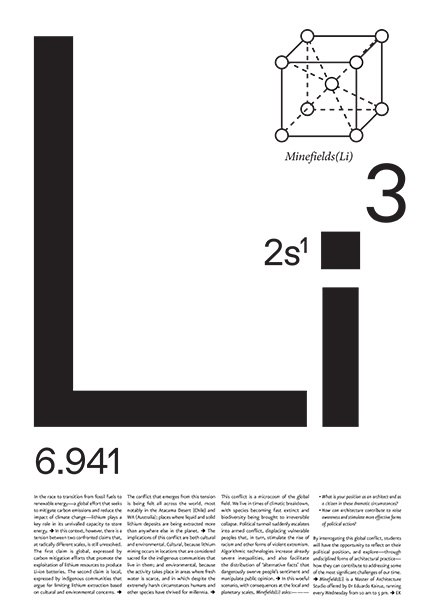
In the race to transition from fossil fuels to renewable energy—a global effort that seeks to mitigate carbon emissions and reduce the impact of climate change—lithium plays a key role in its unrivalled capacity to store energy.
In this context, however, there is a tension between two confronted claims that, at radically different scales, is still unresolved. The first claim is global, expressed by carbon mitigation efforts that promote the exploitation of lithium resources to produce Li-ion batteries. The second claim is local, expressed by indigenous communities that argue for limiting lithium extraction based on cultural and environmental concerns.
The conflict that emerges from this tension is being felt all across the world, most notably in the Atacama Desert (Chile) and WA (Australia); places where liquid and solid lithium deposits are being extracted more than anywhere else in the planet.
The implications of this conflict are both cultural and environmental. Cultural, because lithium mining occurs in locations that are considered sacred for the indigenous communities that live in them; and environmental, because the activity takes place in areas where fresh water is scarce, and in which despite the extremely harsh circumstances humans and other species have thrived for millennia.
This conflict is a microcosm of the global field. We live in times of climatic breakdown, with species becoming fast extinct and biodiversity being brought to irreversible collapse. Political turmoil suddenly escalates into armed conflict, displacing vulnerable peoples that, in turn, stimulate the rise of racism and other forms of violent extremism. Algorithmic technologies increase already severe inequalities, and also facilitate the distribution of ‘alternative facts’ that dangerously swerve people’s sentiment and manipulate public opinion.
In this woeful scenario, with consequences at the local and planetary scales, Minefields(Li) asks:
What is your position as an architect and as a citizen in these dramatic circumstances?
How can architecture contribute to raise awareness and stimulate more effective forms of political action?
By interrogating this global conflict, students will have the opportunity to reflect on their political position, and explore—through undisciplined forms of architectural practice—how they can contribute to addressing some of the most significant challenges of our time.