Parallel Places
Course
- Master of Architecture Semester 2, 2020
Studio leaders
- Andrew Simpson

The notion that architecture can help us live forever is clearly science fiction. But the promise of improving our health and extending our life spans, even just a little, without ever leaving the house? Well, I found that idea irresistible. After all, I am unapologetically indoorsy. It’s not that I don’t like nature; I think nature is lovely. I’ve been camping numerous times—and enjoyed it! It’s just that I’m anxiety-prone and risk-averse, and the world inside my apartment is warm and cozy and safe. Lots of journalists file dispatches from far-flung places— reporting on wildlife in the Serengeti, floods in the Mekong Delta, and ice cores in Antarctica—but I’ve always felt most comfortable plying my craft from deep inside my living room.
— Emily Anthes, The Great Indoors: The Surprising Science of How Buildings Shape Our Behaviour, Health, and Happiness
Dwelling therefore implies something more that ‘shelter’. It implies that the spaces where life occurs are ‘places’ in the true sense of the word. A place is a space which has a distinct character. Since ancient times the ‘genius loci’ or ‘spirit of place’, has been recognised as the concrete reality man has to face and come to terms with in his daily life. Architecture means to visualise the ‘genius loci’, and the task of the architect is to create meaningful places, whereby he helps man to dwell.
— Christian Norberg-Schulz, Genius Loci: Towards a Phenomenology of Architecture
This is a studio of paradoxes
What is remoteness? How do we understand places that we haven’t experienced? Does familiarity require proximity? Can something be designed specifically for a place, but at a distance? Can a design be both repeatable/typical and also tailored/unique to a site? What tools might we use in searching for the ‘spirit of a (remote) place’? Data? Images? Our Imagination? What defines a ‘home away from home’? Does a ‘fully-indoor’ lifestyle still require connection to the outside, or does an outdoor lifestyle still needs some sense of shelter? What does the indoor-outdoor balance offer us?
What
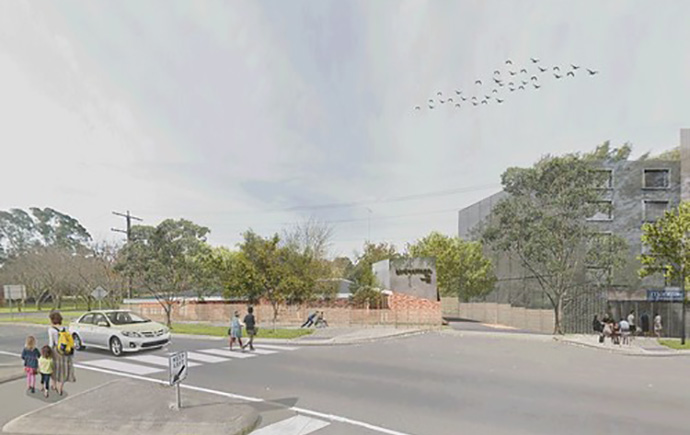
To explore these notions of place-making, (un)familiarity, (ex+in)teriority and paradox, students will build upon a live project that is currently engaged with these questions and developing an architecture to be experienced as a ‘home away from home’. Very Special Kids (VSK) – www.vsk.org.au – is a not-for-profit charity that provides care for children with life-threatening conditions along with family support services. The focus of the organisation is an 8-bed hospice that does not provide intensive clinical care, but rather a place of comfort and respite for children and their families. Part house and part healthcare facility, it offers a safe community-based environment with ancillary therapy services including art, music, soft play, multi-media, hydrotherapy and other allied health support. My office is currently engaged as the design architect to replace the current Glenferrie Road facility with a new building (www.asimpson.com. au/vsk). Students will have the opportunity to draw upon the research and development of this project as it unfolds in parallel with the studio.
Where
Given its state-wide remit and outreach program, VSK is looking to provide similar service support in regional Victoria. This studio will engage in research, site selection strategies, methodologies for remote context analysis, and program development leading to the design of smaller scale hospices in country town-centres. Students are invited to speculate on how VSK might support families and children from regional areas. Studio participants will have the opportunity to engage with staff from the hospice to test their ideas and architectural propositions.
How
The studio will run a parallel series of study tasks: research into the existing state-of-play for this type of hybrid healthcare model; identifying opportunities for VSK facilities in regional Victoria; development of remote site analysis and place-making methodologies; case study analysis; and site selection strategies. While the project is to be framed by coherent and thorough research, there will be a strong emphasis on developing a resolved architecture project.
Who
In the spirit of remote learning, we are also very fortunate to be working with Balazs Bognar — Partner at Kengo Kuma & Associates — who leads many of the Kengo Kuma projects outside Japan in North America and Oceania. (www.designedpodcast.com/episodes/balazs-bognar) As an architect Balazs is very engaged with the specific character of each site and its cultural, environmental and procurement context; and he is intrigued by the challenges of the current pandemic for architecture practices dedicated to methodologies of placemaking. Balazs will be operating remotely, while contributing as a regular guest critic to the studio discussion and reviews through the semester.