
After Aid
Course
- Bachelor of Architectural Design Semester 1, 2020
Studio leaders
- Dr Michaela Prescott Monash Art, Design and Architecture
- Dr Yazid Ninsalam RMIT + Climate Resilient Honiara Project

Working from afar, the design studio will broadly investigate the potential for design (architecture and landscape architecture) to provoke or incite reactions within dynamic urban areas. Investigating the role of design – and the designer – in international development, AFTER AID deals with the ‘wicked’ problems facing informal settlements within the Pacific.
It asks students to speculate on alternative urban futures, asking ‘what next’ after aid/development projects are completed which often are unable to address interlinking problems. Speculative design is a discursive practice, based on critical thinking and dialogue, which questions the practice of design. In this studio students will use this in particular within the context of developing economies that receive aid via infrastructural development.
Ideas generated in the studio will contribute towards a body of design research on designing in and for informal settlements. Building from action-research projects undertaken by researchers in both institutions, students from both cohorts will engage with RISE project materials via broader themes of social and spatial justice, climate change and environmental sustainability within the context of Asia Pacific and advanced geospatial techniques developed in RMIT Climate Resilient Honiara project.
Things to note
- On- and off- campus classes
- Joint Architecture and Landscape Architecture design course.
- Workshop access required- includes digital fabrication techniques for rapid prototyping
- Includes basic Rhino, Grasshopper and GIS tools for working with 3D point Cloud data from drone imagery

Sehani Wickramasekera, Aquaponics
Location: Untia, Makassar, Indonesia
This project was designed to aid local scavengers with a better income as well as providing the community with better health and a cleaner environment.
Concept 1: Three workshops made from recycled plastic barrels from the local area. Collection of plastic bottle/rubbish to be stored, sorted and washed before selling it to a recycling factory.
Concept 2: Aquaponic community garden. When it rains, the roof collects the water to be stored into plastic barrels which provides water for the aquaponics as there is no clean water in the area. Water pumps up from the fish tank to the vegetation, giving nutrition as well as the water getting filtered when it goes back down to the fish.
Both concepts are maintained by the local scavengers so they can truly benefit from a better income system.

Sehani Wickramasekera, Atmospheric

Sehani Wickramasekera, Axo

Sehani Wickramasekera, Inside of workshop

Sehani Wickramasekera, Render

Hon Ng, Cluster Map
The project answers the question of what happens next after implementation? The project is an informal settlement located in Alla-Alla, Makassar City, Indonesia. The aim is to create solutions that would improve community resilience by increasing economic opportunities while being thoughtful of the current financial feasibility and accessibility.

Hon Ng, Stall Types

Hon Ng, Stall Fabrication

Hon Ng, Space Re-organization

Hon Ng, Home Business Scale

Joshua Yeo, Big Perspective
Upward Drive: A Framework for Growth is a project that aims to strengthen micro-communities based on a study site in Untia, Makassar City, Indonesia. Having initially identified the lack of future planning in terms of infrastructure and space to support its growing families and population, this project is a framework for future development consisting of several schemes that different family groups within the settlement can use. It centres around 3 primary objectives: developing to accommodate family growth, creating more productive and usable spaces within the domestic landscape, and cultivating a sense of community between families and neighbours. These will be achieved through different strategies applied at the plot, cluster, and neighbourhood scale that seek not to provide definite and fixed solutions, but to offer and direct possibilities and pathways for locals to choose and adopt as their own. Echoing the kampung culture of allowing informal processes and needs to drive its development and community, Upward Drive is similarly an organic model driven by need rather than by standard, growing with time and demand. It is vital for such communities to have a structure able to continuously support its growth, as the lack of such forward planning could lead to further compromised living conditions as the population continues to expand.

Joshua Yeo, Cluster New

Joshua Yeo, Cluster New

Joshua Yeo, House Perspective

Joshua Yeo, Neighbourhood Plan

Ashley Hanrahan, Floating road diagrams
Meeting the Tide is a prospective plan for adaptation of the informal settlement of Barombong, Indonesia in response to rising tides and significant land subsidence. Focusing on two proposed benchmarks years, 2040 and 2060, this project works to adapt the current residential and public infrastructure for both seasonal and complete water inundation. As a result, three methods have been undertaken in tandem, raising lightweight structures above the benchmarked water levels, creating sacrificial residential levels through the construction of additional stories, and designing new floating infrastructure to facilitate public and transitional spaces. Pedestrian transition and social space had been accommodated through the vertical transition and open roof spaces of the densified residences, where connections between close neighbours and family groups promote the existence of bale-bales and microeconomic opportunities, both permanent and moveable. Overall, Meeting the Tide aims to show that an informal settlement such as Barombong can adapt to a flooded context through utilising current construction and material practices, without sacrificing a sense of community connection.

Ashley Hanrahan, Stage 3, long house axo

Ashley Hanrahan, Sections

Ashley Hanrahan, Stilt house axo full

Ashley Hanrahan, Whole axo

Rebecca Williams, WARP + WEFT
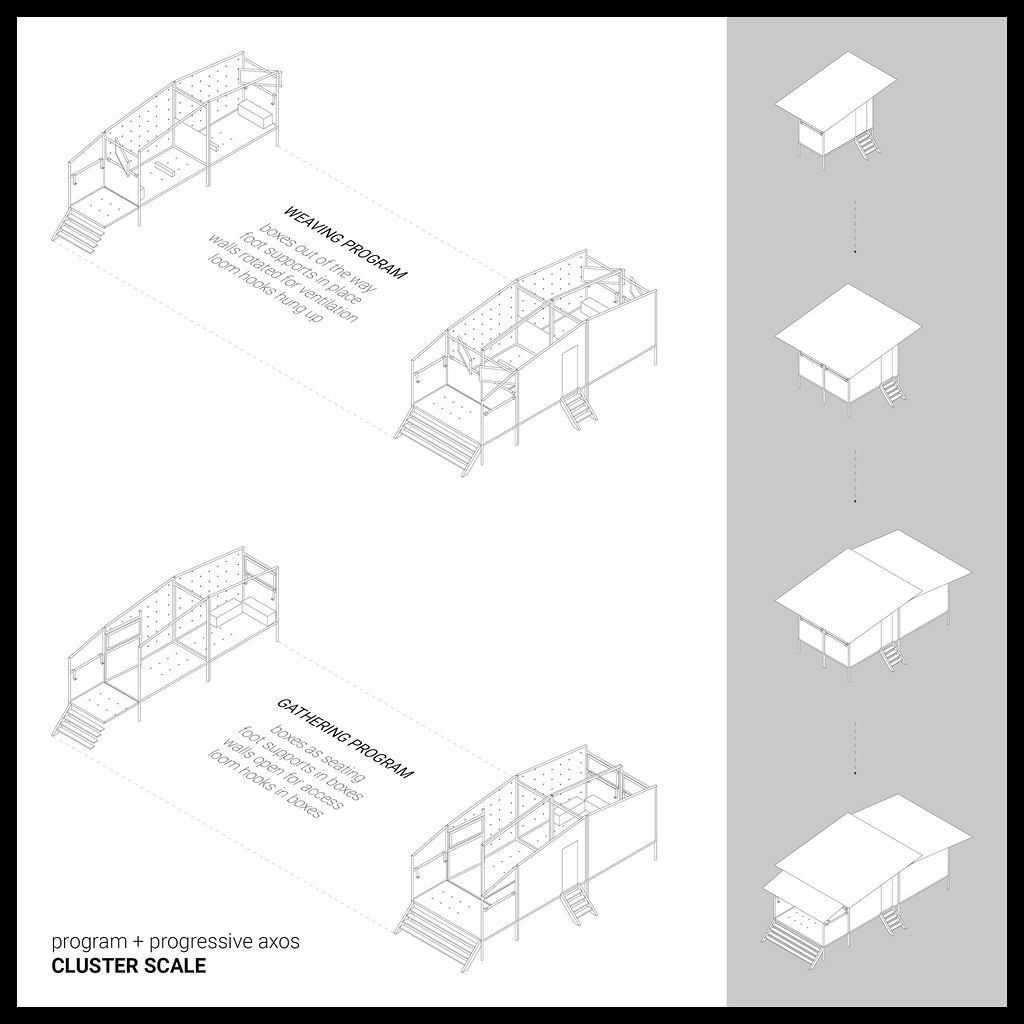
Whilst RISE addressed the physical sanitation needs of the neighbourhood of Alla-Alla, I saw an opportunity in the period of ‘after-aid’ to support a fostering of connection and identity. Warp + Weft seeks to provide a community space, primarily to teach people to weave, and secondarily a gathering space and place to collaborate on creative projects. I focused on making the structure replicable by the community, deconstructable and flexible, which was achieved by using local materials and building techniques, semi-permanent connections, modular and incremental design, and adaptable and multi-use elements. Taking cues from bale-bales (pronounced ‘ba-lay ba-lay’), a local type of small gathering structure, Warp + Wefts lightweight bamboo frame makes it cheap and easy to build. In this vein, a key building material was water hyacinths. This weed grows rampantly in the canal bordering Alla-Alla, blocking its flow and exacerbating local flooding. It can be harvested, dried, and woven into sheets that provide screening, whilst allowing for ventilation. As well as incorporating water hyacinths into the building, Warp + Weft will provide a space for water hyacinths to be woven into products such as baskets that can then be sold, a business model popular in South-East Asia and Africa.
Please feel free to check out my full presentation here: tinyurl.com/warp-weft

Rebecca Williams, WARP + WEFT
Rebecca Williams, WARP + WEFT

Rebecca Williams, WARP + WEFT
