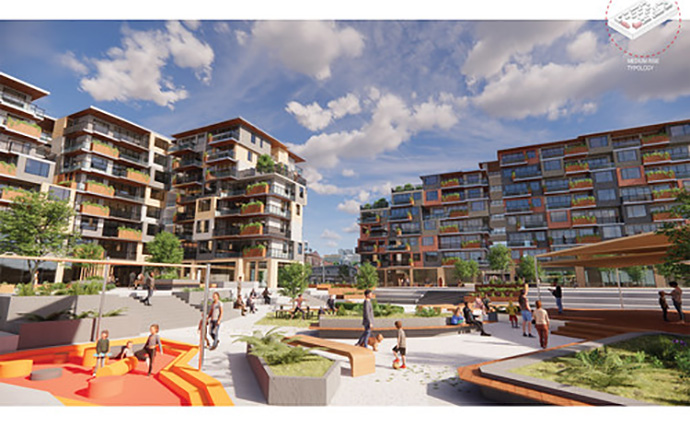
Amplify
Course
- Bachelor of Architectural Design Semester 2, 2020
Studio leaders
- Hannes McNamara MUSK Architecture Studio

Studio site
Fitzroy
Key themes
Adaptive re-use, change-agents and responsive/flexible social housing models.
Studio description
This is a housing studio. Students will propose urban densification in the inner Melbourne suburb of Fitzroy through both the redesign and the adaptive re-use of existing social housing estates. Students will retrofit the existing social housing towers and propose new social housing projects in this studio.
During the Covid 19 pandemic, these estates and specifically the viability of towers became a key discussion point in the media. Built in the 60’s and 70’s, these building have been heavily critiqued and are considered by some as no longer appropriate housing solutions for our most vulnerable. The Amplify studio aims to address this very current and pressing topic through the proposition of an alternative model responding to the needs of the occupants. Students will strategically propose how these sites can respond and evolve to the current needs of its residents. Student proposals will address new family dynamics, a sense of community, changing demographics and the role these estates play within both the city and their immediate suburban context. Students will design at both a precinct scale and the scale of the individual dwelling.
The brief and program
The final brief for the studio will call for the design of a social housing project within an existing social housing precinct. In proposing social housing, students will explore urban conditions, site context, adjacency, contribution to streetscape, solar access, massing and links between internal and external community. Students will interrogate the brief and site constraints to propose a diverse occupant mix reflecting an increased sense of community, changing demographics and diversity of offering, liveability and aging in place.
Students will engage with the relationship between the social housing precincts (including the towers) and their immediate context, to seek to understand and respond to the differences in each location and how replicable strategies may need to adjust to this diverse context. Students will need to complete design tasks considering both retrofitting and new social housing proposals.
Architectural representation and exploration
The studio will include a series of seminars introducing students to reference projects, concepts and existing typologies. Students will use hand drawings and 3D software to develop both programmatic relationship and built form. The existing and proposed building plan, internal relationships, dwelling mix and community spaces will be a key focus of the studio.
Students will investigate precedent architecture, researching, reviewing, redrawing and remodeling in order to understand the spatial and physical elements of architecture. Physical models will be required throughout the semester as students will be required to transfer between digital and physical representations of their design investigations.
Semester breakdown
Students will spend the first third of the semester engaged in specific research into both existing social housing projects while also carefully documenting the existing conditions. Students will be interrogate existing multi-residential models (both local and overseas). Working in groups, students will develop a research agenda for their individual projects. This information will be presented in the form of catalogued plans, diagrams, photographs and physical models. Students will undertake three design tasks during the semester.
Studio outcomes
Following the research component of the semester, Students will be required to actively engage with the social housing and liveability/adaptability discourse within the Fitzroy context. Students will be required to formulate convincing arguments for adaptive proposals in the first instance. In subsequent tasks students will develop a position on the aesthetics of their individual proposals. Students will further develop the brief in section, exploring potential expansions on the project program and unit mix, develop circulation strategies and design the final building form. The research-based work and the tasks completed in the first half of semester will assist students to develop their own unique proposal for the final design critique. Each student’s unique position (regarding research question, resident size and mix, for example) will be presented within the final critique at the conclusion of the semester. Student proposals should actively engage in the current discussion regarding social housing (through increased density).
Studio costs
Students will also be expected to make physical models and pay for associated material costs.
Studio leader
Hannes McNamara is a registered Architect in Victoria, AIA member and a director at MUSK
Architecture Studio, he has previously led Design Studios at RMIT, Melbourne University and Monash University. #muskstudio Photographer: Tiffany Liem