Architecture + the rural community
Course
- Bachelor of Architectural Design Semester 2, 2020
Studio leaders
- Kalliopi Vakras Kalliopi Vakras Architects
Studio Background + Brief
In December 2019 through to February 2020 we saw bushfires across the entire country. As a result, we saw what was believed to be some of Australia’s first Climate Refugees. Climate refugees, or environmental migrants, are people forced to abandon their homes due to change in climatic conditions or extreme weather events.
During this time we also saw a strong sense of community and generosity shine through from people who were not directly impacted by these fires. We saw various social media movements form such as Empty Esky, Spend with Them & The Animal Rescue Craft Guild with an intent to create a sustainable and longer-term approach to assisting affected communities. In our own industries, movements such as Architects Assist were formed as architecture and design practices began responding with offers of assistance to those who had lost their homes.
Within the actual affected communities, we saw positive engagement, hope and a sense of unity.
This studio will study the sense of community, social connection and interaction that was formed during this time. It will focus on the notion of human relationships and how the design of cities and the spaces within them can increase opportunities to connect with others, whether that be via direct or incidental interactions.
The way we build and organise our cities can help or hinder social connection” – Social Cities, Jane Frances-Kelly
As social animals our relationships and interactions with others are critical to our wellbeing. Social connection is about engagement with others and the sharing of information and resources to create more dynamic and resilient communities.
These spaces are important for building communities, creating a sense of belonging and for supporting the wellbeing of its community. A city and its space are activated by the way people inhabit it. A space does not necessarily have to be a defined ‘room’ – it can be the in-between spaces with in our cities, the shared spaces, the permeable pass through spaces, spaces where we pause.
This studio will focus on the notion of the rural town and how it acts as it’s own city with a collection of spaces that form community gathering hubs within. Buildings such as the local pub, general store, cafes, community centres and even the local post office can all bind together to form the life of a rural community.
Teaching Methods, Design Methodologies + Expected Outcome
In the first half of the semester you will work in groups to explore precedents of spaces that have succeeded in providing a vessel for good social connection, as well as spaces that have failed. You will also explore post disaster reconstruction and how as architects we can assist with the reconstruction of communities.
You will investigate how architecture can assist in providing meaningful and interactive spaces that promote wellbeing and encourage people to gather, interact and connect.
The studio also aims to investigate the emotions of how we feel in the spaces we occupy, the experiential qualities of a space and how these might contribute to the success of the useability of a space. It investigates sensory concepts, and how factors including light/ shadow, scale, volume, tactility, intimacy, etc might be applied to the design of your buildings.
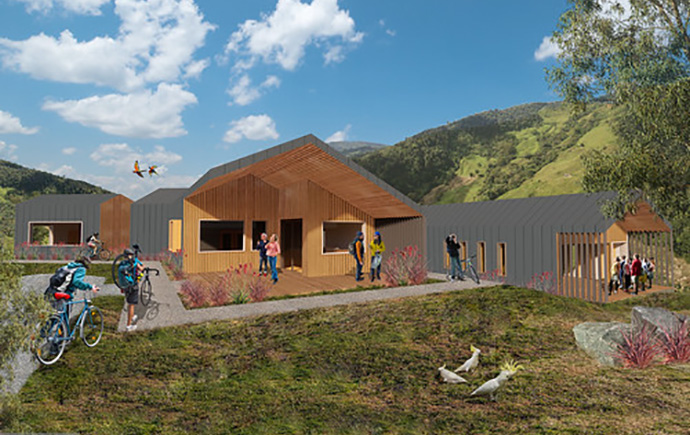
As a group you will develop a new map for a rural town. You will study a town that was affected by the Black Saturday Fires in 2009 and has since lost it’s local pub and General Store, and develop a plan for what the community might need. You will then provide individual buildings within this rural town. Each student providing a different typology of space to fit within the overall scheme. You will be encouraged to focus on non-residential uses with a focus on providing a building that becomes a new gathering space that will form the heart of the community and transform it into an engaging and interactive space for community collaboration and interaction.
At the end of the semester the studio students will map their individual buildings within the overall context of the rural town. Each building will be a medium sized building with community focus. Deliverables will include larger scale mapping projects within the group as well as individual drawing and model making. You will act as socially conscious designers to provide spaces that are resilient in natural disasters, compact, flexible and built with sustainable materials.
Photo credit: Operating Engineers Local Union, Architectural Record