
Gesamtkunstwerk
Course
- Bachelor of Architectural Design Semester 1, 2020
Studio leaders
- James Jamison
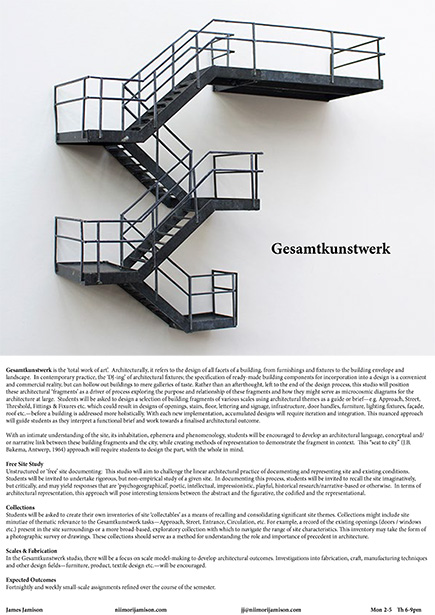
Gesamtkunstwerk is the ‘total work of art’. Architecturally, it refers to the design of all facets of a building, from furnishings and fixtures to the building envelope and landscape. In contemporary practice, the ‘DJ-ing’ of architectural fixtures; the specification of ready-made building components for incorporation into a design is a convenient and commercial reality, but can hollow out buildings to mere galleries of taste. Rather than an afterthought, left to the end of the design process, this studio will position these architectural ‘fragments’ as a driver of process exploring the purpose and relationship of these fragments and how they might serve as microcosmic diagrams for the architecture at large. Students will be asked to design a selection of building fragments of various scales using architectural themes as a guide or brief— e.g. Approach, Street, Threshold, Fittings & Fixtures etc. which could result in designs of openings, stairs, floor, lettering and signage, infrastructure, door handles, furniture, lighting fixtures, façade, roof etc.—before a building is addressed more holistically. With each new implementation, accumulated designs will require iteration and integration. This nuanced approach will guide students as they interpret a functional brief and work towards a finalised architectural outcome.
With an intimate understanding of the site, its inhabitation, ephemera and phenomenology, students will be encouraged to develop an architectural language, conceptual and/or narrative link between these building fragments and the city, while creating methods of representation to demonstrate the fragment in context. This “seat to city” (J.B. Bakema, Antwerp, 1964) approach will require students to design the part, with the whole in mind.
Free Site Study
Unstructured or ‘free’ site documenting: This studio will aim to challenge the linear architectural practice of documenting and representing site and existing conditions. Students will be invited to undertake rigorous, but non-empirical study of a given site. In documenting this process, students will be invited to recall the site imaginatively, but critically, and may yield responses that are ‘psychogeographical’, poetic, intellectual, impressionistic, playful, historical research/narrative-based or otherwise. In terms of architectural representation, this approach will pose interesting tensions between the abstract and the figurative, the codified and the representational.
Collections
Students will be asked to create their own inventories of site ‘collectables’ as a means of recalling and consolidating significant site themes. Collections might include site minutiae of thematic relevance to the Gesamtkunstwerk tasks—Approach, Street, Entrance, Circulation, etc. For example, a record of the existing openings (doors / windows etc.) present in the site surroundings or a more broad-based, exploratory collection with which to navigate the range of site characteristics. This inventory may take the form of a photographic survey or drawings. These collections should serve as a method for understanding the role and importance of precedent in architecture.
Scales & Fabrication
In the Gesamtkunstwerk studio, there will be a focus on scale model-making to develop architectural outcomes. Investigations into fabrication, craft, manufacturing techniques and other design fields—furniture, product, textile design etc.—will be encouraged.
Expected Outcomes
Fortnightly and weekly small-scale assignments refined over the course of the semester.

Mieke Buchhorn, Gesamtkunstwerk
My main theme for the Gesamtkunstwerk studio has been the mundane and unsightly, which developed into a focus on waste and waste processing.
My early Street, Threshold and Fittings and Fixtures fragments each stemmed from mundane objects - the milk crate, roller door and wheelie bin – and sought to celebrate their utility and in some capacity, redesign them.
I then proposed a waste sorting facility as the trajectory for my suite of works. Waste ties into my broader interest in the mundane and unsightly: it connects to my communal bin stations, the use of recycled materials across fragments and my initial observations of unsightly and discarded site paraphernalia.
The facility occupies and adapts the current Wilson’s car park location. By repurposing such a large building, waste disposal is made unapologetically visible. The facility is connected to the communal bin stations scattered around the city as a peripheral part of the design. The building holds two sorting systems: one for general waste and one for recycling. Green waste undergoes a composting process on site. The milk crate is used as a module to form the glass-backed facade, allowing for transparency between the facility and the street. This serves to make waste processing visible, and confront the public with their own waste and consumption behaviours.

Mieke Buchhorn, Gesamtkunstwerk

Mieke Buchhorn, Gesamtkunstwerk

Mieke Buchhorn, Gesamtkunstwerk
