
Material, Society & The Cafe
Course
- Bachelor of Architectural Design Semester 1, 2020
Studio leaders
- James Bowman Fletcher
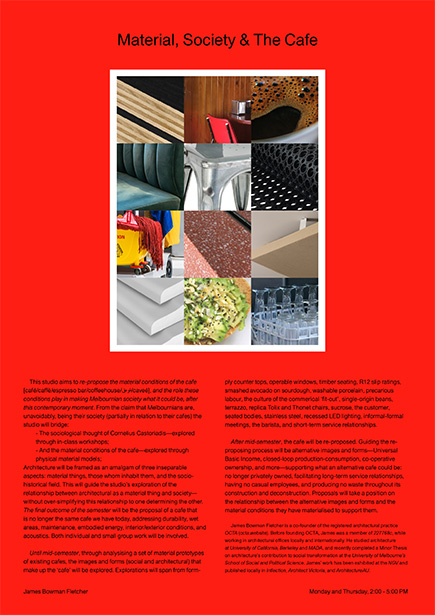
This studio aims to re-propose the material conditions of the cafe [café/caffè/espresso bar/coffeehouse/ ةوهق /caveé], and the role these conditions play in making Melbournian society what it could be, after this contemporary moment. From the claim that Melbournians are, unavoidably, being their society (partially in relation to their cafes) the studio will bridge:
- The sociological thought of Cornelius Castoriadis—explored through in-class workshops;
- And the material conditions of the cafe—explored through physical material models;
Architecture will be framed as an amalgam of three inseparable aspects: material things, those whom inhabit them, and the sociohistorical field. This will guide the studio’s exploration of the relationship between architectural as a material thing and society— without over-simplifying this relationship to one determining the other.
The final outcome of the semester will be the proposal of a cafe that is no longer the same cafe we have today, addressing durability, wet areas, maintenance, embodied energy, interior/exterior conditions, and acoustics. Both individual and small group work will be involved.
Until mid-semester, through analysising a set of material prototypes of existing cafes, the images and forms (social and architectural) that make up the ‘cafe’ will be explored. Explorations will span from formply counter tops, operable windows, timber seating, R12 slip ratings, smashed avocado on sourdough, washable porcelain, precarious labour, the culture of the commerical ‘fit-out’, single-origin beans, terrazzo, replica Tolix and Thonet chairs, sucrose, the customer, seated bodies, stainless steel, recessed LED lighting, informal-formal meetings, the barista, and short-term service relationships.
After mid-semester, the cafe will be re-proposed. Guiding the reproposing process will be alternative images and forms—Universal Basic Income, closed-loop production-consumption, co-operative ownership, and more—supporting what an alternative cafe could be: no longer privately owned, facilitating long-term service relationships, having no casual employees, and producing no waste throughout its construction and deconstruction. Proposals will take a position on the relationship between the alternative images and forms and the material conditions they have materialised to support them.

Matthew Ross, Drawings 1
The design of this cooperatively owned cafe was created to address a number of issues that are pervasive in Melbourne’s cafe industry. Issues relating to wage theft, casualised employment and food scarcity were primary factors in the evolution of this design. Through a modular approach to the cafe’s fitout and operation, we created a number of systems which would allow the cafe to change not only its program, but its business operations with ease. These systems included multipurpose adaptable furnishings, multipart deconstructable countertops, modular stud walls, and a system of ceiling mounts that can support anything from light fixtures to hanging plants and even storage units. The cafe’s flexibility was displayed through a multi-stage development lifecycle, with additional elements being added to the original site over time, and others disappearing or becoming secondary. Our design methodology was decided through consensus decision making in an attempt to further strengthen the theory behind our project. This culminated in a cafe / foodbank hybrid, with the business’ priority shifting over time from profit to social engagement and community support.
Toon Hartman, Matthew Ross, Zander De Vincentis

Matthew Ross, Stage 2 Interior

Matthew Ross, Stage 3 Interior 1

Matthew Ross, Stage 3 Interior 2
