
2023
-
“I would not have gotten anywhere without my professors at Monash”
 Sarah Soboh.
Once Bachelor of Commerce student Sarah Soboh realised she could combine economics with education, there was no stopping her. At last, she had found the social component to match her technical economic skills. Her passion for policy and the support of her Monash professors has taken her all the way to Harvard University.
“I’m grateful for the journey and I would not have gotten anywhere without the guidance and support of my professors at Monash,” she said.
Sarah started out in civil engineering, as it suited her quantitative skills and inclination toward problem solving. But she lacked a sense of purpose in this field, which led her to switch to a Bachelor of Commerce with a major in economics. She was always interested in policy but it wasn’t until she studied Labour Economics that she truly understood the role economics plays in policy.
The unit “ECC3146 - Community, market, and government” with A/Prof Vai-Lam Mui set her on her path. The course discusses the interaction between the three and how community affects the provision of social insurance and redistribution.
“I did not think my economics skills would be useful in education but in this course, I saw all the potential and opportunity. This is when I seriously started to consider using economics for social policy change. A/Prof Vai-Lam was so generous with me in sharing resources and introducing me to people who might be useful in this field,” she said.
He recommended Sarah apply to the Master of Education Policy and Analysis course at the Harvard Graduate School of Education, and wrote her a recommendation letter which led to her admission. She was also selected to receive the Frank Knox Memorial fellowship, one of the most prestigious fellowships at Harvard.
The one-year Master’s degree is flexible and allows her to explore topics like equity and opportunity, learning how people learn, education-to-workforce transition and many more across several Schools at Harvard. She has particularly enjoyed a unit on social entrepreneurship at Harvard Business School.
“It is truly inspiring to be surrounded by a remarkable community of individuals at Harvard. I am surrounded by the most intelligent people in the field. We have ministers of Education from different countries coming here to speak. Recently the ex-prime minister of New Zealand, Jacinda Ardern, was here to speak on leadership,” she said.
“At one seminar I sat between a US Ambassador and the ex-prime minister of Tunisia. My peers are unbelievably intelligent and accomplished. Some have a lot of experience reforming education systems around the world. It is invaluable being in this kind of environment. I try to bring the Australian perspective and I see it as an important part of leadership to learn from different perspectives.”
Sarah is passionate about social policy, with a particular focus on facilitating access for disadvantaged communities to positions of leadership and promoting social mobility. Once her year at Harvard is over, she hopes to return to Australia to instigate positive change within disadvantaged communities across the country. She is open to working in government, or perhaps revisiting social policy consulting, which she tried before studying overseas. And the idea of starting a social enterprise to solve problems and improve society is very much alive.
“Education economics sits on the intersection between social science and economics. It brings the human aspect to economics which I really like. If you work in education policy it’s important to be able to show the value of education programs with economic tools,” she said.
What would you recommend other Monash students do if they want to get into a top US university like you?
“I think a lot of my Australian peers underestimate their own abilities. And we lack guidance on what steps to take to be accepted into international universities. We often question our suitability for such competitive programs. The faculty at the Monash Business School Department of Economics is internationally renowned, and I would encourage others to chat to the professors, tap into their knowledge and learn about their international experience.”
“It is very important to build meaningful relationships as they can provide invaluable support and communicate your potential in letters of recommendation. Harvard and other top institutions seek to attract holistic cohorts. The Australian voice is often underrepresented, so that’s a reason for other Monash students to apply.”
From Honours at MBUS to a pre-doc at Stanford
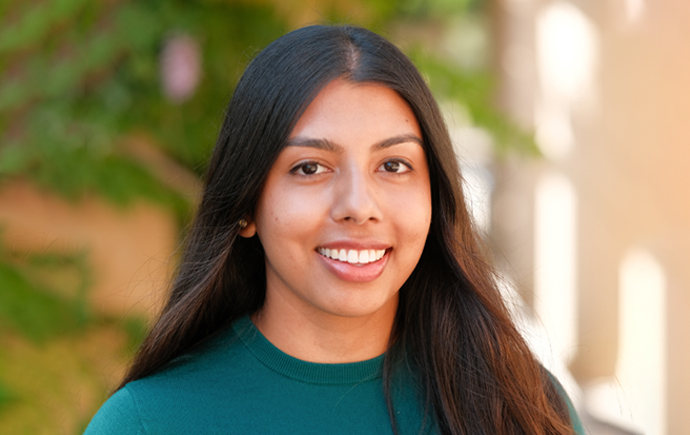 Simone Pandit.
Simone Pandit completed an Honours degree at Monash Business School and worked as a research and teaching assistant before being accepted into the predoctoral research fellow program at Stanford University in California.
It is a two-year program where students interested in pursuing a research career work as research assistants to professors, take classes and attend seminars. Ms Pandit started in early July and she dreams of one day being accepted into a PhD program at a top US university.
“So far, I am really enjoying it here. It’s great to be part of the community of pre-docs and to be in the company of great researchers. I enjoy learning from everybody, from supervisors to peers, and absorbing everything in this environment,” Ms Pandit said.
Ms Pandit’s Honours thesis was in health economics, and focused on the degree of public support for the ethical principle of saving more lives, which was the guiding principle behind many of the public health strategies used during the COVID-19 pandemic. She was supervised by Associate Professor Liang Choon Wang and Senior Lecturer Birendra Rai.
At Stanford she has two supervisors, Associate Professor of Health Policy David Chan and Professor Matthew Gentzkow.
“My Honours year happened during the pandemic which I think influenced my choice of thesis. It has evolved from there,” Ms Pandit said.
“Given my interest in health economics my two supervisors at Stanford are a good fit.”
She also found working as a research and teaching assistant at Monash Business School very helpful.
“Everyone at Monash has been so supportive, (especially) my thesis supervisors Dr Claudio Labanca, who I worked for, and A/Prof Vai-Lam Mui, who wrote an application letter for me. I really enjoyed my time at Monash.”
What were your most valuable learnings?
“All the technical and analytical skills I acquired during my thesis and working as a research assistant. Also data management skills, learning more econometric skills, and how to conduct analysis and fully understand the research process. Teaching also helped me solidify my own knowledge,” she said.
What advice would you give to other students interested in becoming a pre-doctoral research fellow in the US?
“To plan ahead and put in the work to give you an advantage. Study maths if you can, as it generally signals that you want to continue with a PhD down the line, and improve your technical skills as much as you can before you apply,” she says.
What are your future plans?
With pre-doctoral programs becoming more common at the top US universities, many pre-doctoral students go on to apply to a PhD program during their second year - a pathway Ms Pandit is also planning to follow.
“If I can continue on at Stanford that would be great, but I hope to end up at a good program somewhere in the US,” she said.
“I would really like to do something in health or public economics. It’s very competitive so I don’t know if it will happen. We’ll just have to wait and see.”
-
Congratulations to this year’s recipients of the Department of Economics awards and commendations for teaching.
Associate Professor Xiaojian Zhao teaches game theory and business strategy and has been awarded a commendation for his innovative teaching methods. His teaching focuses on turning the cognitive process into a discovery procedure of puzzles and solutions for his students. His ambition is always to stimulate their intellectual curiosity.
What do you most like about teaching?
“I like to adventure in the intellectual wonderland together with the eager young minds. Hopefully setting their desire for future research-oriented life on fire,” says A/ Prof Zhao.
Many students have not returned to on campus lectures after COVID but prefer online options, how do you keep students engaged in the online environment?
“I try to explore the advanced IT tech to create more augmented interactions in the virtual lectures in real time such as using Python with MediaPipe for facial and action recognitions.”
Is there a particular teacher or learning situation you remember from when you were a student?
“I found it extremely exciting to see classic game theory could be successfully expanded in the domain of cognitive psychology when reading the literature of motivated beliefs,” he says.
For A/Prof Xiaojian Zhao, receiving the award means he feels more confident in sticking to his own personally distinctive teaching style.
In this year’s new category which awards Teaching Assistants, two people from the department were successful recipients.
Ms Zhongwen Chen won the teaching award and Ms Icy Guo was awarded a commendation for her teaching.
 Ms Zhongwen Chen.
“I feel more than excited about receiving this award, as our department has too many excellent colleagues who provide outstanding teaching experiences to the students,” says Ms Chen.
What do you do to be the best teacher you can be?
“Probably when I encourage students to communicate with their classmates just before the end of each session? We always want students to be actively engaged in the class, and during communication, people learn from others,” she says.
Ms Zhongwen Chen finds the biggest challenge is understanding what people are struggling with to provide a suitable solution. The best teaching scenarios happen when everyone is engaged in a discussion and shares their ideas.
“This fosters creativity, critical thinking, and the exchange of diverse perspectives. In this kind of environment, the synergy of different ideas and viewpoints can lead to unexpected breakthroughs and "spark fires" of inspiration.
“It's fascinating how group thinking can generate new insights and solutions that may have eluded an individual working in isolation,” says Ms Chen.
For Ms Icy Guo the most fulfilling teaching experience happens when she witnesses the spark of enlightenment in her students' eyes when they successfully solve a challenging problem.
 Ms Icy Guo.
She highly values the feedback provided by her students, as it allows her to adjust her teaching methods and maintain their enthusiasm, interest, and motivation.
“As a Hong Kongese born in mainland China and now teaching in Melbourne, I have encountered various cultural differences. One of the challenges I face at this stage is finding appropriate and engaging examples to make complex concepts more easily understandable for my students. “
“In my opinion, an excellent teacher possesses a genuine passion for teaching, along with a strong foundation of subject knowledge, a lifelong commitment to learning, and effective communication skills, which include empathetic listening and maintaining academic integrity,” Ms Guo says.
She thoroughly enjoys when students visit her office to share their study plans and discuss their future career ambitions.
“Their trust and confidence in me reinforce my dedication to continuously improve as a teacher. I feel so thrilled and honoured to be the recipient of this award. It is a recognition that I genuinely believe I deserve,” she says.
-
Learn more about our new restructured PhD program
The Department of Economics has launched its new restructured PhD program.
The program allows PhD students one foundational year of coursework plus four years of research, all fully funded.
The changes will ensure PhD students improve their skills, increase their options, endure less stress, and are better prepared for the job market.
Previously the PhD program ran for a maximum of four years because of regulations. The new program launched this semester introduces a “pre-PhD” year in the form of Master of Economics with a research option where the students have plenty of time to improve their training during the first year by completing eight units of course work before embarking on their PhD thesis.
The new master’s year is modelled on the Master of Commerce in the Department of Banking and Finance and is a stepping stone into the PhD program.
“The old program was very stressful for the students, and we have been wanting to change it for years. If students spent a year doing course work, very little time was left for doing research and writing a thesis. This resulted in students being pushed very hard through the program by serving them up with ideas or co-authoring research with them to speed up the process,” says Associate Professor Choon Wang, who has recently overseen this process.
The changes to the PhD program were started by Professor Zhijun Chen, supported by Head of Department Professor Michael Ward, Deputy Dean Research Russell Smyth and Monash Business School Dean Simon Wilkie as well as administrative staff to ensure the structural and financial changes to the program were successful.
Similar extensions of the PhD program have already been introduced at the University of Melbourne and University of Technology Sydney, for example. In the US it is common practice to complete two years of course work and at least three years of research for a PhD.
Historically the Department of Economics Honours program has been very successful, and many students have been sent to American universities to complete their PhDs. But students from foreign universities who come to Monash to complete their PhD don’t always have the same thorough pre-PhD training. They will be invited to the Master of Economics with a research component to make sure they are up to speed before starting their PhD thesis.
“It gives students more time to explore their area of interest and get specialized. When they improve their skills during the master’s degree, they increase their chances of getting a scholarship for the PhD. They also have more time to find a suitable supervisor and we hope to avoid any mismatches,” A/Prof Choon Wang says.
The long-term goal is to improve the quality of training of the PhD students to ensure they land good positions after they leave Monash.
“We want to place the students well in the job market. If we can get them good jobs this builds our reputation and helps us attract new students. If our students continue to do high quality research in other places and we continue to collaborate, then it benefits the department. This change will make the program better,” says A/Prof Choon Wang.
To find out where our PhD students find jobs, read more here.