
Exploring the Emotions Shaping LGBT Law Reform

The Castan Centre for Human Rights Law hosted a thought‑provoking public seminar, The Emotions of LGBT Rights and Reforms: Repairing Law, on 12 March 2026 at Monash University Law Chambers, Melbourne.
Led by Associate Professor Senthorun (Sen) Raj in conversation with Professor Paula Gerber, the event unpacked the emotional dimensions of legal reform affecting lesbian, gay, bisexual, transgender and queer communities. The discussion formed part of the Castan Centre’s broader mission to advance human rights through rigorous scholarship, public engagement and advocacy.
This event attracted an enthusiastic audience committed to understanding the intersections of emotion, justice and law. Raj is a critical legal scholar working across emotion, culture, race, gender, sexuality, law, and justice, and this was an excellent opportunity to focus on his 2025 monograph The Emotions of LGBT Rights and Reforms: Repairing Law.
The conversation illuminated how emotional forces, such as resentment, anxiety, anger, love, grief and joy, shape contemporary law reform debates. It spoke to the heart of the Castan Centre’s goal to empower scholars, practitioners and community members to use law as a tool for social justice.
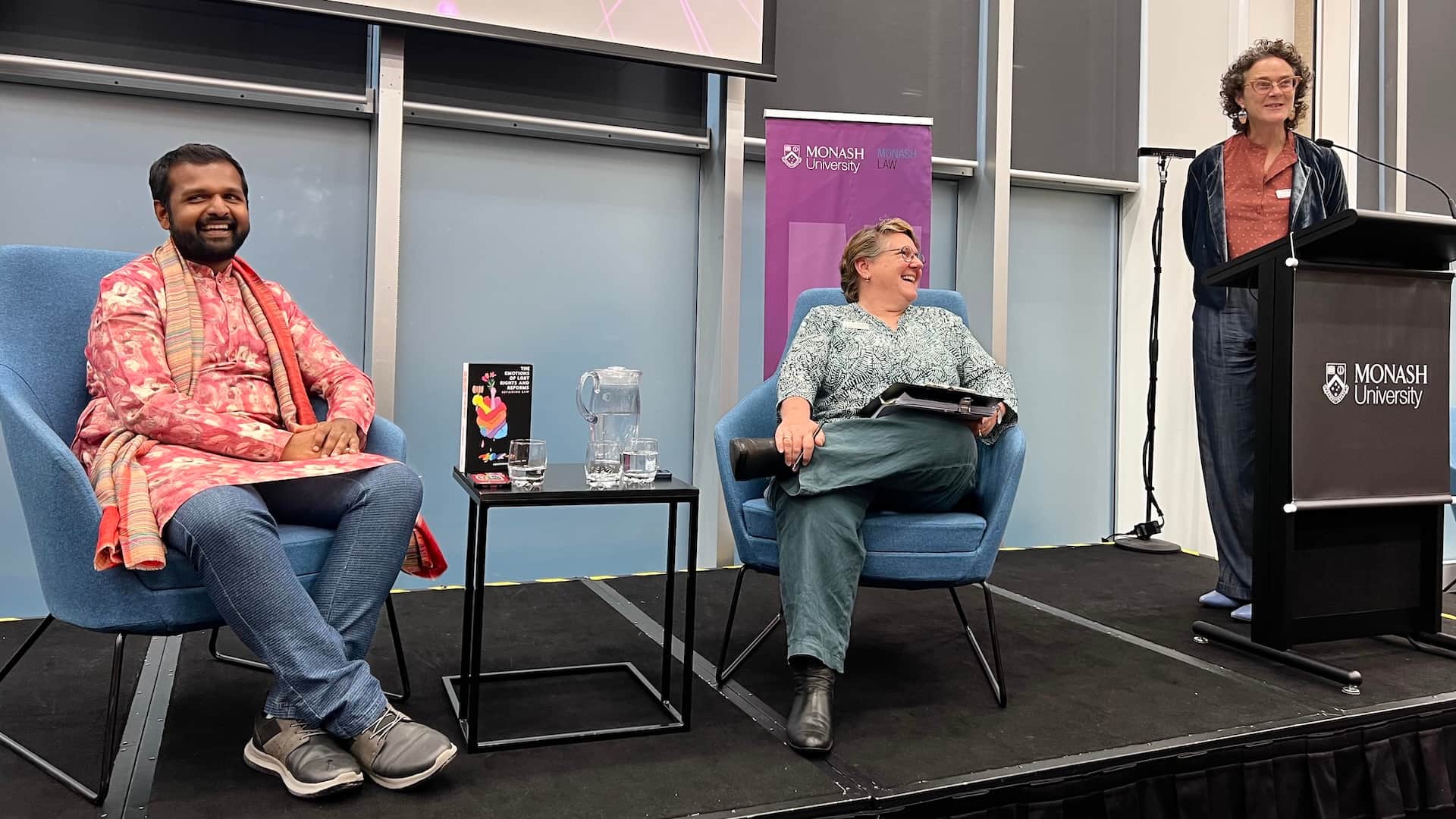
Dr Senthorun Raj, Professor Paula Gerber and Professor Julie Deblejak.
Raj’s Framework: Emotional Grammar in Law Reform
The seminar centred on Raj’s concept of “emotional grammar,” a theoretical tool he developed to better understand how emotions are embedded in lawmaking processes. His book analyses emotions that shape conflicts of rights that emerge between different groups across law reforms aimed at better supporting LGBT people. It draws from Hansard, legislation, case law, law reform consultations and statutory guidance.
“Sen Raj's concept of 'emotional grammar' brilliantly unpacks how feelings like resentment and anxiety fuel clashes between religious freedom and LGBT rights, as seen in discrimination cases involving cake bakers and website designers; offering lawyers and activists a vital tool to foster understanding amid division,” Professor Paula Gerber said.
The emotional dynamics underlying legal disputes, particularly around rights conflicts, are often under‑recognised in formal legal reasoning. By naming these emotions, Raj’s work enables practitioners to identify deeper tensions and to navigate debates with greater nuance.
The seminar explored law reform issues that are both urgent and globally resonant. In a wide ranging conversation, Raj and Gerber examined contemporary law reform debates about LGBT rights, including religious exceptions to anti-discrimination laws, legal gender recognition, and sex and LGBT education in schools in various countries, including Australia, the United Kingdom and United States.
By examining these issues through an emotional lens, Raj encourages legal actors to move beyond reactive or polarised positions and toward more thoughtful, context‑sensitive engagement.
Storytelling, Identity and the Emotional Weight of Legal Questions
A highlight of the conversation was Raj’s use of personal narrative to illustrate the emotional undercurrents of identity-based assumptions.
“In sharing his personal story of being asked ‘How he could be both Hindu and gay?’, Sen masterfully illustrated the emotional undercurrents of identity assumptions, reminding us all that even well-intentioned questions can wound,” Professor Gerber said.
This underscores a key theme of Raj’s work, which points out that storytelling is not merely illustrative but essential to justice‑oriented scholarship. Emotions are not external to law. They flow through the lived experiences of those who seek legal recognition, protection or redress.
Professor Gerber says that storytelling and lived experience must sit alongside doctrinal analysis. This was one of the aspects of Raj’s work that really struck her during the conversation.
By creating space for personal and community narratives like this, the Castan Centre helps ensure that legal scholarship is grounded in humanity rather than abstraction.
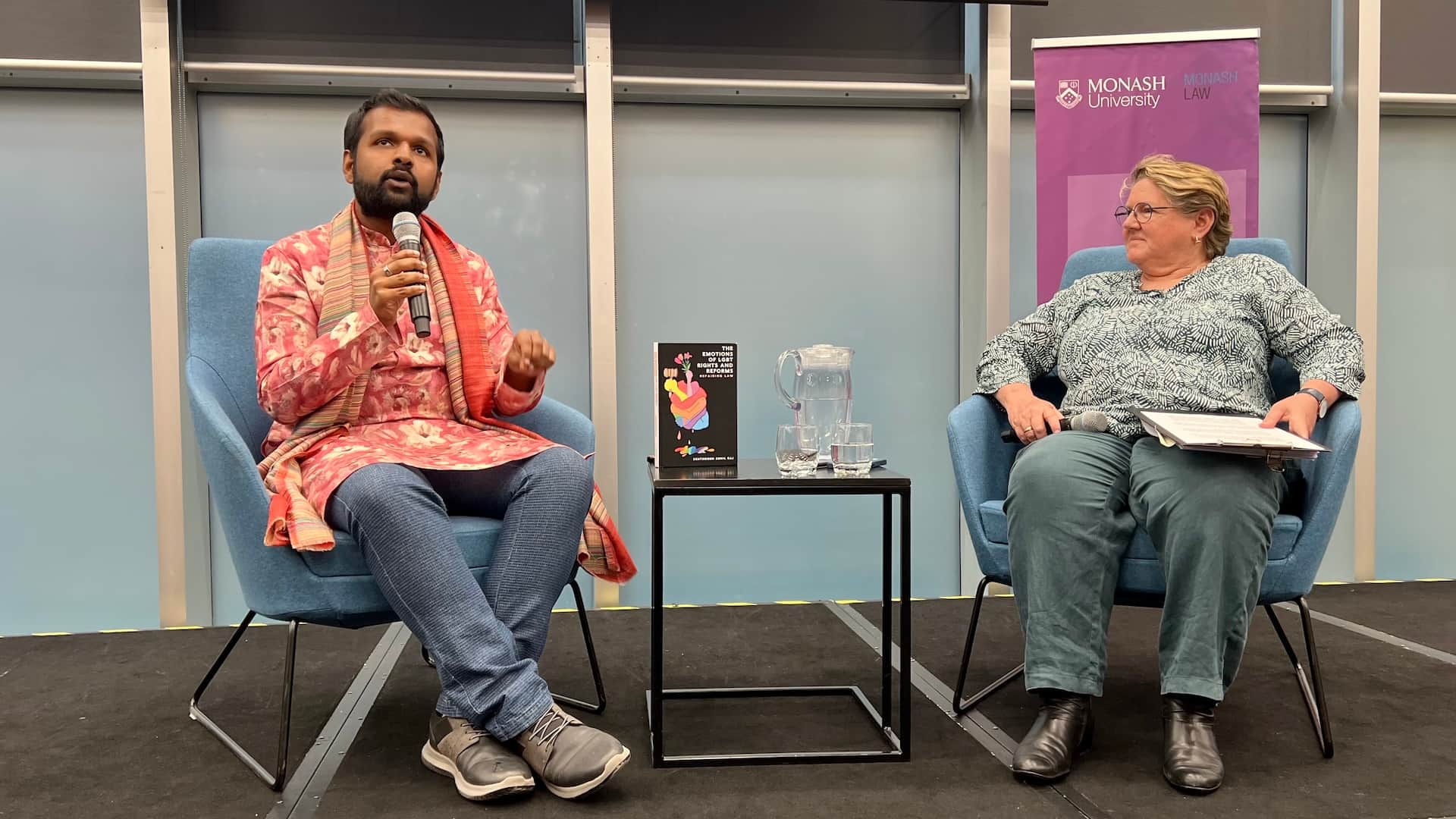
Dr Senthorun Raj and Professor Paula Gerber.
Examining Emotional Drivers in Education Reform
Education reform emerged as another significant strand of the discussion, with Raj’s work examining sex and LGBT education in schools across jurisdictions.
“Sen critiqued laws like Florida's 'Don't Say Gay' with intellectual clarity, and provided practical tips on how we can have sex education in schools that honours childhood vulnerability without erasing queer realities,” Professor Gerber said.
“He demonstrated how we can have rights respecting classrooms while still acknowledging parental and religious concerns.”
Her remarks reflect Raj’s balanced approach, one that recognises both the vulnerabilities of children and the rights of queer students to representation, safety and affirmation.
This balance is central to human rights law which is a focus of the Castan Centre’s educational advocacy, emphasising the importance of promoting rights-respecting schools while engaging respectfully with families and communities.
The Castan Centre’s Role in Advancing Human Rights
This event is one of many through which the Castan Centre advances its mission to strengthen human rights in Australia and beyond. By convening conversations about legal reform, identity, emotion and justice, the Centre plays a vital role in shaping national debate.
The Emotions of LGBT Rights and Reforms: Repairing Law seminar showcased the Castan Centre’s commitment to thoughtful, justice-oriented advocacy. By bringing together critical scholarship, lived experience and community dialogue, the event highlighted the emotional complexity that underpins legal reform and human rights.
With Professor Paula Gerber’s reflections adding depth and clarity, and with Raj’s scholarship offering a robust conceptual lens, the event underscored the value of approaching law not simply as a set of rules, but as a human, relational and emotional practice.