
Law PhD highlights the right to food on death row
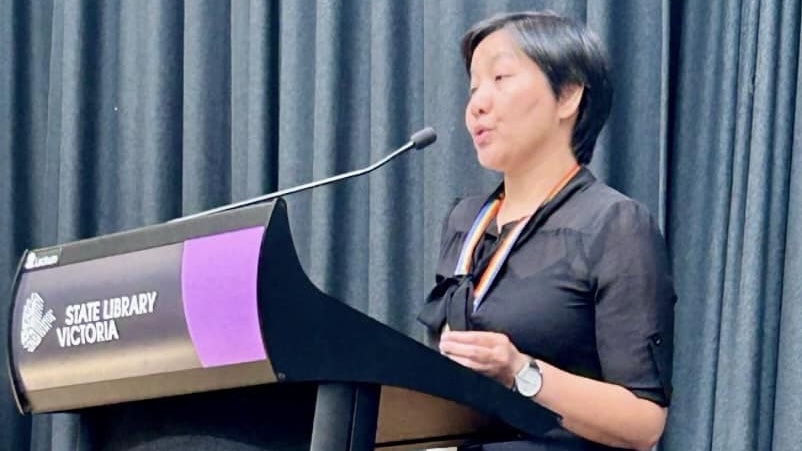
According to Amnesty International, there were 2,428 death sentences in 52 countries in 2023. In addition, at least 27,687 people were known to be under sentence of death. Many of those on death row will suffer the additional punishment of food insecurity.
“The moment the sentence of death is imposed, there is this view that they’re no longer humans - they’re just waiting to die,” reveals Dr Leavides Domingo-Cabarrubias, post-doctoral researcher at Eleos Justice.
“There's so much evidence showing that they are no longer afforded the dignity of being a human being and this manifests in many ways. For example, it impacts their right to health because some doctors don’t view them as needing health interventions anymore. That general view also affects their right to food because the thinking is if they are no longer treated as human then what is the point of giving them adequate food,” shares Dr Domingo-Cabarrubias.
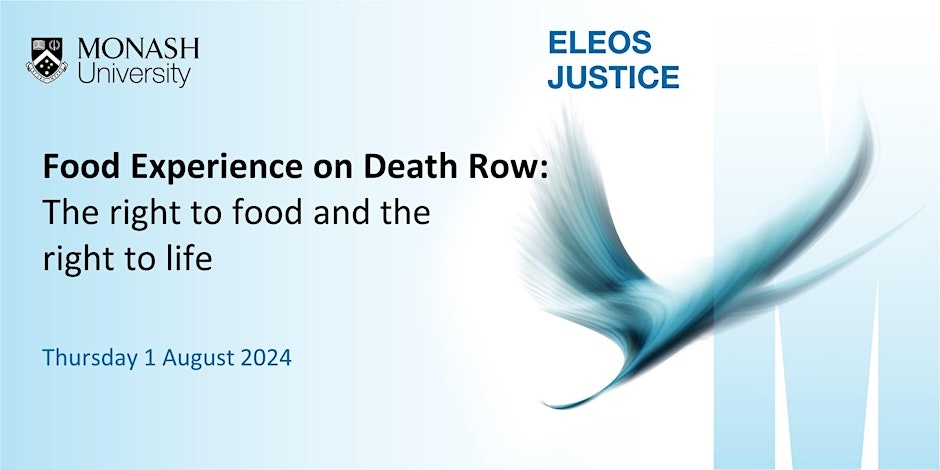
Register now for Food Experience on Death Row: The right to food and the right to life.
The right to food as a PhD thesis
The right to food was the subject of Dr Domingo-Cabarrubias’s PhD studies at Monash Law, but her pathway to this higher degree research was lifelong.
“Most of my life in the Philippines was spent as a human rights activist and a feminist. So when I became a lawyer in 2003, I worked as a government lawyer representing poor people who could not afford the services of counsel,” explains Dr Domingo-Cabarrubias.
Shortly after Dr Domingo-Cabarrubias became a lawyer, the Anti-Violence Against Women and Their Children Act of 2004 was passed into legislation in the Philippines.
“Even though the Public Attorneys office where I was working was supposed to be defending the accused, the laws specifically mandated us to also assist women victims of violence. So that’s where I was assigned and I spent most of my latter part of being a lawyer representing women victims of violence.”
After half a decade of applying the new Anti-Violence Against Women laws Dr Domingo-Cabarrubias was recruited as a gender consultant by the Asian Development Bank (ADB) to bring gender into the mainstream of ADB projects.
“My work was informed by my experience as a feminist and as a human rights lawyer. So I was questioning whether the work we were doing was actually having an impact on the lives of women on the ground,” recalls Dr Domingo-Cabarrubias.
Making the decision to begin PhD studies
The questions from Dr Domingo-Cabarrubias’s experience as a feminist and as a human rights lawyer eventually crystallised into a research project.
The aim was to investigate the extent to which the policies and practices of the Asian Development Bank are informed by human rights principles and therefore positively impacting the lives of women in Asia. That’s the proposal that Dr Domingo-Cabarrubias sent to the Law Faculty at Monash University.
“At the time I was sending my PhD proposals, I really did not have any idea what I was doing. Everything depended on the information I could find in my internet searches,” reveals Dr Domingo-Cabarrubias.
Fortunately Monash University responded quickly. The Monash Graduate Research Office offered Dr Domingo-Cabarrubias a stipend scholarship and the Faculty of Law offered a tuition scholarship.
It wasn’t long before she was refining her PhD topic with supervisor Associate Prof. Heli Askola and Joanna Kyriakakis.
“They were very helpful in steering the direction and making it more specific, because when I started the proposal, it was just human rights, it didn’t zero-in on the right to food.”
The full title of Dr Domingo-Cabarrubias’s thesis was Locating women’s right to food in development work: A critical examination of the Asian Development Bank’s policies and practices.
“I was able to put in one document a coming together of all my experiences as a lawyer, as a human rights activist, and a gender specialist at ADB. With my research I was able to crystallise that all into one project,” says Dr Domingo-Cabarrubias.
The Monash Law experience of PhD studies
During her research, Dr Domingo-Cabarrubias took the crystallisation of her ideas one step further and refined her project into a 3 Minute Thesis. This powerful presentation won the Faculty of Law’s 3 Minute Thesis competition and went on to compete in the university-wide competition.
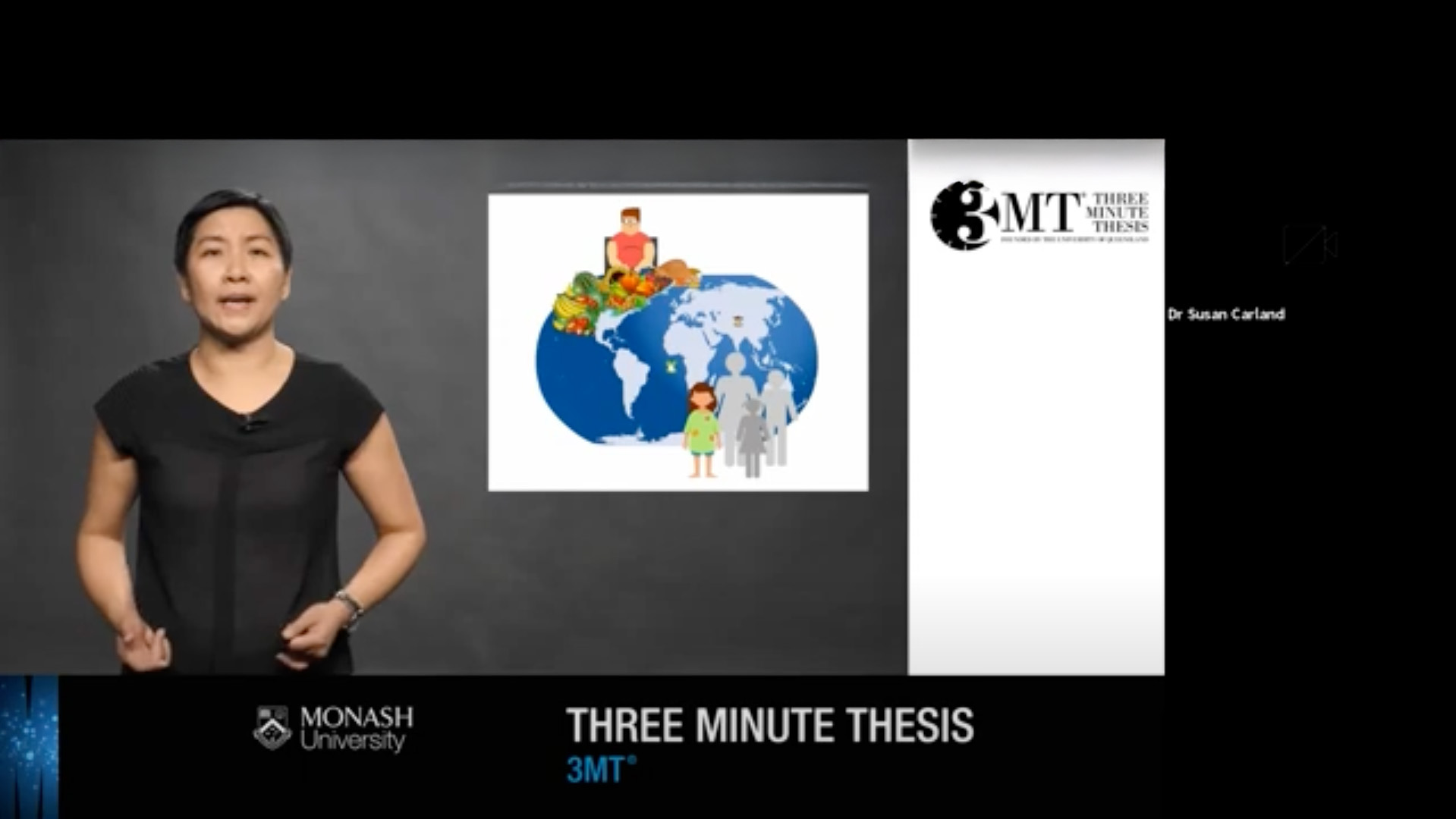
Watch Dr Domingo-Cabarrubias's Law Faculty winning 3 Minute Thesis presentation.
Dr Domingo-Cabarrubias also won the Postgraduate Publications Award for Law in 2022. This prize provides financial support for students who have submitted their thesis and wish to write up some of their research for publication while they await the result of their thesis examination.
The prize money from the Postgraduate Publications Award enabled Dr Domingo-Cabarrubias’s to publish one of her first articles under the title The right to food and substantive equality as complementary frameworks in addressing women's food insecurity. It appeared in the International Journal of Law in Context, Volume 19 - Special Issue 3 - September 2023, ‘‘Law in Context’ in Post-Colonial South Asia’. This article caught the attention of the United Nations’ Special Rapporteur on the right to food Michael Fakhri, who emailed Dr Domingo-Cabarrubias to tell her that the article is “fantastic”.
“I had a super great time at Monash university. It has many initiatives and programs that develop you not just professionally, but also personally. I think the My Development part of the PhD which requires us to finish a certain number of units is both helping us to grow professionally but also as a person,” reflects Dr Domingo-Cabarrubias.
“You never feel that you are left behind - there’s always some help available. I would highly recommend Monash University for PhD studies, based on my experience, and the opportunities that have opened up for me in Australia.”
Post PhD life in a Monash Law research centre
During the latter years of Dr Domingo-Cabarrubias’ PhD studies, Associate Prof Mai Sato, inaugural director of Eleos Justice, became her HDR main supervisor. Prof Sato, whom she also considers her mentor, introduced Dr Domingo-Cabarrubias to many opportunities to further her professional development.
“Working with Prof. Sato and with Eleos Justice opened so many doors for me. For example, I have been a part of a number of research projects, and I’ve attended conferences as a part of Eleos Justice. I could publish research under my name or in collaboration with other scholars. I’d never published before, I’m not an academic in that sense - I was a practising lawyer so I never thought of publishing,” exclaims Dr Domingo-Cabarrubias.
Eleos Justice is a research centre based in the Faculty of Law at Monash University. The mission of Eleos Justice is to restrict and abolish the death penalty in the Asian region.
Eleos has the unique ability to offer vital advocacy, evidence-based research and teaching to become a leading hub for fighting the death penalty in the Asian region.
“In my work with Eleos Justice I’ve worked on several topics related to the death penalty and right to life which have given me opportunities to publish and also to co-publish research with Associate Prof. Mai Sato.

Dr Leavides Domingo-Cabarrubias at the Australasian Law Academics Association (ALAA) Conference 2022 in the Monash University Law Chambers, where she shared her thesis Locating Women’s Right to Food in Development Work: A Critical Examination of the Asian Development Bank’s Policies and Practices.
The right to food in anti-death penalty advocacy
Within Eleos Justice’s focus on the death penalty and the right to life, Dr Domingo-Cabarrubias has been able explore projects that are related to her PhD thesis. From this exploration comes the international online event Food Experience on Death Row: The right to food and the right to life.
“This event about the right to food on death row is uniting these two topics - my specialisation in the right to food and the death penalty which is Eleos Justice’s focus.”
Dr Domingo-Cabarrubias began this project with Maitreyi Misra, a founding member of Project 39A which is a criminal justice initiative at the National Law University Delhi where she is currently Director, Mental Health and Criminal Justice as well as Death Penalty Mitigation.
Maitreyi Misra was a Visiting Academic to the Monash Faculty of Law and Eleos Justice between October and December 2023.
“Maitreyi is a lawyer and an expert on the situation of death row prisoners in India where she has been working with prisoners on mental health issues. It was a great collaboration because her expertise is more on the practical side and my expertise is more on the theory of the right to food as it applies to vulnerable populations.”
At the online event, Dr Domingo-Cabarrubias and Maitreyi Misra will share initial findings of their research on the right to food on death row. In a soon to be published article, the authors demonstrate that on death row - where prisoners experience a continuous threat to their dignity and humanity - the consumption of food can become a major site of pain and degradation.
Food Experience on Death Row: The right to food and the right to life
The aim of Food Experience on Death Row: The right to food and the right to life is to raise awareness of these issues for people working in policy formulation, law students planning their future research, and individuals working in prisons.
In addition to Dr. Domingo-Cabarrubias and Ms. Misra, the online event will include ethnographer and folklorist Leslie Soble. Ms Soble has spent over five years immersed in research on the carceral eating experience and its impacts on individuals, communities, and the environment. Ms Soble is Senior Program Manager of the Food in Prison Project at Impact Justice.
“Leslie Soble is the lead author of the article that helped me when I was drafting my part of the “right to food on death row” which I co-wrote with Maitreyi. When I reached out to her, she responded immediately and was very enthusiastic about participating in this event,” shares Dr Domingo-Cabarrubias.
Based on her research Dr Domingo-Cabarrubias believes there hasn’t been any online conversations or events focussing specifically on the food experiences of death row prisoners. Instead, the usual focus is on things like solitary confinement or physical violence.
“This is a gap because food, as we all know, is an integral part of our everyday experience. The aim of this event is to bring attention to the fact that prisoners are also suffering when it comes to this supposedly positive experience that every human being needs.”
“We are bringing a spotlight to experiences of populations that are not usually given voice and marginalised. This is a good opportunity to take a few minutes of your time to focus on something that's not talked about in other platforms. And there are several findings that might be helpful and inspire ideas on possible topics that scholars and Law Students can explore.”
Register now for Food Experience on Death Row: The right to food and the right to life.