
Mooting Profile - Monash Law alumnus William Liu
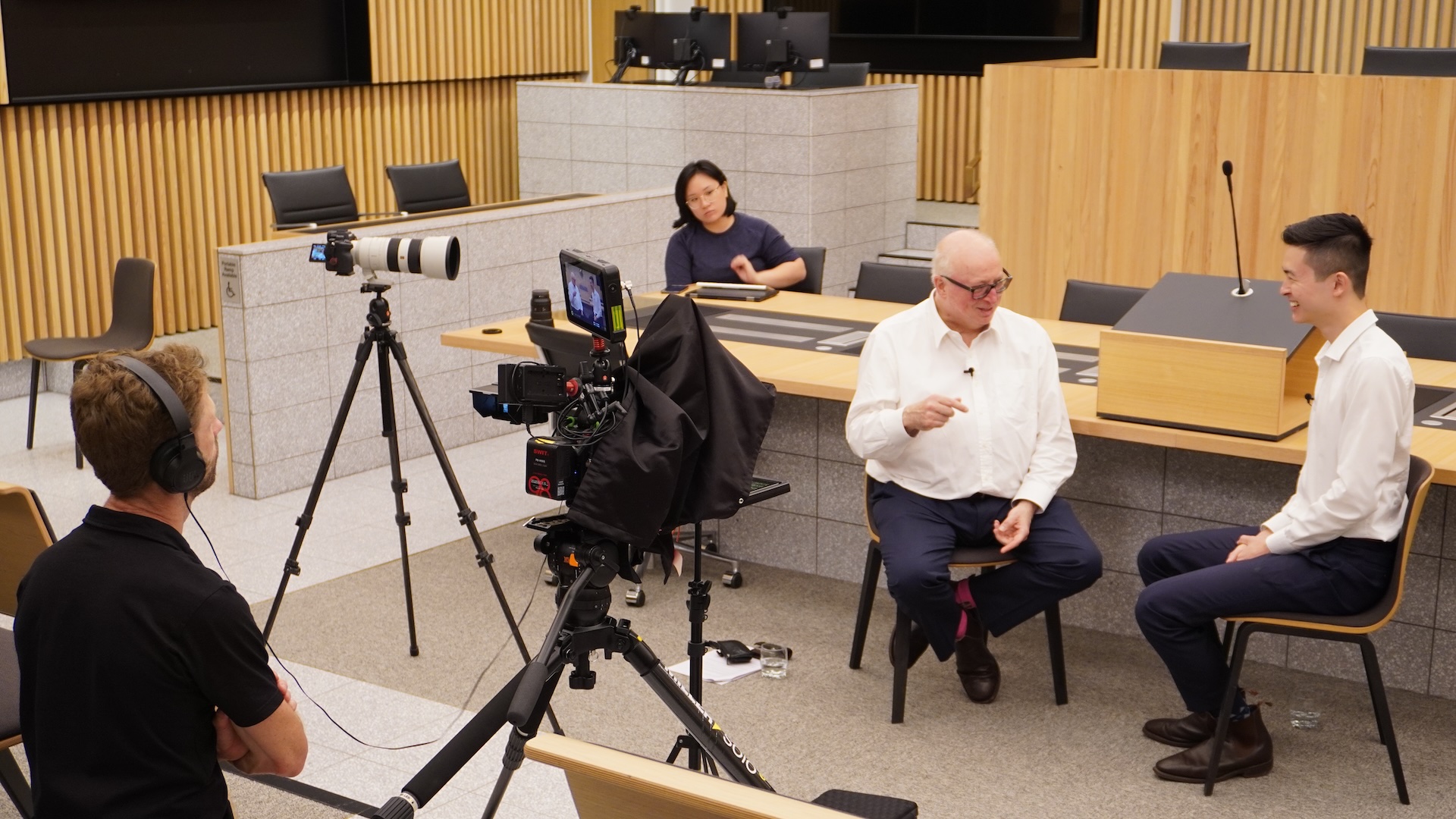
William Liu is a Monash Law alumnus with an impressive track record in mooting.
In August 2021 William competed in the 9th Annual Michael Kirby Contract Law Moot with a team of four that reached the semi final.
In September 2021 he was part of a pair that reached the grand final of the University of Wollongong’s Hugo Law Group Intervarsity Criminal Law Moot.
William was winner and best oralist in the Monash Law Students’ Society General Moot in 2022. (He went on to win this competition again in 2023.)
Later in 2022 he was part of the team of three that won the Grand Final of the 2022 Ian Fletcher International Insolvency Moot. He also won the Best Individual Mooter in that event for both the Semi Final and the Grand Final.
Sign up for Mooting and Advocacy elective LAW4805
But before we go any further, let’s clarify exactly what mooting is.
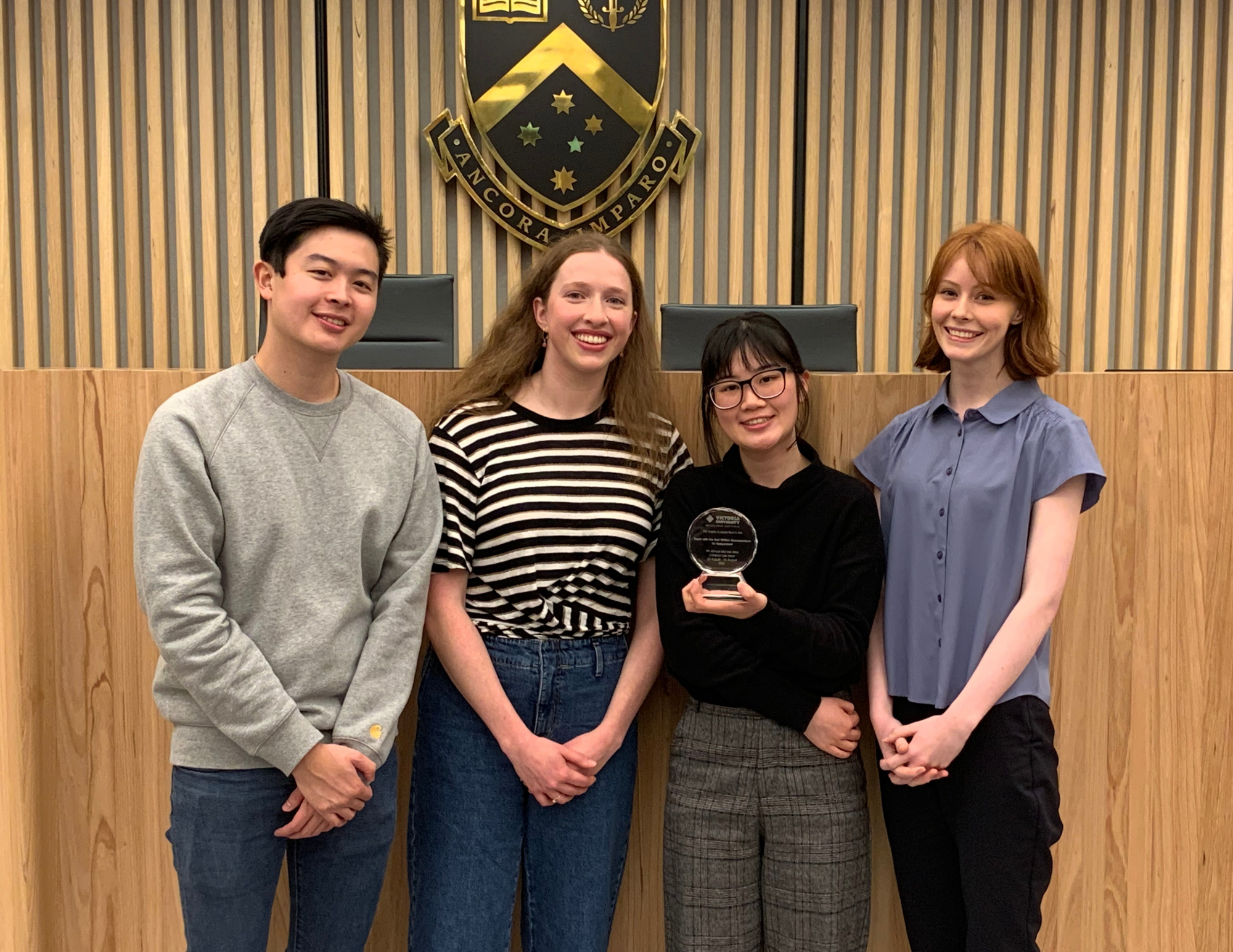
L to R: William Liu, Pippa Thorne, Kimberley Ng, Merryn Cagney, Monash Law's team for the 9th Annual Michael Kirby Contract Law Moot
“Mooting is debating for law students. You begin with a problem-question and you have to make submissions and present your case for your client, in front of a number of judges”, explains William.
“When I was in high school, I did quite a bit of debating. What I really liked about mooting is you retain a lot of that skill set. There’s logical argumentative thinking and the importance of presenting clearly, coherently and concisely. You get to apply what you're learning in the classroom and hone your research skills as well", says William.
While debating experience is a nice-to-have, it’s not essential for mooting. One of the best places to begin your mooting journey at Monash is in a unit called Mooting and Advocacy.
“It's run by a prominent silk in Victoria. During those classes we got to watch our peers moot, and our judges were also peers. We got to sit and observe and see how people advocate,” recalls William.
That silk is William’s namesake - William Lye OAM KC who is Chief Moot Coach at Monash Law. In addition to teaching Mooting and Advocacy, William Lye coaches Monash Law’s mooting teams to help them prepare for local, interstate and international mooting competitions.
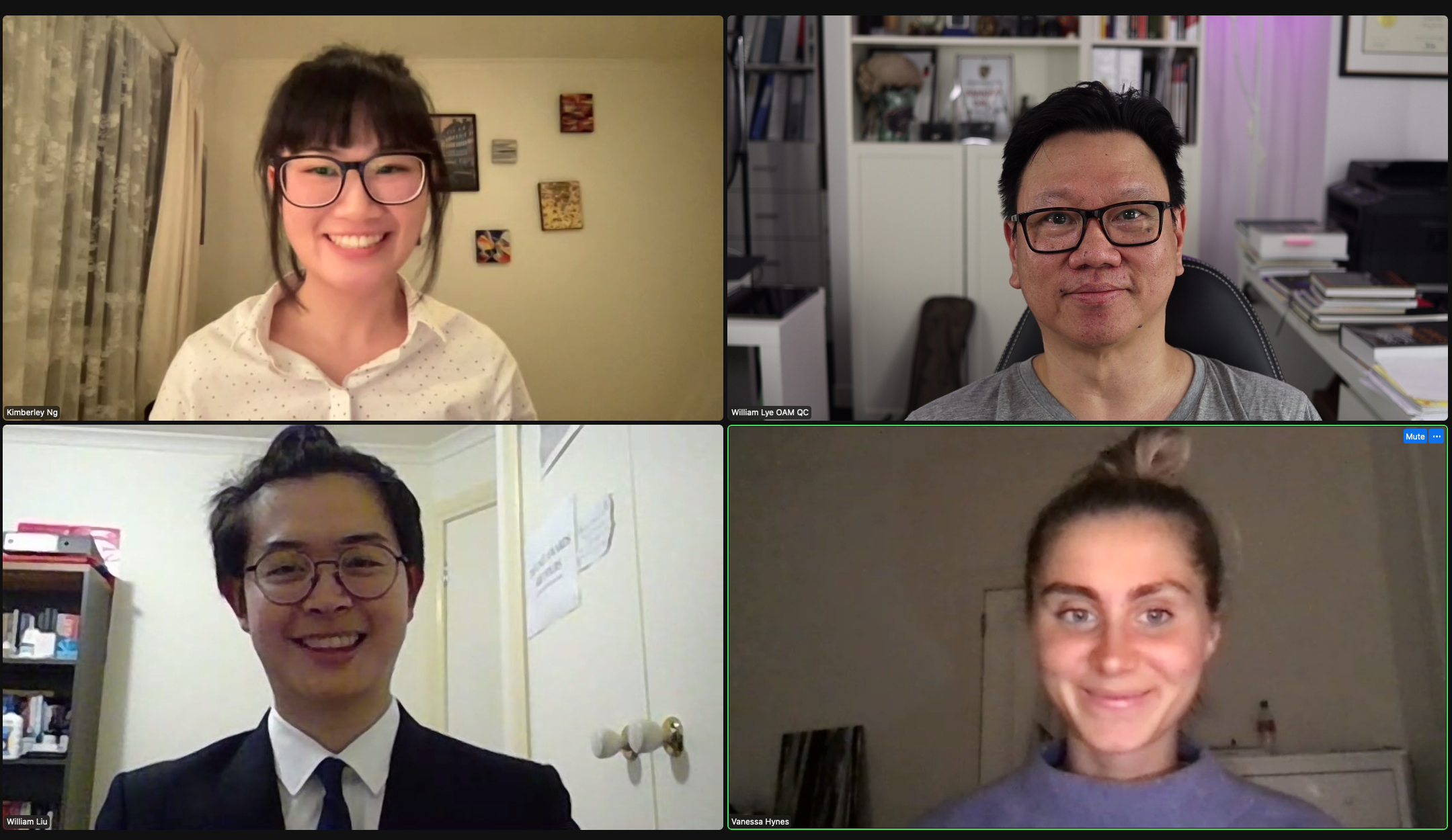
Top (L-R):Kimberley Ng and William Lye OAM QC (coach), Bottom (L-R): William Liu and Vanessa Hynes, the first Australian team to win the Fletcher Moot since its inception in 2017.
“Watching our peers was useful because when you're up there yourself and speaking, you're often not so conscious of various tendencies you might have. Whether that's to speak too quickly, too slowly, or to dodge and weave a little bit,” says William.
William applied his finely honed presentation skills as the MC of the Monash Law Gala Dinner in 2023. As the MC, William revealed that he didn’t know any lawyers when he was growing up, but that Monash Law has helped him to see all of the different paths a law career could take.
He also shared that he’s inspired by lawyers from diverse backgrounds and is proud that Monash Law is home to one of the first two Asian-Australian lawyers to take silk in his mooting mentor, William Lye OAM KC.
Under William Lye’s guidance, William Liu also assisted a team of Monash Law students who won the grand final of the 2022 Administrative Appeals Tribunal National Mooting Competition.
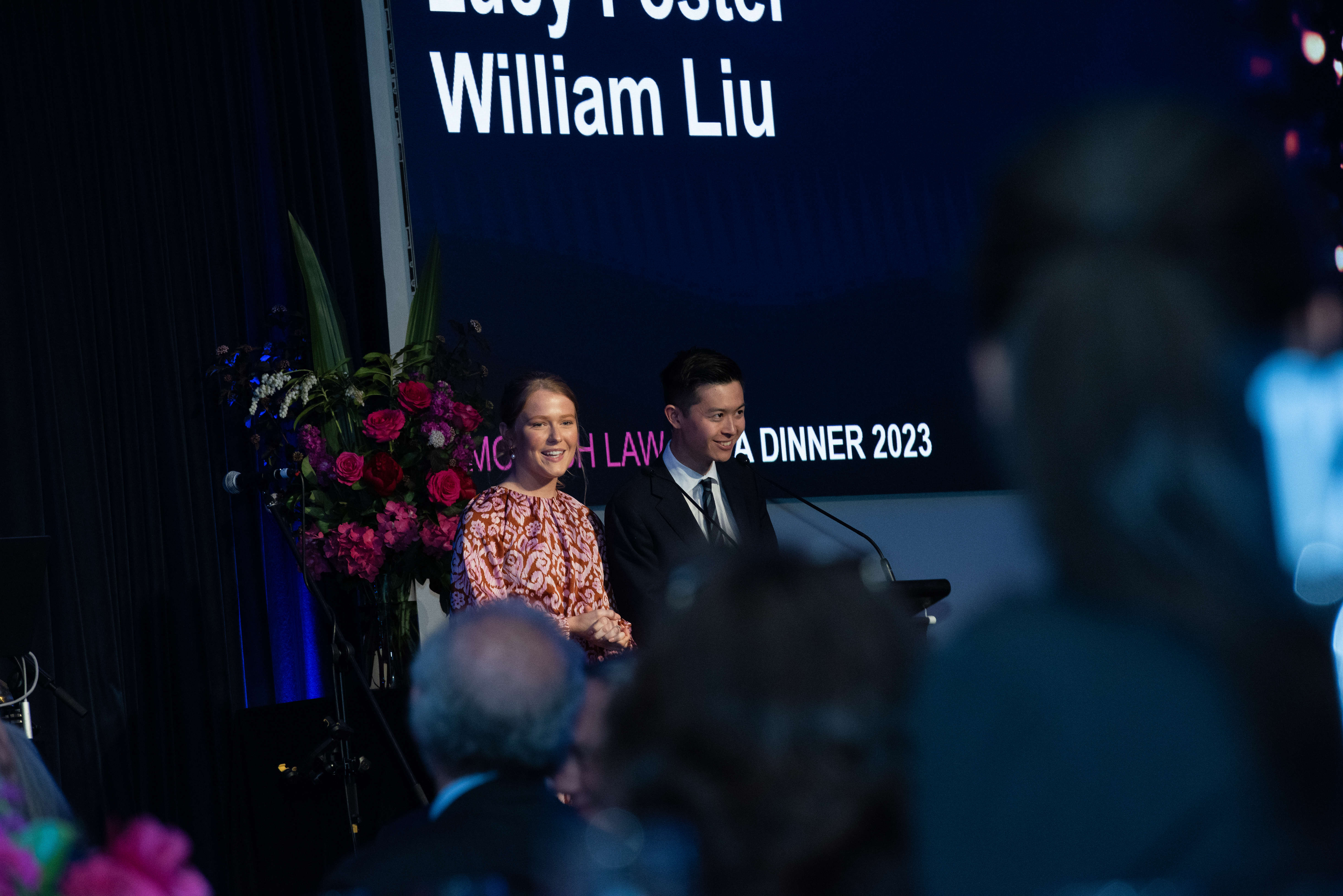
Monash Law Gala Dinner 2023 co-hosts Lucy Foster and William Liu
When you think about mooting, you might imagine a mock trial. However, like the title of the Administrative Appeals Tribunal competition suggests, mooting can also be an appeal or a sentencing submission.
“Probably the most common type of moot is an appeal, because you don't need to elicit evidence - it's pure legal argument,” clarifies William
“It really rewards creative and critical thinking. I think what I loved most about mooting was you had a problem and you had a case to argue but you could run it in any which way that you wanted. It was completely up to you.”
The mooting process begins far from the moot court, with research that will help form your arguments and provide the broader knowledge that will give you the edge to think on your feet in the heat of battle.
“You could research precedents - perhaps the main ones that everyone's familiar with. You could also look up more obscure precedents and try and formulate arguments that are a little bit more left-field.”
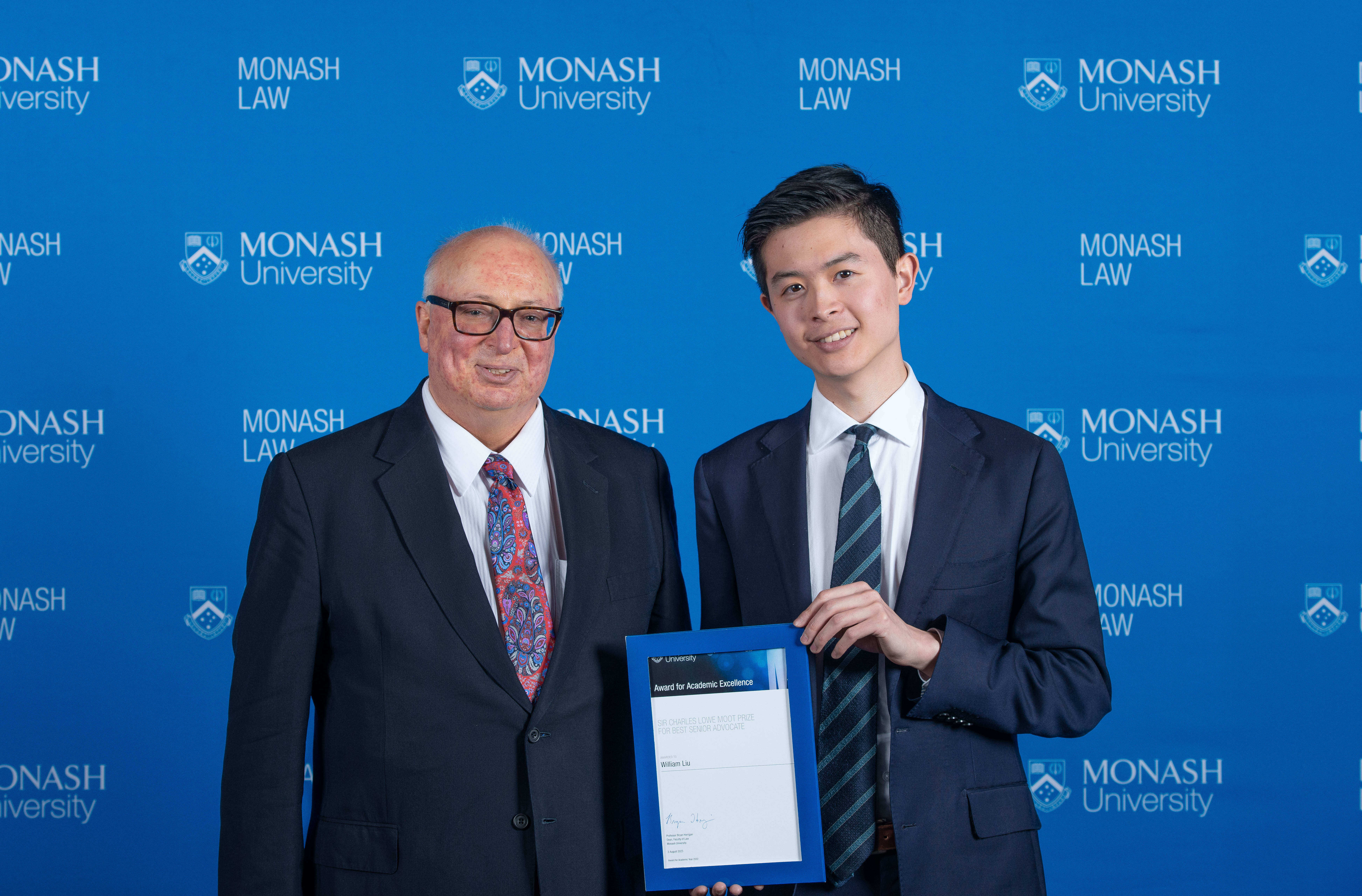
Professor Bryan Horrigan with William Liu at the 2023 Monash Law Undergraduate Prize Ceremony. William won the Sir Charles Lowe Moot Prize for Best Senior Advocate
Once you’ve done your research and prepared your strategy, it’s time to approach the bar table and present your argument. William describes the pointy end of the mooting competition as a visceral experience.
“Well, you're probably shaking. You're breathing probably quite deeply and I think there's a transitional moment when you're in that state of nervousness and you're just trying to begin presenting your case. Then at some point you become immersed, and you become lost in what you're doing.”
“You enter a state of flow and then it's just this wonderful conversation of minds between you and the judge. And then of course, once the moot finishes, you breathe this sigh of relief and then you go, ‘I want to do that again’.”
So, what’s William’s secret to success in mooting? In addition to preparing well, William recommends paying close attention to the people you intend to persuade.
“One of the things that I've seen that separates stronger teams from weaker teams in mooting is the ability to be dynamic. Look at where the bench wants to go and is particularly interested or perhaps vexed and try to resolve those knots for them.”
“If judges are interested in a specific part of the case and you can resolve that for them then and there, you can really make an emotional impact and that can leave them thinking, ‘I'm persuaded by the case’.”
Monash Law supports mooting students beyond the classroom and sponsors them for interstate and international competitions. It was this support that took William to his favourite mooting experience, the Fletcher Moot.
The Ian Fletcher International Insolvency Moot is a global competition focusing on international cross-border insolvency law disputes. It’s named after Professor Ian Fletcher QC, who was an eminent scholar, internationally recognised for his outstanding achievements in the field of insolvency law.
“I had no idea about insolvency law at all. But, through doing the moot and doing well in it, I developed an aptitude and a liking for the area,” he says.
In fact, William did so well in the Fletcher Moot that he was awarded a stipend to visit the UN Commission on International Trade Law in Vienna. In addition to having a chance to visit the Christmas markets of Austria, William had a courtside seat to observe international insolvency law at the highest level.
“Getting to see competent insolvency lawyers discuss cross border insolvency, how to unite different jurisdictions’ insolvency laws, and seeing the macroeconomic benefit that a sound, consistent set of insolvency laws can have - that was all incredible.”
William graduated from Monash Law in 2023 and is currently working as an associate in the Court of Appeal in the Supreme Court of Victoria. He says his mooting experience at Monash Law has helped him prepare for this role.
“From day one of that role I was reading written submissions and none of it felt foreign.”
As for his future legal career, it appears that William will be capitalising on his mooting skills for some years to come.
“I recently sat the Victorian Bar exam and fortunately I passed. So next year in 2025, I'll be sitting the Reader's Course.”