
Monash Architecture students share what home means at the 2025 Venice Architecture Biennale
Monash Architecture students share what home means at the 2025 Venice Architecture Biennale
Image: HOME, Australian Pavilion at 2025 Venice Biennale. Photography by Peter Bennetts
Artefacts created by Monash Architecture students Shantel Gilmore, Melika Hatami and Emma Matthews, have been selected to be part of the Australian Home Pavilion at the 2025 Venice Architecture Biennale.
The artefacts, or Living Belongings, are the tangible outcome of the immersive learning experience “Home: Country as Creative Process”, in which 125 students from 11 Australian universities were tasked with exploring their idea of home.
Throughout the studio unit, the three Monash students worked closely with studio leader Bradley Kerr, to bring their unique interpretations of home to life.
Bradley is a Quandamooka man, architect and lecturer at Monash Architecture, and one of the Creative Sphere of First Nations architects, designers and practitioners behind the groundbreaking Home exhibition in Venice.
“Working with Brad was an amazing opportunity. He helped me see things on a different level,” says Melika. “He created a safe space where we could openly explore our emotions and personal stories. Through his guidance, I was able to understand my own journey and the place I call home.”
 Melika Hatami and her work Echoes of Home
As part of the unit, the students expanded their understanding of Australian First Nations cultural practices by focusing on Country as an influence on material and creative processes relating to architectural practice.
They experimented, explored and observed how different materials can empower visual and communicative impact, culminating in the creation of a Living Belonging, an artefact or object that represents their personal idea of home.
For many architecture students, the shift to creating an artwork rather than a built structure is both liberating and deeply reflective. Melika explains that the process behind designing a building and creating an artwork are very similar.
“Any building we design as architects is an artwork on a larger scale. What I really enjoyed about this experience was the freedom. It was about pure expression rather than adhering to codes and briefs,” she says.
Bradley’s mentorship was key in fostering this approach.
“Architects focus on the big picture, but Bradley takes a micro-scale approach, questioning and simplifying creatively. He values process over the end product, examining every detail,” Emma adds.
 Emma Matthews and her artefact
 This is also reflected in the Home project and Biennale Pavilion, which positions Indigenous knowledge as a critical design methodology, where the process of connecting with Country through conversation and two-way knowledge sharing, is of equal importance to the tangible outcome.
Living Belongings and the meaning of home
The Living Belongings created by Melika, Emma, and Shantel each respond to the theme of Home in a unique way.
Echoing her Italian background and the importance of sharing food and drink, Shantel chose to make a textured abstract cup with various colours representing different parts of her life.
“A simple cup, often overlooked, carries meaning,” says Shantel. “Its chips, stains and imperfections record interaction, reinforcing the idea that Home is an evolving feeling of comfort, routine, and familiarity. My hope is for visitors to hold it and feel a sense of comfort and connection.”
 Shantel Gilmore and her artefact
 Emma’s artefact is an indented circular dish that features swatches of pigments mixed with natural ingredients from her home like charcoal from bonfires, golden wattle flowers and pink gum blossoms, and includes the scent of eucalyptus to give people a sensory experience.
“My sculpture is about this tangible and intangible connection with Country. I want everyone to interact with it and to sense and understand the concept of home that is represented visually and through the senses in my work,.” says Emma.
Melika’s artwork ‘Echoes of Home’ is an interactive lightbox exploring the fluid concept of home through poetry, materiality, and memory. Crafted from Australian blackwood and stained glass, it features a bird symbolising movement and shifting perspectives.
“When users look through the glass, they see my perspective. The bird shifts and changes depending on their position, reinforcing the idea that home is not a fixed place but an evolving concept shaped by movement and personal experience,” Melika explains.
Inside the box, ten engraved stones, collected from significant locations across Victoria, hold words that resonate with Hatami’s personal experiences. These stones, reminiscent of childhood memories of skipping rocks, represent fragments of home that must be moved and explored to reveal the poem’s deeper meaning.
“My inspiration came from a poem I wrote in the first week of class. Throughout the summer, I kept returning to it as I worked on this project,” she says.
The poem speaks to the loss, rediscovery, and redefinition of home, a theme that permeates the pavilion’s broader narrative.
“As students we have the opportunity to design with Country; more than just the land itself, the people, the skies, everything that has been before and everything that is to come. We as architects are constantly building on Country and have a responsibility to care for it.” explains Emma.
Being a part of this exhibition has helped her understand “The way we interact with Country will affect the architecture we produce.”
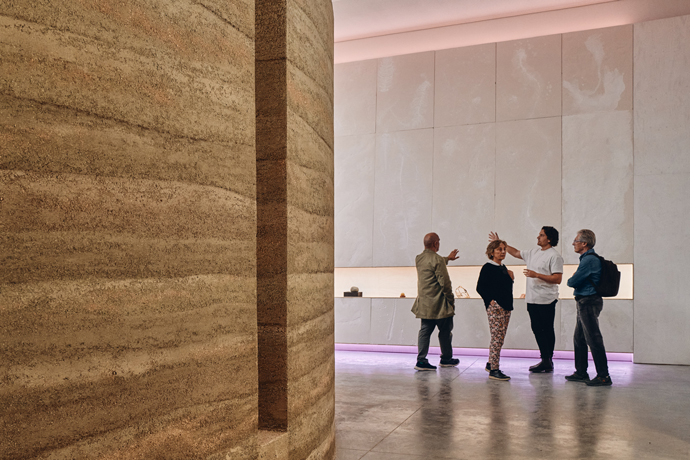
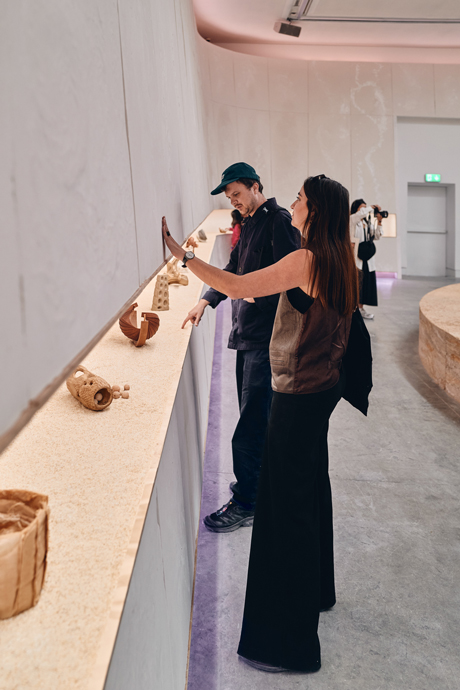
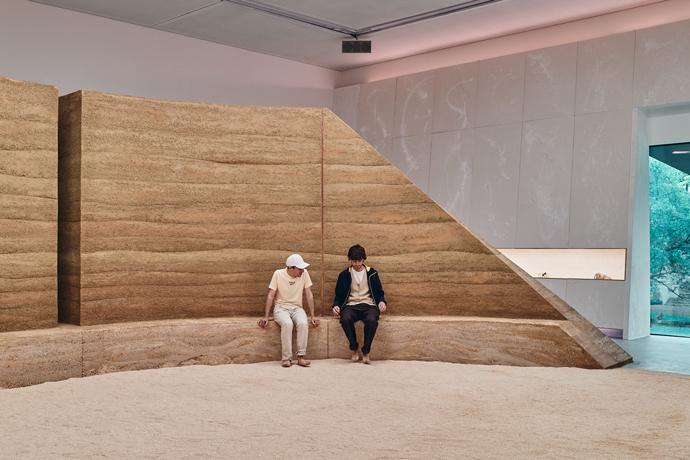
Images: HOME, Australian Pavilion at 2025 Venice Biennale. Photography by Peter Bennetts
A moment of pride and excitement
For the students, participating in the first all Indigenous-led Australian Pavilion is both a privilege and a moment of personal fulfillment.
“I feel incredibly honoured and excited,” Emma expressed. “I hope to visit the Biennale with my family when it opens.”
“It’s an incredible honour to be selected and to have my work on display at Venice which is globally recognised is quite surreal,” Shantel added.
As the 2025 Venice Architecture Biennale opens its doors to the world, the Home pavilion represents a response to Australia’s evolving architectural discourse, emphasising Indigenous knowledge systems, cultural narratives, and personal experiences.
Through the works of Brad and his students, audiences are invited to engage with the deeply personal and universally resonant concept of home, making this Pavilion a landmark moment in both Australian and global architectural history.
“Architecture often reiterates just one world view. It is important to open up to other viewpoints.” explains Brad.
“We are providing Australia's interpretation of the theme, which is about letting other people be part of the exhibition and essentially, part of the story of what home means.”