
Core-Coralations

Image: Nicholas Mangan, Core-Coralations (still), 2023. Image courtesy the artist and Sutton Gallery, Melbourne
Last year, following an instinct, artist Nicholas Mangan travelled to Townsville to see the world’s largest collection of massive coral core samples. These long, narrow columns form an archive of mineral residues extracted from the bedrock of dead coral reefs. Like tree cores and ice cores, their striated layers are a physical register of growth and changing environmental conditions over time. In this particular collection – housed at the Australian Institute of Marine Science (AIMS) – the growth dates back more than 700 years, before both observational records and human interference in global weather systems began. As a consequence, the microscopic information contained in the collection provides a crucial resource for scientists piecing together macro histories of climate change.
In addition to modelling climate histories, one of the key roles of AIMS is to monitor the health of the Great Barrier Reef. Perhaps it is fitting, then, that these coral cores are similar in form to the geological samples used in mining exploration to identify potentially high-value sites. According to the CSIRO, about 90 per cent of global carbon emissions and most of Australia’s CO2 outputs flow from the extractive industries, making them the primary driver of ocean warming. In turn, mining is inextricably linked to the mass coral bleaching events that have occurred on the Great Barrier Reef since the 1980s and are written into the coral cores.

Image: Nicholas Mangan, Core-Coralations (still), 2023. Image courtesy the artist and Sutton Gallery, Melbourne. Image: Coral Ossuary #1, 2022, coral, aragonite, mineral powder and acrylic resin, 52 x 40 x 60cm. Courtesy the artist and Sutton Gallery, Melbourne. Photography: Andrew Curtis.
Such material histories have long been a source of fascination for Mangan. In the past, he has looked to limestone monoliths, coconuts and ancient stone money to trace narratives in which colonisation, resource extraction and globalisation intersect. For Mangan’s latest project, the coral cores at AIMS provide the conduit for a work that links coral polyps with planetary extinction, bringing the issue of environmental crisis to the fore. As with his earlier works, Core-Coralations revolves around a tension between the small, self-contained and immediately perceptible, and a concept of such magnitude that, like the Great Barrier Reef, it cannot be fully apprehended.
In Mangan’s practice, fieldwork is as vital as time in the studio. Along with his visit to AIMS in Townsville, Core-Coralations has evolved out of a University of Queensland Art Museum Heron Island Artist Residency, which saw the artist spend time at the university’s embedded research station. Upon first encountering the reef during this trip, Mangan says he was struck by its “intense beauty and otherness”, which felt both “prehistoric and interstellar”. To his artistic eye, the amalgamation of so many different species was akin to a form of sculptural assemblage. But above all, it was the liveliness of the reef that absorbed Mangan’s attention, its dynamic relationship to the ebb and flow of the tides, and its smell, which is always absent from the lush images of tourist marketing: “the smell of a living organism, salty, soggy, dank.”
The first major iteration of Core-Coralations reflects the duality of these experiences, one focused on living coral and the other on dead specimens. Due to premiere at the National Gallery of Victoria as part of Melbourne Now 2023, the installation is divided into two elements: a sculpture, Death Assemblage (2022), and a film, Core-Coralations (2022–23). The sculpture takes the form of a large vertical plane made from aggregated coral rubble mounted on a metal support. In part, this is inspired by the operating logic of the Great Barrier Reef, which forms a literal protective impasse between the Pacific Ocean and the Queensland coast. It also riffs on Mangan’s time in Townsville in the wake of multiple Covid lockdowns – blank billboards lined the roadsides, signalling the precarious state of a tourist economy that relies on the health of the reef.

Image: Nicholas Mangan, Coral Ossuary #3 (detail), 2022, coral, aragonite, mineral powder and acrylic resin, 56 x 47 x 34cm. Courtesy the artist and Sutton Gallery, Melbourne. Photography: Andrew Curtis.
To further animate these ideas, Mangan embedded bioluminescent pigment in the sculpture, which will be periodically activated in the gallery by ultraviolet light. When the light is on, the sculpture will glow a bluish-purple, calling to mind the UV light used in coral laboratories to highlight growth lines in specimens affected by extreme climate events, such as coastal flooding. This lurid colour also conjures the fluorescence emitted by living corals during bleaching events – a form of chemical sunscreen they use as a last-ditch effort to survive. The fluorescence is effectively a heat stress signal for individual reefs, but since tropical and subtropical reefs are acutely vulnerable to rising sea temperatures, it can be read more broadly as an early distress beacon for planetary catastrophe.
In Core-Coralations, Mangan elaborates on this idea. Here, he flips the orientation with a floor-to-ceiling projection intended to elicit the affective, immersive experience of encountering the reef first-hand. The film draws on footage from his time at both AIMS and Heron Island, tracking through a series of chapters that highlight the rapid decline of the Great Barrier Reef since colonisation. At the outset, it invokes Captain Cook’s arrival as a recent but momentous rupture in the deep time of the reef’s evolution. Other sections touch on bleaching events and current scientific efforts to future-proof coral against anticipated climate risks. Strikingly, there is a reference to the use of modern portfolio theory (MTP) – a form of economic modelling – to identify reefs with the highest likely return on conservation investment. As Mangan notes, this is one of many “strange ways humans are trying to come to terms with the loss and damage.” If there is a paradox at the heart of the work, it is precisely this: the correlation between reef death and climate disaster points to a symbiotic breakdown. Human civilisation is effectively dependent on the health of coral colonies, which support an estimated 25 per cent of the world’s biodiversity. The great irony of much so-called ‘coral philanthropy’ geared towards reef survival is that it is funded, directly or indirectly, by the profits of high-emissions commerce.
Core-Coralations reflects on this state of affairs from a situated perspective. As always for Mangan, this involves telescoping outwards from the specific material and historical conditions of a site to bring aspects of national, regional and global politics into view. The mythic place of the Great Barrier Reef in Australia’s civic consciousness is key here, but also, as Mangan puts it, the “island-continent dilemma” in which distance and isolation distort a sense of collective responsibility towards issues that exceed sovereign borders. Ultimately, Core-Coralations foregrounds this mental barrier – which separates the pride of a UNESCO World Heritage listing from the pragmatic work required to safeguard the reef – as the fundamental obstacle to real and necessary progress.
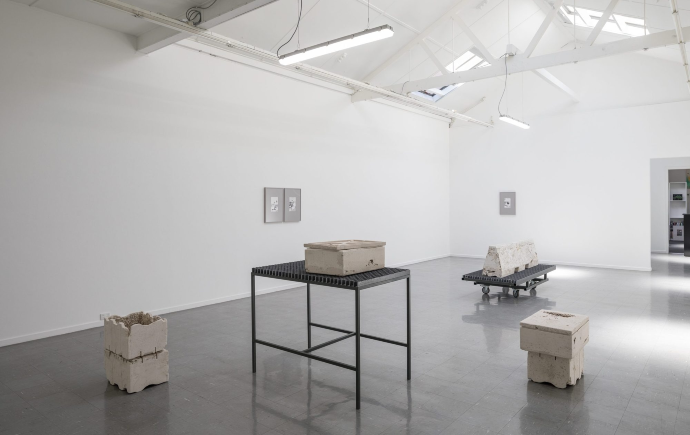
Image: Nicholas Mangan, Core-Coralations (Death Assemblages), 2022, installation view, Sutton Gallery, Melbourne. Photography: Andrew Curtis.
Nicholas Mangan is an artist and graduate research supervisor at Monash Art, Design and Architecture, where he received his PhD in 2015.
Anneke Jaspers is Senior Curator, Collections, at the Museum of Contemporary Art Australia.