Co-designing a model of care for depression in elderly care recipients for Silverchain
Co-designing the inputs to a new model of care for recognising, assessing and treating depression in older adults.
Investigators
- Associate Professor Leah Heiss
- Professor Daphne Flynn
- Dr Troy McGee
- Dr Gretchen Coombs Monash Art, Design and Architecture
Co-investigators
- Hatoun Ibrahim Monash Art, Design and Architecture
Partner organisation
- Silverchain
Funded by
- Silverchain
Undertaken within
Silverchain is a leading provider of complete in-home care services in Australia, supporting 105,000 people each year across a range of services in their homes including hospital in the home, palliative care, aged care, allied health and social support, and virtual care monitoring.
Up to 50% of older people who receive aged care services at home display symptoms of depression. With one million home aged care recipients in Australia and continued expansion of the sector, this is a rapidly growing public health concern. Current approaches to detection and treatment of mental health conditions are suboptimal, with an over-reliance on medication and limited attention to psychological interventions. Home care services lack routine screening, staff training in mental health assessment, and integration of mental health care with primary providers.
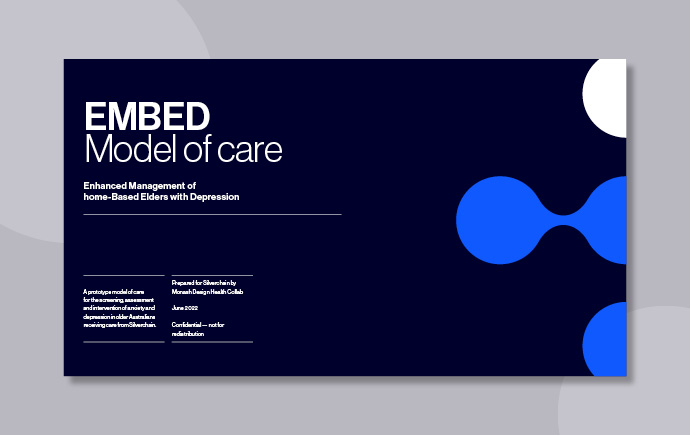
Recognising the need to tackle this serious but largely-silent epidemic, Silverchain approached Monash University’s Design Health Collab for help in co-designing a model of care for recognising, identifying and treating depression in elderly care recipients who received ageing in place services. This became the Enhanced Management of Home-Based Elders with Depression Model of Care (EMBED MoC).
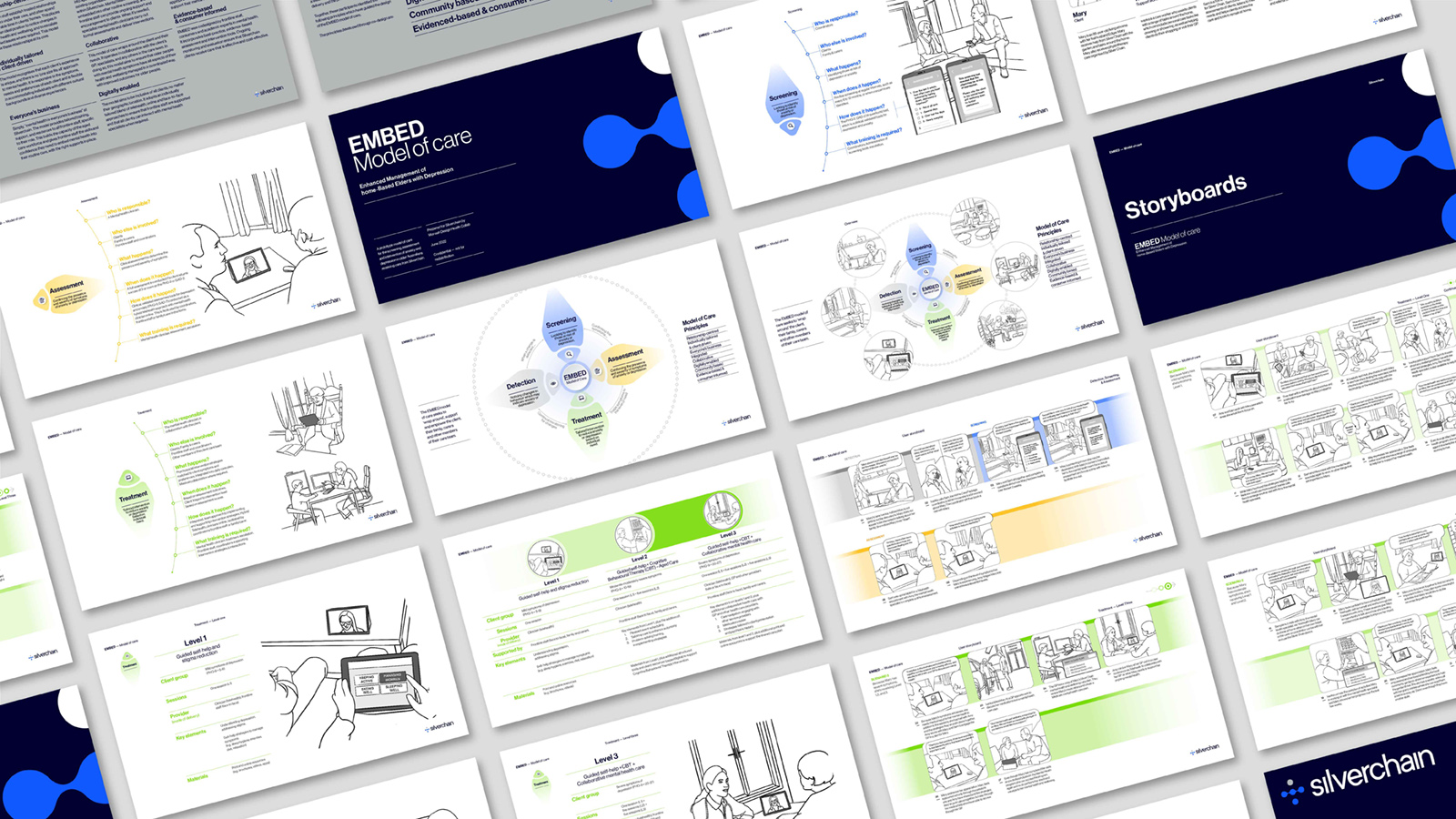
The Design Health Collab supported Silverchain to develop their new EMBED MoC by designing and facilitating two co-design workshops with Silverchain stakeholders, that brought together more than 40 participants across four Australian states. These participants included Silverchain leadership, homecare package coordinators, frontline care staff, support workers, patient advocates and carers. Participants brought a wealth of experience about frontline service delivery and the provision of care services, which was drawn out using the Tactile Tools co-design methodology. Key to the activities was the use of personas – fictional profiles, co-created with Silverchain – of people receiving in-home care services. These personas were carefully crafted to reflect the complexity of existing care packages and reflected the experience of individuals and their care providers. From this, a pitch pack and storyboard were developed to facilitate further co-design activities. The MoC was then tested and refined through interviews with caregivers and patient advocates.
Pitch deck and storyboard prepared for Silverchain by Monash Design Health Collab.
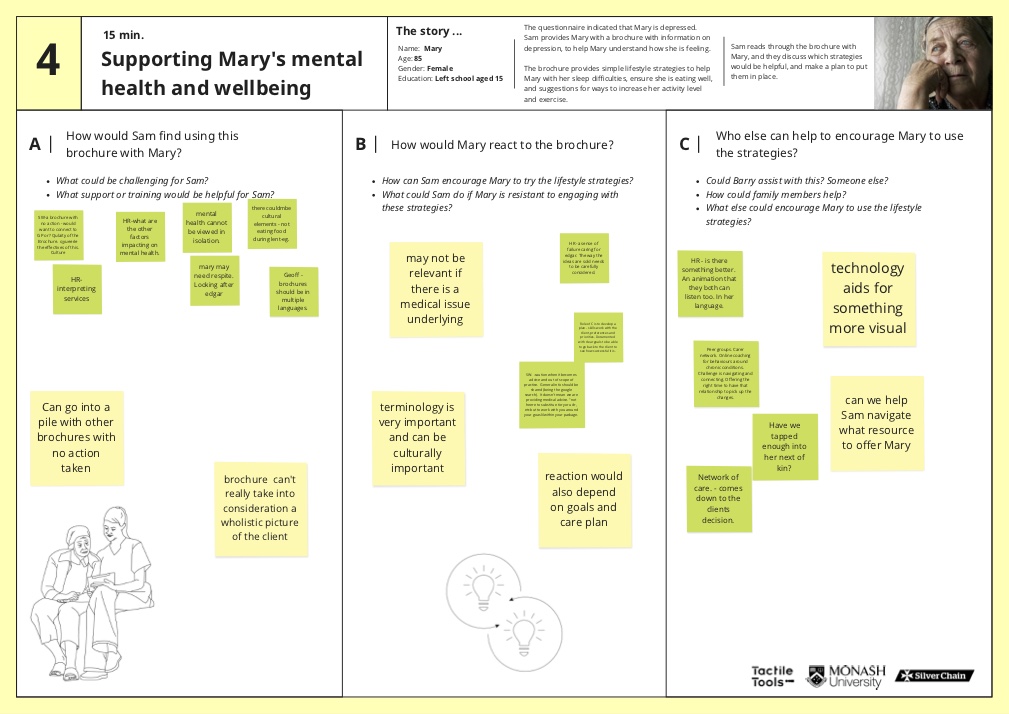 ‘Supporting Mary’s mental health and wellbeing’ MIRO board from the Silverchain co-design workshops.
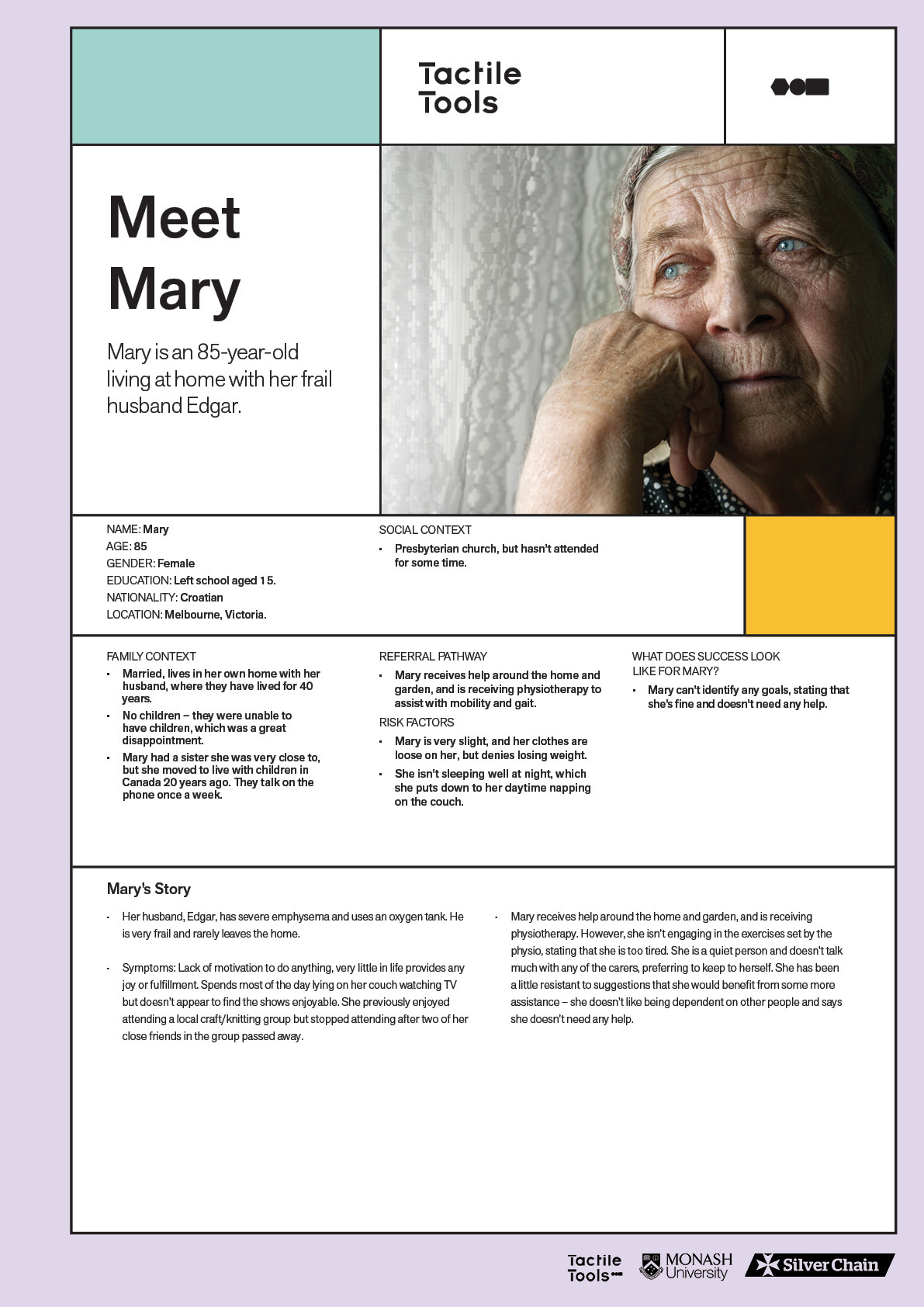 ‘Mary’ persona used in the Silverchain co-design workshops.