
Kummargi Ghadab Yulendj Tarrang highly commended in the South Australian Museum’s Waterhouse Natural Science Art Prize
Kummargi Ghadab Yulendj Tarrang (the trees are rising up) by Professor Brian Martin (Bundjalung, Kamilaroi and Muruwari), Director of Wominjeka Djeembana Indigenous research lab, and N'arweet Dr Carolyn Briggs AM, Senior Elder of the Yaluk-ut Weelam clan of the Boonwurrung and Monash Adjunct Professor and others, was highly commended in the South Australian Museum’s Waterhouse Natural Science Art Prize 2024.
Excerpt of Kummargi Gadhaba Yulendj Tarrang. Digital video, 100x60, run time 6 min. By N’Arweet Professor Carolyn Briggs AM, David Tournier, Professor Brian Martin, Julian Rutten, Alexander Holland and Dr Stanislav Roudavski, Wominjeka Djeembana Indigenous research lab at Monash University, Deep Design Lab and the University of Melbourne.
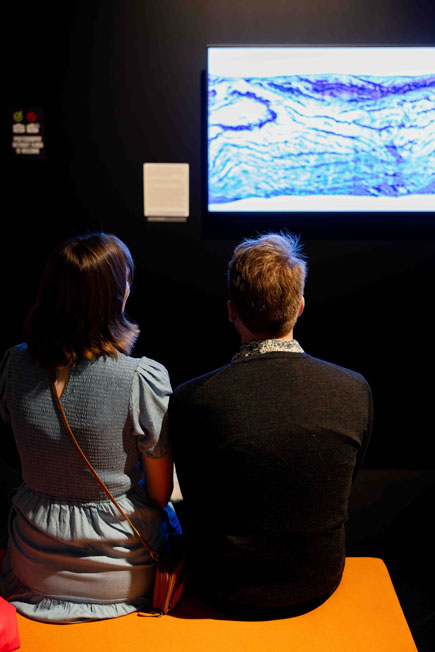 Installation view of Kummargi Gadhaba Yulendj Tarrang. Photo courtesy of the South Australian Museum and Angus Northeast/Topbunk.
 Kummargi Gadhaba Yulendj Tarrang roughly translates as the knowledge of the trees is rising up in Boonwurrung language and is a name of a work that explores new ways of learning from trees. Using laser scans, this project creates a digital model of a tree marked by Kulin Ancestors who used its bark to make canoes, shields or coolamons. Analysing millions of points produced by laser reflections reveals meaningful features of the tree including cultural markings, wood anatomy, traces of past fires, and the work of insects who called this tree home. These features refer to holistic ecologies where all share and nothing dies.
The project also featured in Wominjeka Djeembana’s More Than a Tarrang (Tree): Memory, Material and Cultural Agency exhibition at the Bunjilaka Aboriginal Cultural Centre, Melbourne Museum.
The Waterhouse Natural Science Art Prize was launched in 2002 and is named in honour of the South Australian Museum’s first curator, Frederick George Waterhouse. The prize is an opportunity for artists to investigate the world around them and present their perspectives on natural science. It encourages artists to make a statement about the scientific issues facing our planet and offers a valuable platform for them to contribute to the environmental debate. Over the years the competition has become a much-loved fixture on the arts calendar, allowing artists and audiences to explore natural science through a range of creative outlets.