
Breaking BADS: Architecture students challenging the rules of apartment design
A bold studio partnership with Six Degrees Architects is giving Monash Architecture students the tools and the permission to challenge what good apartment design really means.
 Image: Tina Tsunga
 Maria Betina Tsunga (known as Tina) came to Monash University from the Philippines, expecting to work within the rules. Instead, she found herself questioning them.
Tina is one of a cohort of Master of Architecture students in the Breaking BADS studio, a practice-embedded design studio run in partnership with Six Degrees Architects, one of Australia's most influential practices. The studio focused on Victoria's Better Apartments Design Standards (BADS), the framework introduced in 2017 to lift the quality of multi-residential housing across Melbourne. The question posed to students was: Are those standards still fit for purpose?
"Usually we have to follow the standards," Tina says. "But with Six Degrees, we ask: why are we doing this? Maybe for this standard there isn't just one solution."
Learning by doing and questioning
Students in the Breaking BADS studio split their time between the Monash Caulfield campus and the Six Degrees studio in Fitzroy, working through site analysis, apartment precedents, yield studies, and finally a full mixed-use building design across 15 weeks. Guest presentations from Six Degree architects, builders, urban designers, and ESD specialists punctuated the studio schedule.
Site visits to Nightingale Village, Hawke and King Apartments in West Melbourne, and hospitality venues around Richmond put the theory in conversation with the real city.
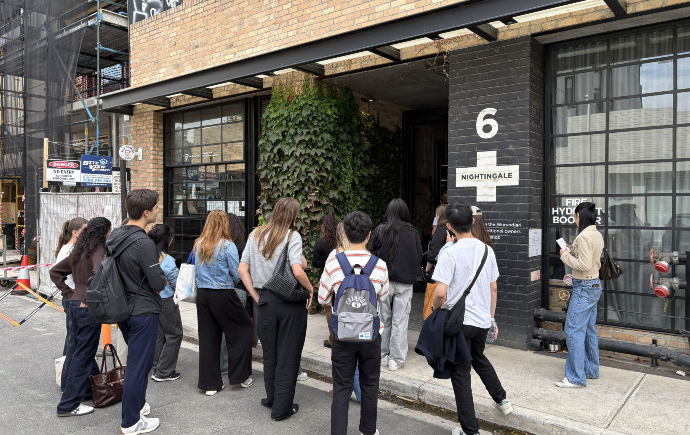 Image: Studio group site visit to Nightingale Village
 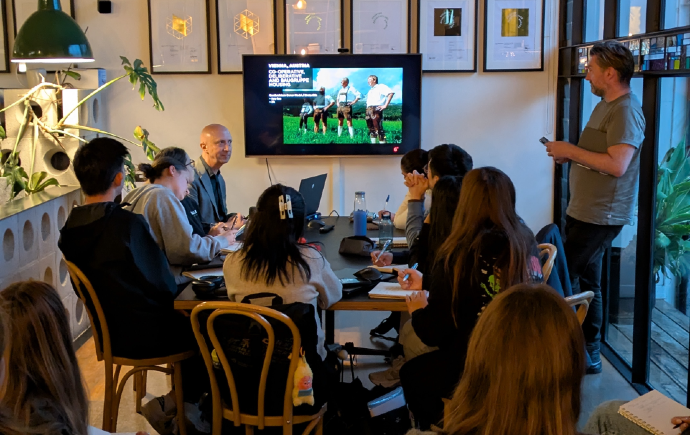 Image: Studio group at Six Degrees
 Tina chose the Corner Hotel site on Swan Street, Richmond, a constrained, complex site next to an iconic live music venue. The challenge appealed to her.
"This brief required us to build with existing infrastructure. It was a small site, but I was intrigued by the restrictions," she says. "I felt it was more of a challenge."
Her allocated BADS theme was noise. While the standards focus on minimising it, Tina asked: what about the people who want to engage with sound?
"The BADS focus on reducing noise, but what about people who choose to live near a music venue? I wanted to give people selective participation instead of assumed preferences" she explains.
A design that moves with its residents
Tina's response is an apartment building where the boundaries between inside and outside are deliberately blurred, and entirely up to the resident. Walls sit on tracks and they are moveable. Drop seals can lock a panel in place or open a room entirely to the street, the corridor and the noise below. If residents want to hear the band, they can choose to open up the space. If they want quiet, they can choose to close down the space.
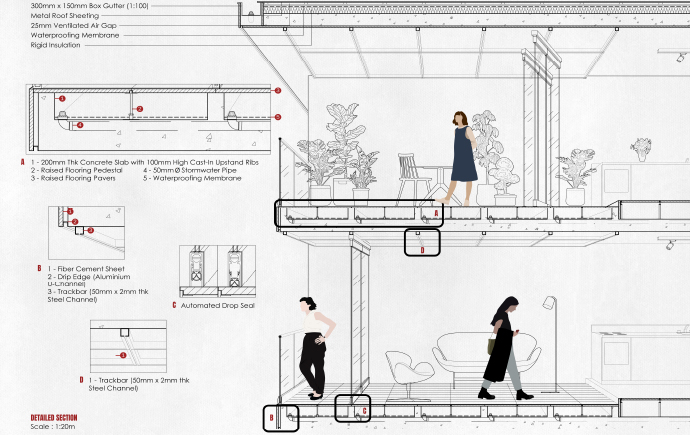 Image: Blowup cross-section of two apartments
 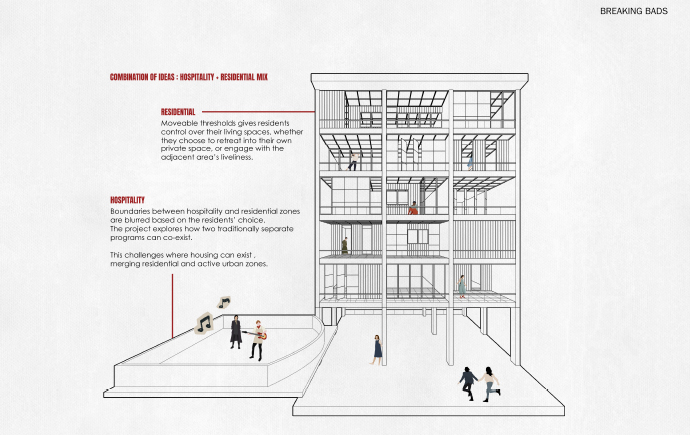 Image: Concept 3 cross-section
 The scheme offers studio, one-bedroom, and two-bedroom configurations across six design variations, giving future residents genuine agency over their sonic environment. The ground floor reimagines the under-utilised service and storage space adjacent to the Corner Hotel's stage as a flexible community venue available for concerts, performance, or group exercise.
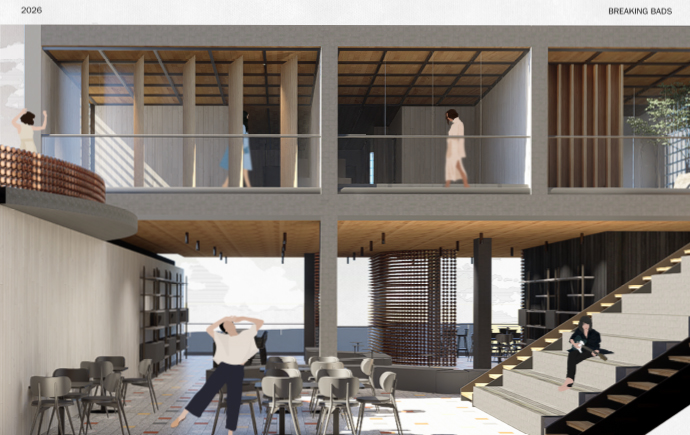 Images: Hospitality design renders
 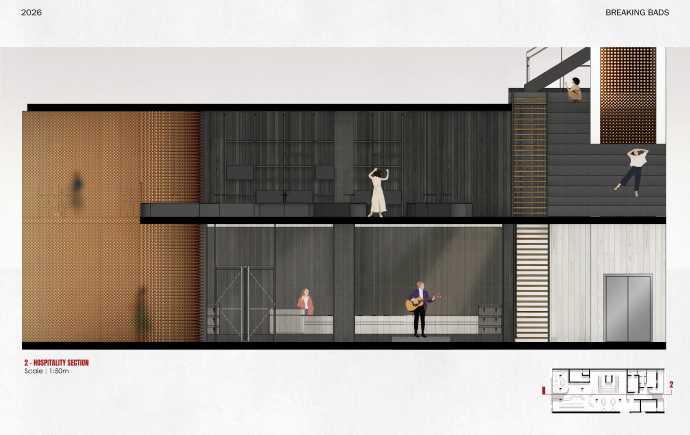 Images: Hospitality design renders
 "I'm happy with how unconventional it is," Tina says. "I wanted to do something that was very responsive to the actual lifestyle of the users. My project asks: Why do we assume what people want?"
She also challenged BADS requirements around balconies. The standard mandates a minimum 1.8 metres of private open space. Tina asked what happens when a resident simply doesn't want one. The moveable wall system effectively extends the apartment outward on demand, dissolving the distinction between balcony and living room.
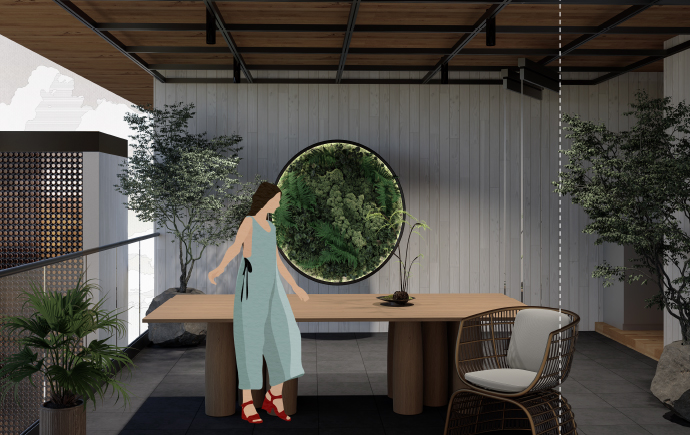 Image: Balcony design render
 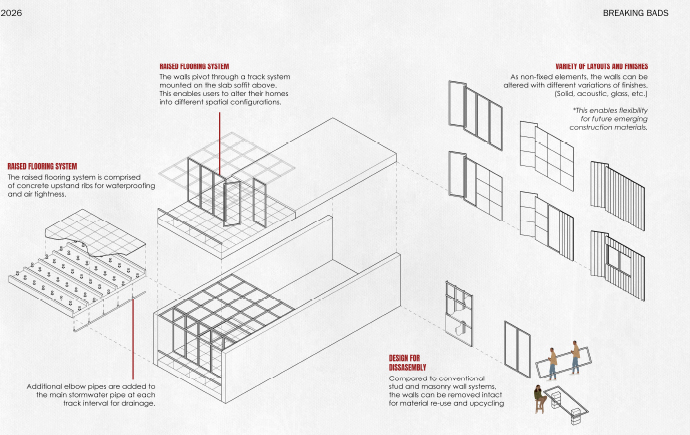 Image: Concept 2 Flooring and walls
 Getting there wasn't without difficulty. The technical challenges like weatherproofing, thermal performance, or the mechanics of a moving wall, were substantial. A guest presentation from a builder mid-semester proved to be a turning point.
"I was so concerned about waterproofing," Tina recalls. "But he pointed out that was manageable and I should think more carefully about temperature performance. Those real-world insights were invaluable."
Critique from the real world
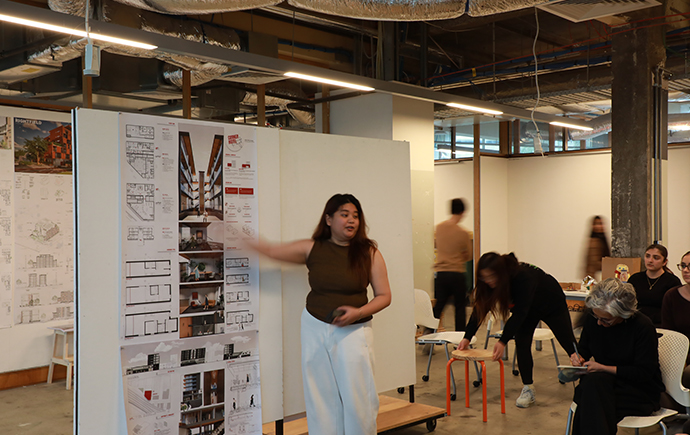
Image: Tina presenting at the final review
At the mid semester review, student projects were presented to an independent panel including Alayna Chapman from the City of Merri-bek, and Ben Thorp, urban design expert from the Urban Design Forum Australia.
Ben says "There was some great work and very competent architecture featured in this studio." His involvement in the student review panel is a direct investment in the future of the profession. "Negotiating with Council officers around urban design outcomes is something graduates will encounter in practice, and the sooner they experience that dialogue, the better prepared they'll be."
For the final review, students presented to Professor Maryam Gusheh from the Department of Architecture and Michael Neve, Senior Associate at Six Degrees.
Michael says
"Participating as a guest critic in the Monash University end of semester review was a rewarding and stimulating experience. The students presented work that was well resolved, but also speculative and playful, as student work should be. Seeing confident and unique design voices and communication styles emerge was particularly pleasing."
Why Six Degrees
The Breaking BADS studio is the latest chapter in a long-standing partnership between Six Degrees and Monash Art, Design and Architecture (MADA), spanning design studios, industry placements, and joint policy studies.
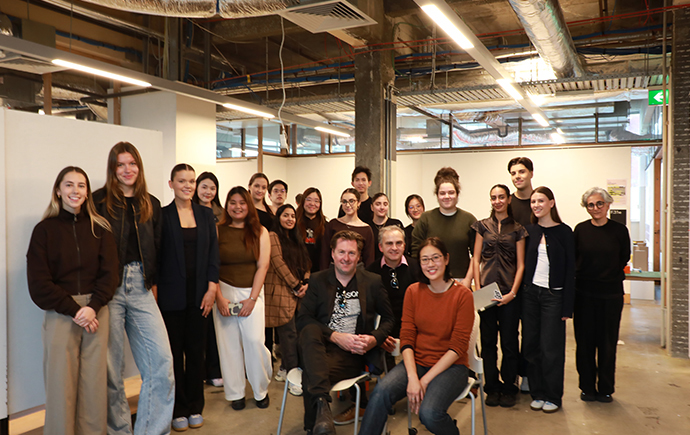
Breaking BADS Studio group. Front L-R: Mark McQuilten, Michael Neve, Wendy Li and far right: Professor Maryam Gusheh
Studio tutors Wendy Li and Mark McQuilten, both registered architects with more than 20 years of experience, brought the Six Degrees inquisitive spirit directly into the studio.
"Our approach has always been to interrogate the why, the how, and ultimately the why not," says Wendy. "Rather than treating standards as a final destination, we look to understand their underlying intent, using them as a foundation to discover creative solutions that address the individual living experience."
Mark sees the partnership as genuinely reciprocal. "Students like Tina bring fresh eyes to problems that practitioners can stop questioning. Her moveable wall concept is technically demanding, but grounded in a real insight about how people want to live. That's the kind of thinking that changes the industry."
For Tina, working inside a practice, not just hearing about one, has made the difference.
"I love how they keep asking the why in everything. Working with Six Degrees shows there is not one way to work; there is always another option," she says. "Do we even need plasterboard ceilings? Can we cut costs there and spend that money elsewhere? That kind of thinking opened up my whole design process."
Industry partnership, real impact
"The next generation of architects shouldn't just inherit the rules, they should understand them well enough to improve them," Wendy and Mark say. "Working with Monash gives us the opportunity to put that into practice, and the calibre of thinking from students this semester has been genuinely exciting."
The Breaking BADS studio gives students like Tina the chance to stress-test apartment design standards alongside builders, developers, and Council officers. It pushes them to produce work that asks whether BADS is truly serving the people that Melbourne's housing crisis is failing most.
"Monash gave me the space to think differently," Tina says. "The facilities, the connections to industry and the chance to work with a renowned practice like Six Degrees was a unique experience."
Tina's project doesn't answer every question the housing crisis raises, but it proves they're worth asking.
"I've enjoyed questioning the standards," she says. "Standards evolve because architects challenge them. That's what we're doing here."