
How Xavier is protecting Australia’s endangered animals through sustainable design
How Xavier is protecting Australia’s endangered animals through sustainable design
From a young age, Xavier was drawn to the natural world. Australia’s landscapes, ecosystems and wildlife shaped how he thought about responsibility, care and the role humans play within the environment. That passion ultimately became the driving force behind Bush Cradle, a modular habitat system designed to support Australia’s endangered native animals.
Xavier’s path to industrial design was unconventional. He began at Monash University studying a Bachelor of Biomedical Engineering, driven by a desire to understand biological and mechanical systems. It was in the Bachelor of Industrial Design, however, that everything aligned, offering the balance of creativity, making and problem-solving that allowed him to unite his passion for conservation with his instinct to build.
“Industrial design gave me the freedom to turn ideas into real objects,” says Xavier. “And to do that in a way that could genuinely support the environment.”
That freedom was critical during his final-year project. Confronted by Australia’s alarming rate of species extinction, the highest in the world for terrestrial mammals, Xavier wanted to use design as a direct response. He focused on habitat loss, one of the most significant threats to native wildlife. Tree hollows, fallen logs and other essential shelters take decades to form, yet they’re disappearing at a far faster pace.
The result was Bush Cradle: a modular habitat system that can be adapted to suit the unique needs of different species. Unlike traditional nest boxes, which are often generic, poorly insulated and difficult to modify, Bush Cradle functions as a kit of parts. Its modular components can be assembled and reconfigured to create species-specific shelters for animals living both on the ground and in trees.
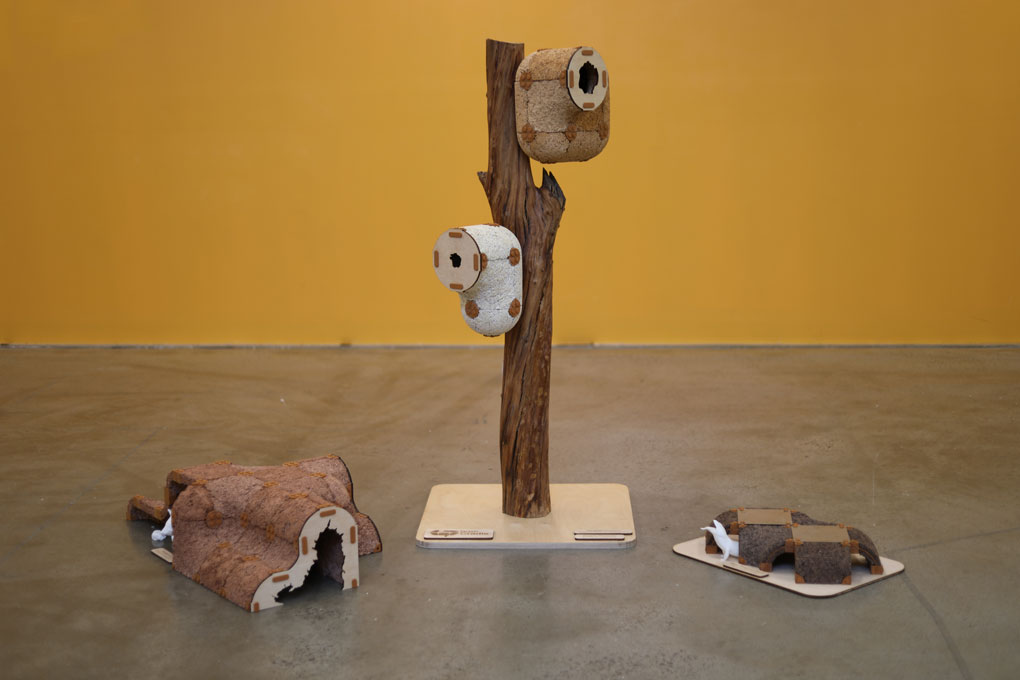
Material choice was central to the project’s sustainability focus. Xavier turned to hempcrete, a biodegradable, fibrous material that closely mimics the insulating properties of wood. Combined with 3D printing and casting techniques, the system balances natural biomimicry with advanced manufacturing. The design process moved fluidly between hand sketching, CAD modelling, prototyping and physical testing, an approach strongly supported within Monash Design.
A key influence on Xavier’s project development was his internship at Reef Design Lab, a multidisciplinary design company pioneering marine habitat infrastructure, founded and led by Monash Design alum Alex Goad. Being mentored by Monash Design alum and Reef Design Lab designer Zac Vassallo in his second year was an encouraging and formative experience that helped Xavier grow and visualise his future and role as a designer.
“Alex and Zac were incredible mentors. Their guidance in combining traditional casting methods with digital 3D modelling and printing was pivotal. Crucially, they showed me how design can exist within ecological systems, not just alongside them,” Xavier says. “That way of thinking had a huge impact on how I approached Bush Cradle.”
Testing the design with wildlife was a defining moment. Installing a prototype in his backyard, Xavier observed ringtail possums gradually investigate and eventually inhabit the structure. Seeing animals comfortably use something he had designed confirmed the project’s potential beyond the studio.
Throughout his studies, Xavier’s understanding of design evolved. What began as an interest in form and aesthetics shifted toward creating new systems that offer genuine environmental benefit. For students considering a career in design, his advice is “embrace the physical! In an ever-digitalising world, being able to make things is a skill that won’t be made redundant.”
“Design has the power to influence the physical world,” he says. “When you use that power with intention, even small interventions can make a real difference.”
Now working full-time at Reef Design Lab, Xavier continues to explore how design can support ecosystems on land and in the ocean. With Bush Cradle, he has shown how thoughtful, adaptable design can help create space for Australia’s wildlife to survive and recover.