
Redefining Artistic Space: The launch of the 2nd Studio
Redefining Artistic Space: The launch of the 2nd Studio
Image:Participant drawing at ACCA as part of The Second Studio Publication Launch in the exhibition, Julius von Bismarck, This is not the storm 2026.
Amélie Scalercio, Lecturer and Coordinator of Drawing at Monash Art, Design and Architecture (MADA), is challenging how we perceive creative production through a new collaborative publication The Second Studio: Drawing on Contemporary Art in the Gallery. The publication is the culmination of Scarlecio’s extensive studio education research and first-of-its-kind collaboration between Monash Art, Design and Architecture (MADA) and the Australian Centre for Contemporary Art (ACCA).
The initiative began as a creative response to engage students with physical spaces at the end of the pandemic. Working closely with ACCA Artist Educator Lauren Simmonds over the last five years, the program has scaled significantly. The partnership now brings over 500 students per semester into ACCA’s free exhibition spaces, transforming how diverse student communities connect with contemporary art.
An immersive, extended studio space
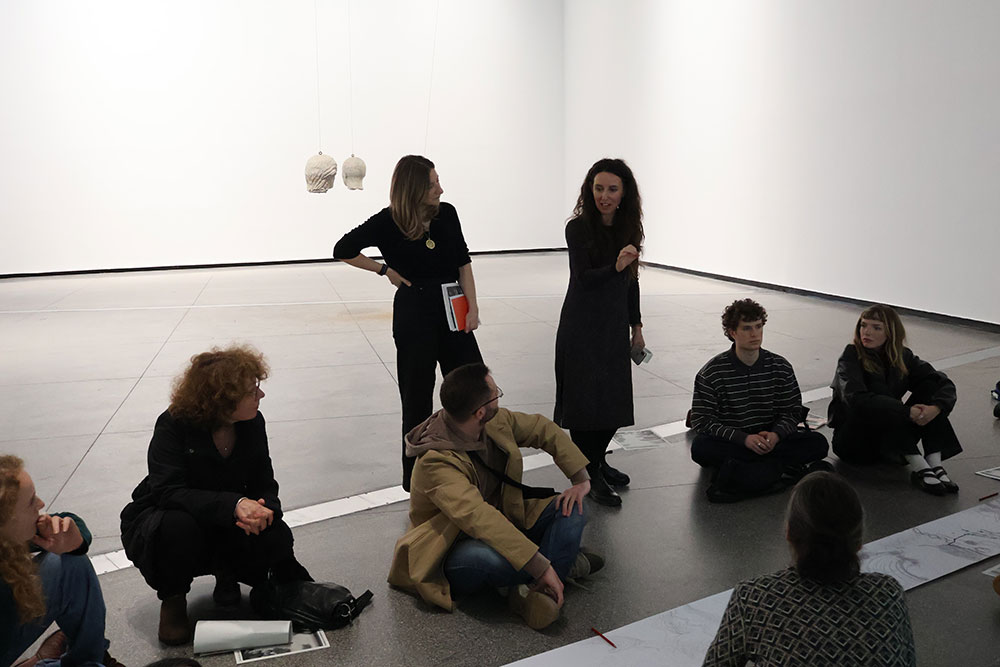
Image: Participants drawing at ACCA as part of The Second Studio Publication Launch in the exhibition, Julius von Bismarck, This is not the storm 2026.
Central to Scalercio’s research is an embodied reframing of the gallery as an alternative, extended studio space. Instead of treating artistic production as something isolated within four walls, this methodology invites students to visually and perceptually engage with architectural conditions, international and local artworks, and public movement.
"The concept of the studio no longer requires physical boundaries," Scalercio explains. "The second studio exists in a mobile way through drawing that can be activated anywhere, enhancing any given moment because of how it positions your body in that place and time."
This democratic approach strips away the intimidating aura often associated with contemporary art galleries, transforming a public exhibition space into a shared civic workshop. The physical environment shifts how participants interact with their surroundings.
“ACCA is an all-sensory experience of sound and scale," Scalercio notes. "Drawing is just as physical. We work with a range of sensory prompts to get students to anchor their thinking within the space, responding directly to the environment through embodied mark-making."
Reclaiming time in a digital era
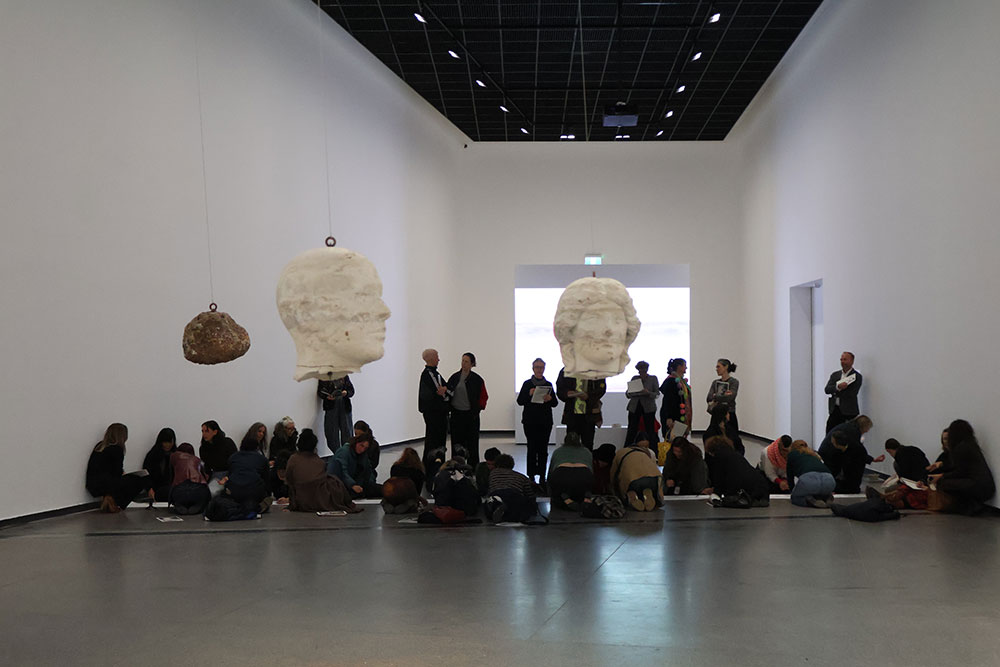
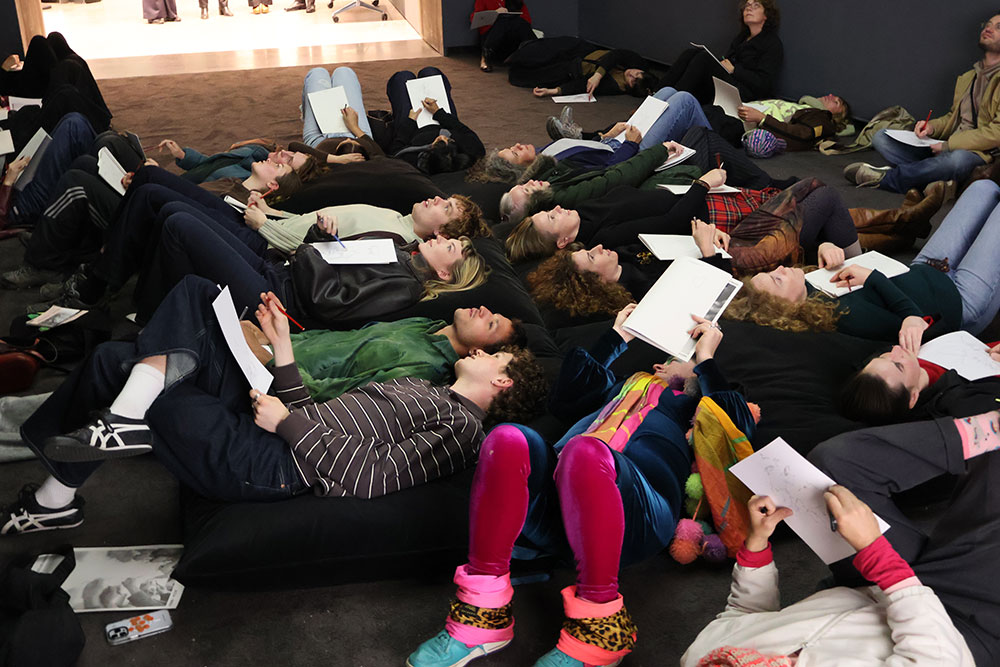
Image: Participants drawing at ACCA as part of The Second Studio Publication Launch in the exhibition, Julius von Bismarck, This is not the storm 2026.
In an age where everyday experiences are heavily mediated by digital devices, this research prioritises tactile grounding. While technology pushes for rapid, efficiency-driven communication, the physical act of drawing intentionally recalibrates our relationship with time and space.
"When I’m scrolling on my phone, I lose my understanding of time," Scalercio says. "But drawing allows us to step outside of modern society's obsession with speed. Drawing is not slow time—it is actually real time. It is a fundamental practice that brings us back to our physical senses and connects us intimately with the world at a human scale."
The impact on student confidence is immediate. "It is rewarding to watch students start off a bit uneasy, but through the process of drawing become more grounded as they find a physical tether to the artwork."
Unlocking collective power at the public launch
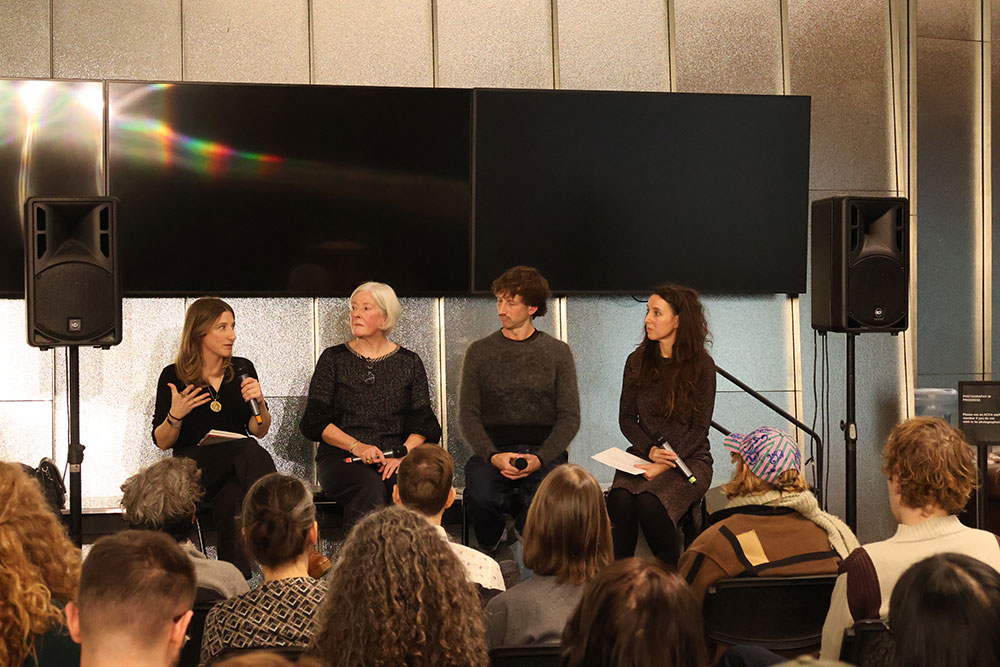
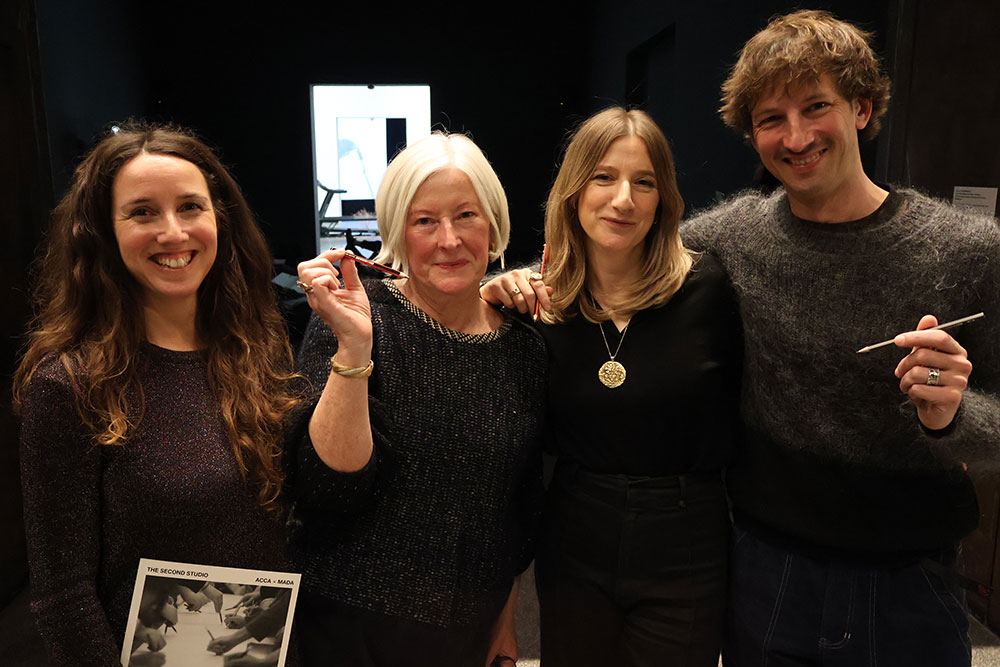
Image:The Second Studio Publication launch at the Australian Centre for Contemporary Art (ACCA).
The real-world impact of this research partnership came to life at a public launch hosted at the Australian Centre for Contemporary Art (ACCA). The event brought together a dynamic panel of creatives, including ACCA Artist Educator and studio collaborator Lauren Simmonds, contemporary artist Dr. Rosslynd Piggott, artist Andrew Atchison and MADA Coordinator of Drawing, Amelie Scarlecio, who celebrated drawing as an open universal language.
Community members participated en masse, lying down on the gallery floor to draw alongside one another. This collaborative activation transformed the formal exhibition space into a shared workshop. Inviting the community to occupy the gallery floor activates public architecture in a freeing way, anchoring participants to physical reality while reclaiming the space for communal learning. It shows how effectively we can co-design meaningful educational experiences well outside institutional walls.
"Art isn't only meant to be viewed on a screen or in a book; it's meant to be experienced at scale," says ACCA Art Educator Lauren Simmonds. "Watching people move from viewing a work passively, to actively making in the gallery changes the students' experience of the artwork entirely. Drawing in the gallery breaks down the invisible barriers that often make contemporary art feel out of reach, turning the exhibition space into a living, breathing studio."
Interdisciplinary learning
The research methodology expands well beyond creative disciplines, positioning drawing as an active pedagogical tool for interdisciplinary discovery and human improvement across the university. Through her new doctoral project, Expanding Worlds, Scalercio collaborates with diverse student cohorts to enrich global learning.
In joint units with Dr Alex Brown in Architecture, students utilise drawing as a spatial exploration tool to interpret sites. In the School of Biological Sciences with Dr Chris Lee, plant biology students draw alongside fine art students to heighten their observation skills. Crucially, the practice has become essential for Biomedical Science students studying anatomy. Because photography is prohibited in dissection labs, drawing serves as the sole, active method to record and deeply understand human specimens. Faced with the complex structures of human anatomy, students utilise the physical process of drawing as a cognitive ordering system to achieve deep engagement with the human scale.
A toolkit for deeper connection through meaningful collaboration
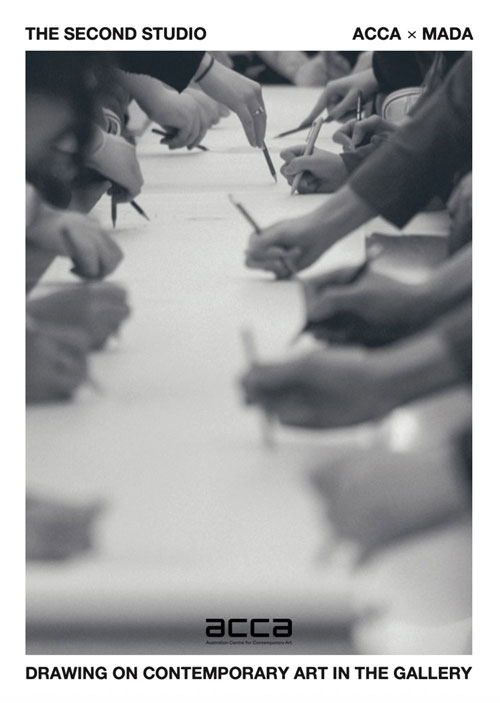
The Second Studio: Drawing on Contemporary Art in the Gallery functions as a practical field guide and a pedagogical toolkit. It provides art educators and learners with a sensory framework to investigate complex ideas, emphasising that drawing is a foundational way of thinking—a fluid conversation with our environments.
"My hope is that people will continue to find the deep value in drawing," Scalercio explains. "It shouldn't be reserved just for learners in creative disciplines. It is incredibly important for all of us to use our bodies in this way to physically connect with the world around us. Drawing is thinking in motion- It reveals the physical exchange of relationships, encounters, and connections that emerge through an embodied process."
The long-term collaboration between MADA and ACCA exemplifies how public institutions and universities co-design spaces for collective learning. By taking education beyond traditional campus boundaries, the initiative creates an accessible environment where diverse communities can thrive through shared creative practice.
“It has been rewarding to see students develop confidence through their ongoing visits to ACCA and to witness how their sustained engagement in the space enhanced their appreciation and understanding of art and drawing” says Simmonds. “I hope that experiences like this continue to build student confidence in returning to the gallery. It has been a pleasure to work with MADA students and collaborate with Amélie on this publication.”
Collaborating with a world-class contemporary art space like ACCA changes everything for our students," Amélie reflects. "It allows us to practice place-making in real-time, transforming a public gallery into an active, extended studio.
The Second Studio: Drawing on Contemporary Art in the Gallery is available to purchase online through ACCA and in the gallery.