
Intergenerational Playground
NCHA Intergenerational Playground
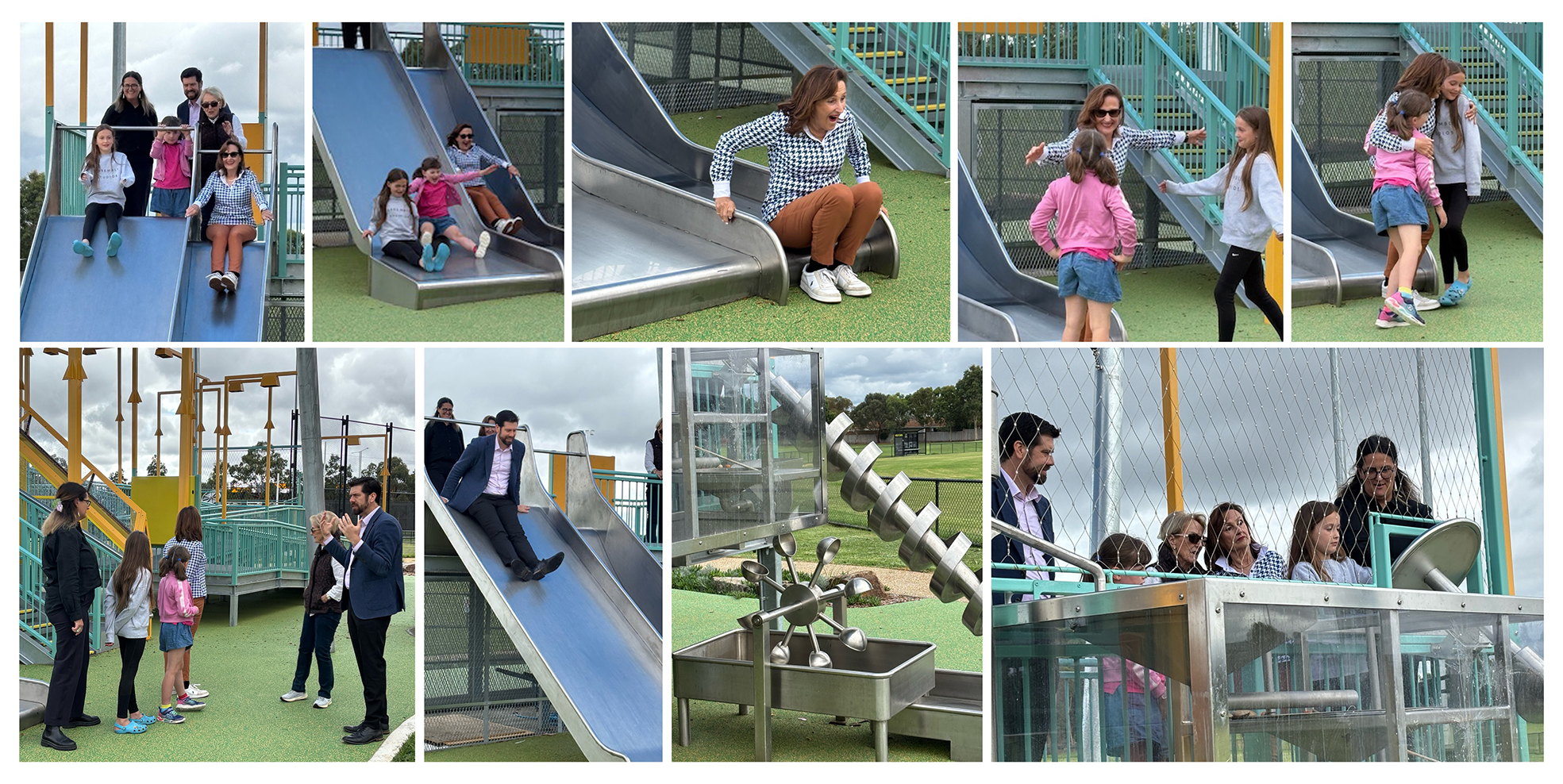
The Intergenerational Playground is located at the Healthy Futures Hub in Seaford and is the world’s first open-air research laboratory which examines how community infrastructure can be designed to optimise intergenerational connection, STEM learning (Science, Technology, Engineering, and Mathematics), and physical activity.
Included within this same open air environment is the Adult Exercise Park, offering age-friendly equipment to support balance, strength, and mobility, with research showing it improves function and reduces falls.
-
Research significance
 Intergenerational programs involving primary schools have the capacity to benefit both older adults and students (Cole, 2023). When older adults are encouraged to share knowledge and skills with children, they can feel heard and respected (Cole, 2023), which promotes an increased sense of self-esteem, confidence, worth, and usefulness (World Health Organisation, 2023). These outcomes are particularly beneficial for those entering retirement, a phase of life which can be met with feelings of depression associated with lack of purpose, fear of being forgotten and reduced sense of identity (Sargent et al., 2011).
School students who participate in intergenerational programs may experience improved self-esteem (Cole, 2023), well-being, quality of life, intergenerational consciousness and respect for older adults (World Health Organisation, 2023).
Whilst we understand that intergenerational initiatives benefit school students in a multitude of ways, we are yet to examine whether these programs have potential to enhance academic outcomes. This untapped area of research is of particular relevance to the Australian education landscape because data tells us that our nation’s students are falling behind their international counterparts in key academic subjects including science, technology, engineering and mathematics (STEM) (dandolopartners, 2020). STEM capabilities are essential to the building of national economic growth and productivity (Department of the Prime Minister and Cabinet, 2015). Therefore, it is in our nation’s best interests to discover more about how STEM learning and how it can be promoted.
Research conducted at the Intergenerational Playground fills this gap in literature by investigating how infrastructure can be designed to effectively support older adult involvement in STEM learning. It also seeks to understand how this infrastructure can optimise the physical activity of older adults. We anticipate that communities around the world will draw from our research findings when developing intergenerational public spaces which support health and learning outcomes.
What does the Intergenerational Playground include?
The Intergenerational Playground features a series of interactive STEM learning exhibits designed by experts working in the fields of primary education, psychology, physiotherapy and occupational therapy. Every exhibit encourages adults and children to solve STEM problems together whilst having fun and being physically active.
Sensor technology in the playground enables the NCHA to track the number of people interacting with various exhibits together with the height of these people (providing an indication of how many are adults and how many are children). This data helps NCHA researchers understand which activities encourage the most STEM learning, intergenerational engagement and physical activity.
Who is the Intergenerational Playground for?
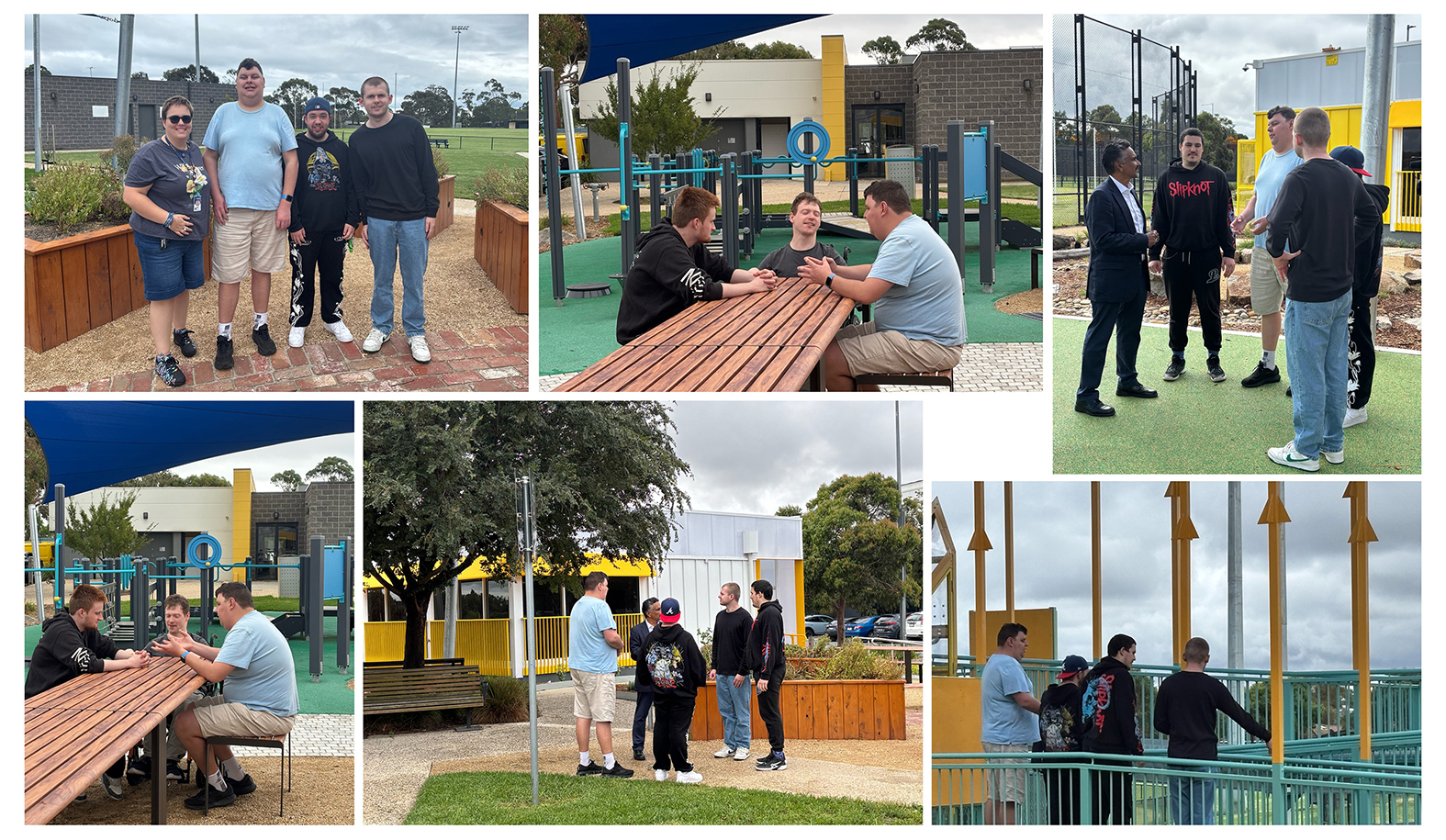
General public
- The Intergenerational Playground can be accessed by the general public at all times and is free of charge. The NCHA encourages local families to visit the playground frequently so that STEM learning becomes routine.
School groups
- Local school groups visit the Intergenerational Playground on planned excursions to connect with older adult volunteers. These volunteers have received training in the use of the infrastructure and work together with students to better understand the scientific concepts underpinning each exhibit.
- This program is informed by evidence suggesting that imagination, play and intentional teaching practices promote STEM learning (Fleer, 2015). School group excursions also enable professional development for classroom teachers. Literature tells us that when educators observe students engaged in intergenerational learning, they are able to see first-hand the purpose of what they are teaching and how it applies to real world experiences (Cole, 2023).
Practitioners
- The playground is also accessed by practitioners engaging children and their families in capacity building activities. This includes playgroup facilitators and NDIS providers such as play therapists and occupational therapists.
What makes the Intergenerational Playground unique?
The intergenerational playground is the world’s first open-air research laboratory which examines how community infrastructure can be designed to optimise intergenerational connection, STEM learning and physical activity.
Researchers observe and analyse how older adults and children interact with exhibits, then modify the exhibits to see whether participant responses change. The modifications are possible because the exhibits are located inside weatherproof cases which can be unlocked and adjusted. This adaptability enables researchers to pinpoint the precise conditions which promote the most positive outcomes for participants.
Another special aspect of this playground is the process through which it was designed. Monash University researchers interviewed key stakeholders from the local community including children, guardians, older adults and primary education experts. Feedback was also sought from guardians of children with complex additional needs and disability inclusion facilitators from primary schools. Findings from this study helped the NCHA understand what should be prioritised in the Intergenerational Playground to ensure it meets the ongoing needs of the children and older adults who use it.
-
The building process – from concept to delivery!
From planning and design to construction and handover.
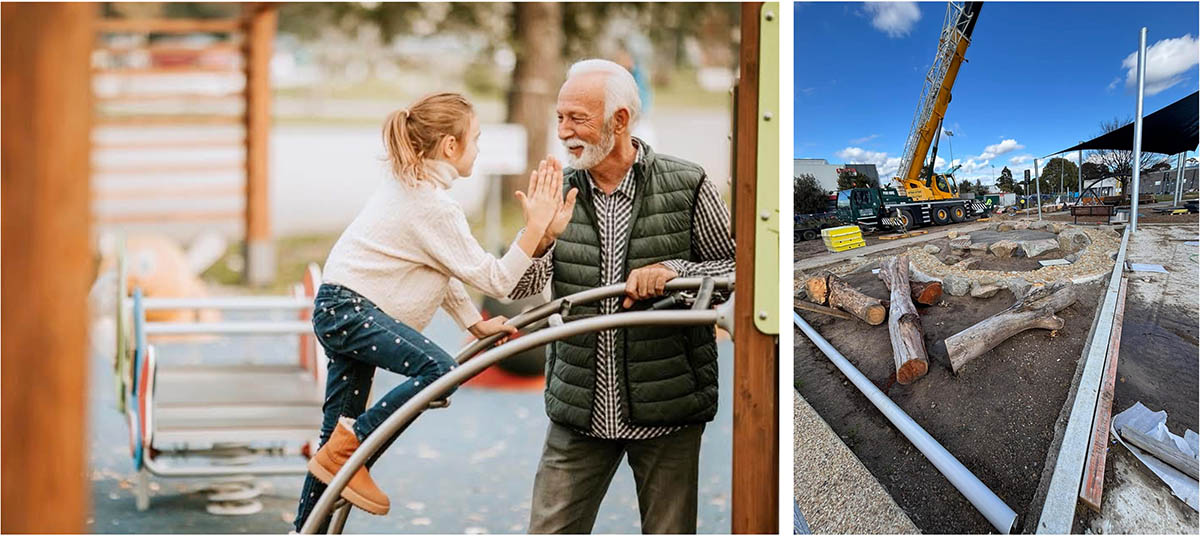
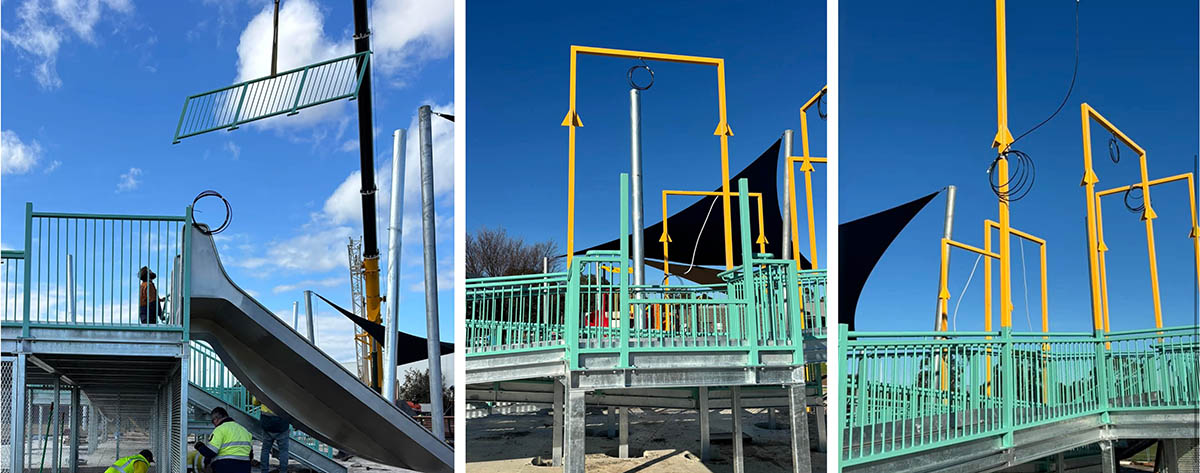
Image 1: Intergenerational programs involving primary schools have the capacity to benefit both older adults and students
Image 2: The beginnings of a group time area made of rocks and wood stumps. School groups will gather here when they arrive for excursions
Image 3: Intergenerational Playground slide and balustrade being installed
Images 4 and 5: Sensor technology being installed in the playground. When this infrastructure is powered, it will sense the height of people as they walk or stand under every flat arch. This information will help researchers better understand which features of the playground most effectively encourage children and adults to play together.
-
References
- Cole, F. (2023). Intergenerational Practice in Schools and Settings: An Educator’s Handbook (1st ed., Vol. 1). Routledge. https://doi.org/10.4324/9781003262688
- dandolopartners. (2020). Evaluation of early learning and schools initiatives in the National Innovation and Science Agenda: Report to the Department of Education. Australian Government Department of Education. https://www.education.gov.au/download/18700/evaluation-national-innovation-and-science-agenda-nisa-schools-and-early-years-initiatives-final/39446/document/pdf
- Department of the Prime Minister and Cabinet. (2015). National innovation and science agenda. Commonwealth of Australia. https://www.industry.gov.au/data-and-publications/national-innovation-and-science-agenda-report
- Fleer, M. (2021). Conceptual Playworlds: the role of imagination in play and learning. Early Years (London, England), 41(4), 353–364. https://doi.org/10.1080/09575146.2018.1549024
- Sargent LD, Bataille CD, Vough HC, Lee MD. (2011). Metaphors for retirement: Unshackled from schedules. Journal of Vocational Behavior. 79(2), 315-24.
- World Health Organisation. (2023). Connecting generations: planning and implementing interventions for intergenerational contact. Geneva: World Health Organization. https://iris.who.int/handle/10665/373056