
Biomarker Discovery
The Monash High Precision Biomarker Discovery Platform Node (BMD) is a specialised technology hub within the ISO-accredited Monash Proteomics and Metabolomics Platform at Monash University, established to support robust, reproducible biomarker discovery.
The Node provides clinicians, researchers and industry partners with access to cutting-edge and emerging omics technologies for preclinical, clinical and translational research. Through a collaborative and consultative model, it bridges the gap for collaborators between valuable biological samples, clinical questions, and the advanced technologies needed to uncover meaningful molecular signatures of disease, treatment response and patient stratification.
Open to academic, clinical and commercial collaborators, the Biomarker Discovery Node is designed to strengthen Australia’s biomedical research ecosystem by making new, disruptive biomarker discovery technologies accessible, expertly supported, and aligned with key biomedical research partners.
What is ‘biomarker discovery’?
Biomarker discovery is the process of identifying measurable molecular indicators that reflect where an individual sits along the continuum between health and disease. These may support diagnosis, prognosis, patient stratification, treatment selection or monitoring of disease progression and recovery. As shown in the figure, biomarker discovery is a staged process: it begins with a large pool of potential molecular candidates and progressively narrows these down through discovery, confirmation and validation toward biomarkers that are clinically useful.
In proteomics, this process begins with discovery within a highly complex molecular landscape containing tens of thousands of possible protein candidates. In biofluids such as plasma, there may be more than 10,000 detectable protein candidates, with even greater complexity arising from protein isoforms, variants and modified forms. A major challenge in early biomarker discovery is therefore one of detection: before proteins can be assessed for clinical relevance, they must first be observed and measured reliably within this vast and dynamic background.
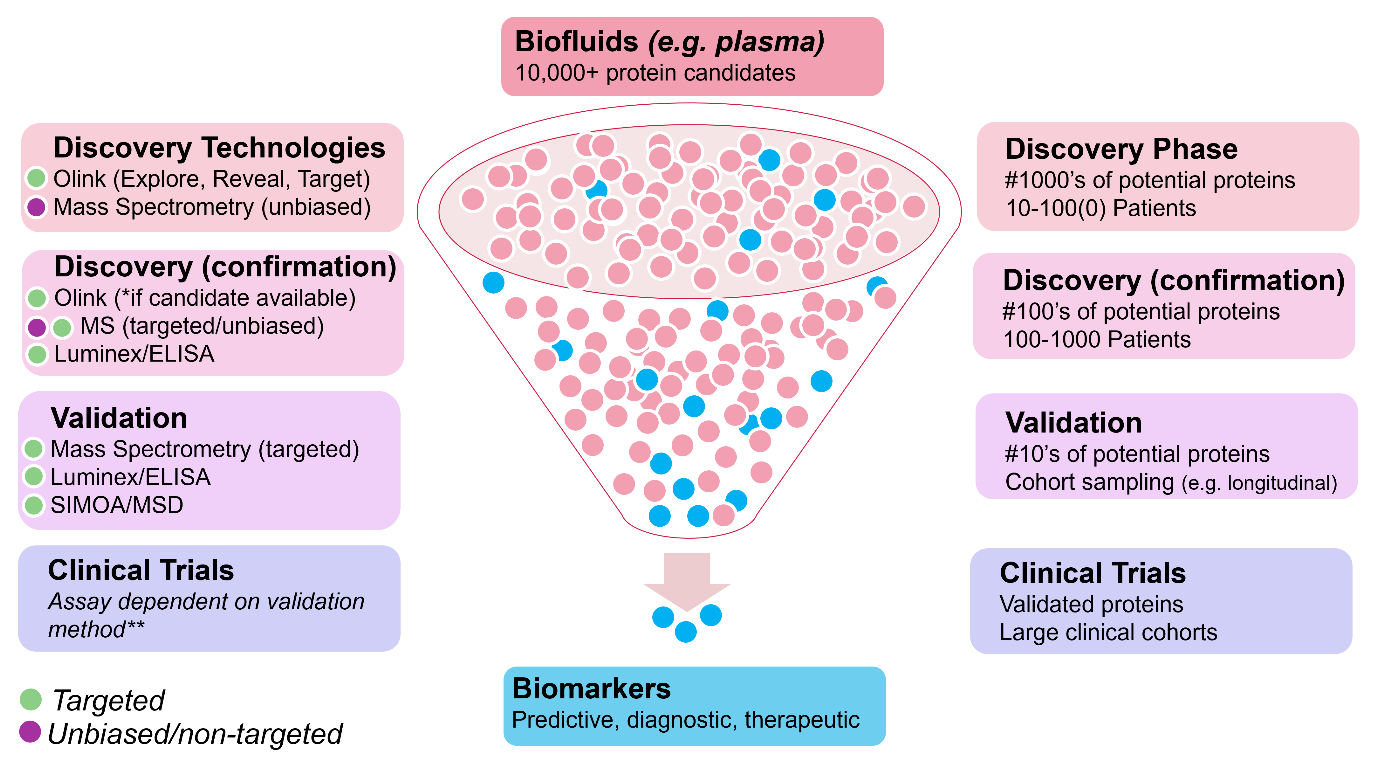
Figure 1. Staged proteomics-enabled biomarker discovery pipeline: Biofluids such as plasma contain thousands of potential protein biomarker candidates. Discovery technologies, including unbiased mass spectrometry and high-plex affinity platforms, help detect and prioritise candidates, which are progressively refined through confirmation and validation stages toward clinically useful predictive, diagnostic or therapeutic biomarkers. Green markers indicate targeted approaches; purple markers indicate unbiased/non-targeted approaches.
To do this, biomarker pipelines often combine untargeted and targeted discovery approaches, particularly in early phases. Untargeted, or unbiased, discovery aims to survey as many proteins as possible without pre-selecting candidates, making it particularly powerful in the earliest stages where novel or unexpected signals may emerge. Targeted approaches focus on defined proteins of interest and are often used as the pipeline narrows, helping confirm, refine and validate promising candidates in larger or more clinically structured cohorts. As illustrated in the figure, these complementary approaches help move from thousands of initial candidates, to hundreds of shortlisted proteins, and ultimately to a smaller number of validated biomarkers.
Proteomics are a key enabling technologies in these early stages, and this is where the Biomarker Discovery Node is designed to contribute. The Monash High Precision Biomarker Discovery Platform Node has both mass spectrometry and Olink platforms and technological specialists to select fit-for-purpose technologies for clinical samples and cohorts. This is done within an ISO-accredited platform, and a collaborative and consultative facility model. The following pages provide a high-level overview of our current workflows, instruments and facility models, although we encourage you to reach to discuss your specific project and cohort for tailored and specific advice.
Contacts:
Dr Samantha Emery-Corbin, BMD Node Manager, Samantha.emery-corbin@monash.edu
Professor Ralf Schittenhelm, MPMP Director, Ralf.schittenhelm@monash.edu