
Plasma (biofluid) Proteomics at MPMP and BMD
Plasma remains one of the most globally collected biofluids, and the largest share of FDA-approved biomarkers assay protein targets. It is therefore a powerful sample type for biomarker discovery, particularly for studies focused on disease activity, tissue injury, immune signalling, treatment response and patient stratification.
The challenge is that plasma has an extreme protein dynamic range. The top twenty proteins by mass account for approximately 99% of total plasma protein content, which suppresses detection of lower-abundance proteins. Yet these lower-abundance proteins often include tissue-leakage, inflammatory and immune-signalling molecules – the protein classes most biologically informative and likely to contain clinically relevant biomarker candidates.
This analytical challenge has driven major innovation in plasma proteomics over the past five years. Detection depth has shifted from approximately 500 plasma proteins using pre-2020 mass spectrometry workflows, to up to 10,000 proteins using enrichment technologies (Figure 1.1). Even neat plasma analysis has advanced substantially, with latest-generation mass spectrometry instruments now enabling detection of more than 1,000 human proteins without prior enrichment.
The High Precision Biomarker Discovery Node runs an ongoing research and development pipeline to vet, acquire and implement novel biofluid technologies that deliver deeper plasma proteomes for collaborators. A key consideration for inclusion in our technology portfolio is that each technology provides distinct strengths across sample input requirements, including volume, collection SOPs and anticoagulants; species compatibility, including human, rodent and other preclinical mammalian models; and potential cross-biofluid application, including urine, cerebrospinal fluid, sputum and nasal fluid.
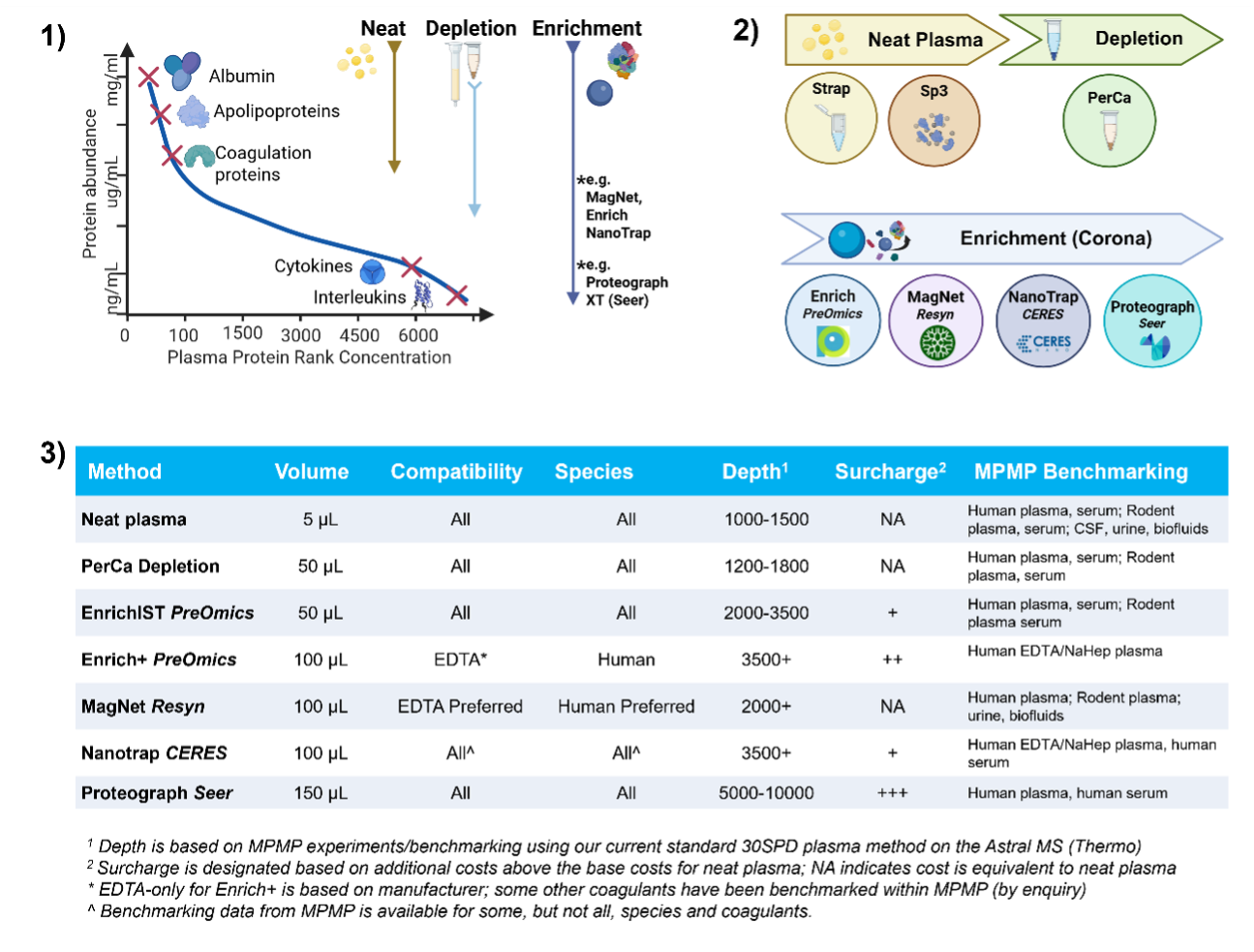 Figure 1.2. Plasma proteomics technology portfolio available through the Biomarker Discovery Node: 1) Plasma proteomics is challenged by an extreme protein dynamic range. Neat plasma, depletion and enrichment workflows each address this challenge to different depths. 2) The Node provides access to complementary workflow classes, including neat plasma preparation, depletion-based methods and enrichment/corona-based technologies. 3) Current technologies available are benchmarked across practical study considerations, including sample volume, anticoagulant compatibility, species, expected proteome depth, relative surcharge and MPMP benchmarking experience.
All technologies offered through the Node have been tested and verified using real human and preclinical samples (Figure 1.2). Where collaborators have specific proteins of interest, target detectability can also be cross-checked with our benchmarking datasets during project consultation to help guide technology selection and study design. MS-based discovery plasma projects are analysed on our top-tier, latest-generation mass spectrometry platforms, specifically the Orbitrap Astral and Astral Zoom, to support optimal workflow performance.
Seer Proteograph One is available through BMD and MPMP
Within this portfolio, we are proud to partner with Seer and Thermo Fisher Scientific to provide Australian clinical researchers with access to Seer Proteograph One technology. This automated, end-to-end plasma proteomics workflow includes sample preparation on the Seer SP200 instrument at Monash University’s Clayton campus, analysis on our Orbitrap Astral Zoom mass spectrometer, and data analysis using Seer’s Proteograph Analysis Suite software.
This provides Australian clinical researchers with rare national access to a high-throughput, deep plasma proteomics workflow designed to support biomarker discovery in preclinical and clinical research.