
BMD Charges and Collaborative Engagement
The Biomarker Discovery Node operates through a collaborative engagement model, supporting projects from early experimental planning through to data generation, analysis and reporting. BMD projects typically involve consultation around cohort design, workflow selection, and experimental design to ensure each study is matched to an appropriate discovery strategy.
Project charges are structured across four core workflow stages: sample preparation, mass spectrometry analysis, database searching, and data analysis/reporting (Figure 1).
- Sample preparation costs reflect the workflow-specific reagents, consumables and staff time required to prepare samples for LC-MS. Neat plasma preparation using S-Trap is the base workflow, while depletion and enrichment approaches involve additional technology-specific costs.
- Mass spectrometry analysis costs reflect the instrument platform, method length and number of injections required, including standard LC-MS consumables such as solvents, analytical columns and related platform requirements.
- Database searching converts raw MS data into peptide and protein-level identifications and quantitative outputs, including protein inference and generation of analysis-ready proteomics datasets. We have all major software platforms available, including license and subscription-based software.
- Data analysis and reporting includes quality-control evaluation, assessment of experimental performance, statistical analysis and preparation of a written project report. Reports include methodological details, QC metrics, experiment-level summaries and statistical outputs, with full results tables provided alongside.
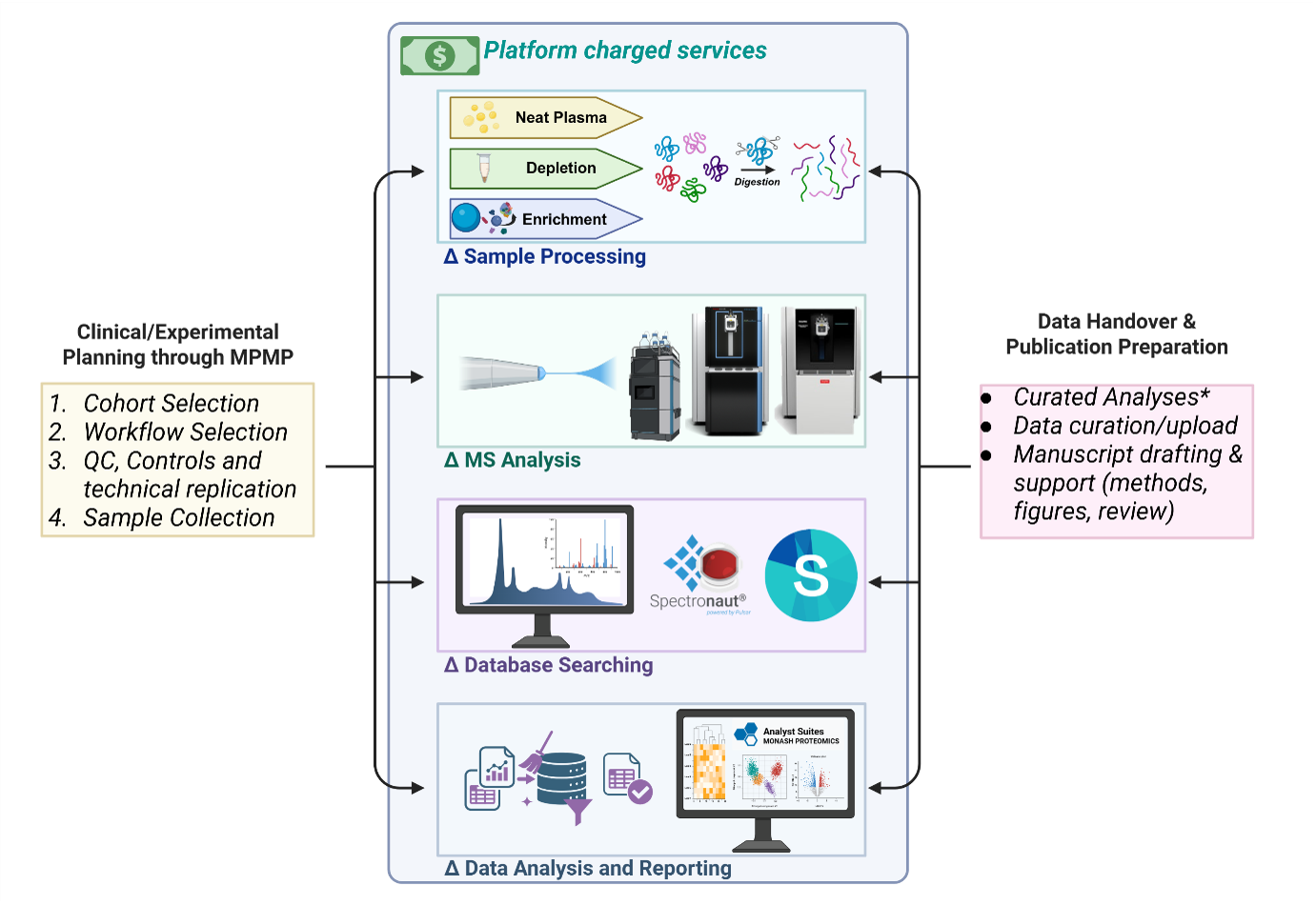
Figure 1. BMD project workflow and collaborative service model: Biomarker Discovery Node projects are supported from clinical or experimental planning through to sample processing, MS analysis, database searching, data analysis and reporting. Project charges are structured across the core platform workflow stages, with additional collaborative support available for curated analyses, data handover, publication preparation and manuscript-related outputs.
Clinical/Experimental Planning collaboratively with MPMP
Project pre-planning is one of the most important steps in a successful biomarker discovery study. Early discussions with MPMP staff are provided without charge and form part of the collaborative engagement model that underpins the Biomarker Discovery Node. This early planning helps ensure the selected technology, sample design and analysis strategy are aligned before samples enter the platform workflow.
During pre-planning, we work with collaborators to consider cohort selection, workflow selection, quality control, controls, technical replication and sample collection. These decisions can strongly influence the quality and interpretability of deep plasma proteomics data, particularly in clinical cohorts where biological variation, collection procedures and clinical metadata all shape the final dataset.
Our team can advise on cohort design, including case-control matching, longitudinal or paired sampling, clinical metadata and potential confounders, as well as sample collection SOPs such as anticoagulant choice, processing timelines and storage. We also implement structured QC designs incorporating appropriate controls and technical replicates to monitor technical variation and support robust downstream statistical analysis.
What support is available after data handover?
We work closely with the Monash Genomics and Bioinformatics Platform (MGBP) to support additional, curated and custom bioinformatic analyses for clinical proteomics. MPMP also curates and stores project information, methods and raw data generated through the platform. Additional support for data upload, manuscript methods, figures, review responses or publication preparation are included as part of the collaborative engagement.