
Olink and Orthologonal Biomarker Technologies
Complementary affinity-based proteomics technologies
In addition to mass spectrometry-based discovery workflows, the Biomarker Discovery Node can help collaborators access complementary affinity-based proteomics technologies. These platforms are particularly useful when projects require targeted measurement of predefined protein panels, including cytokines, immune mediators and other low-abundance signalling proteins.
The Biomarker Discovery Node provides access to Olink Target 96, Olink Target 48 Cytokine and Olink Flex through our Clinical Proteomics Node at Hudson. If you are interested in including these Olink platforms in your project, please include Dr Terry Lim at terry.lim@monash.edu in your enquiry.
Through our Biomarker Discovery Node MRFF partners at the Walter and Eliza Hall Institute of Medical Research, collaborators can also access the broader Olink technology portfolio, including Olink Reveal, which measures approximately 1,000 protein targets, and Olink Explore HT, which measures more than 5,000 protein targets. If you would like to include these Olink analyses as part of your project, please include olink@wehi.edu.au in your initial email enquiry.
Olink affinity proteomics at WEHI
Affinity proteomics techniques use highly-multiplexed targeted reagents for detection of a known set of proteins. The Olink platform in particular offers a valuable complement to discovery mass spectrometry. Olink reagents use pairs or oligonucleotide-labelled antibodies to produce a unique DNA barcode during a highly specific Proximity Extension Assay (PEA). The barcodes are then quantified by microfluidic qPCR or next-generation DNA sequencing, allowing for high sensitivity and reliable data generation. The makeup and scale of the protein target list varies across available panels, and therefore can be selected to suit project aims, scope and budget.
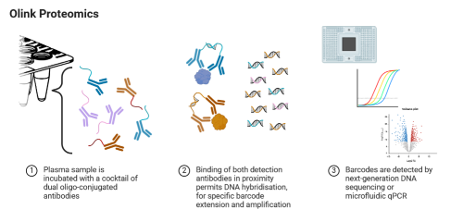 Cross-technology benchmarking studies from our labs and others commonly show a minor overlap between the proteins detectable on Olink and MS proteomics platforms, reflecting their different measurement principles, assay designs, dynamic ranges and detection biases.
Olink is particularly strong for predefined panels of low-abundance cytokines and immune-signalling proteins that can be challenging to detect by MS. In contrast, discovery MS provides a broader, more unbiased view of the plasma proteome, including tissue- and cell-associated proteins that may reveal novel molecular signals. Used together, these technologies can provide a more complete and strategically layered approach to biomarker discovery.
The Olink protocol makes use of miniaturised automation and only requires 5-20uL of sample, depending on the panel chosen. Panels are validated for human plasma and serum but can be applied to almost any patient biofluid. For more information on the Olink affinity proteomics platform at WEHI, click here or email olink@wehi.edu.au.
Multi-omic analyses available through MPMP and its Nodes
We also offer soluble HLA analysis and immunopeptidomic workflows via our clinical proteomics node at the Hudson and the Translational Antigen Discovery Lab (run by Associate Professor Pouya Faridi). For immunopeptidomic analyses, please contact Dr Gabriel Goncalves gabriel.goncalves@monash.edu
We can provide matched-sample untargeted metabolomics and lipidomics biofluid analysis through the Metabolomics team also housed at our Clayton Facility. For clinical small-molecule analyses, please contact Dr Chris Barlow chris.barlow@monash.edu