
When science meets storytelling
When science meets storytelling
Suzie Miller is an acclaimed playwright, novelist and screenwriter, but it was her science degree at Monash University that informed the "discipline and rigour" with which she writes.
It was the summer of 1982 when young Suzie Miller, then 18 (“I remember the year,” she says, “I was student number 8230063”), sat down inside the historic Rotunda at Monash University in Clayton, for her first tertiary education lecture.
It was Biology 101, and she remembers how the room seemed massive, swelling close to full. And yet her standout memory isn’t the crowd of classmates but the lecturer down the front, and the words he shared which remain with her now – four decades later.
“You all think you’re coming here for me to teach you,” he said, “but what you’ll learn is that university is not about us telling you what you need to know – it’s about you seeking information, and us telling you the process of how to find it.”
The campus library was filled with books, and in that literary landscape lay the answers they sought – to almost any question. His primary task was helping them read their own maps within this new world.
“He was right,” says Miller, now 62. “We’re not just going to be given information to regurgitate – we’re going to learn how to research. And that really stayed with me. Monash did that spectacularly well – teaching people how to think for themselves.”
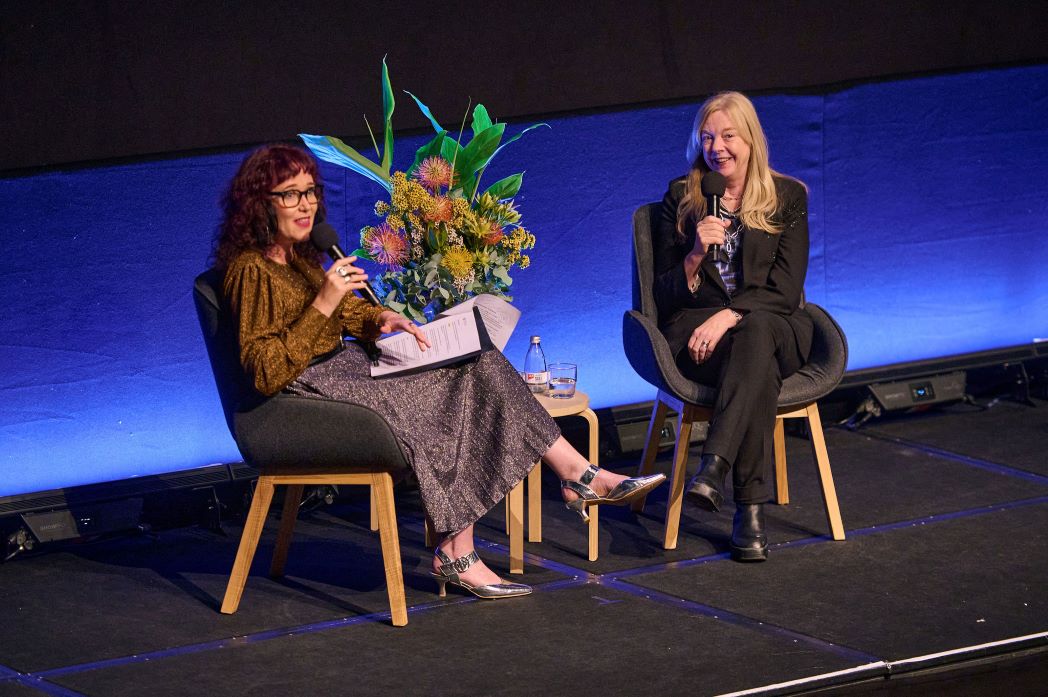
For the uninitiated, Miller is a playwright, novelist and screenwriter of global renown – a former lawyer whose plays Prima Facie and Inter Alia have graced the West End and beyond, starring the likes of Jodie Comer and Rosamund Pike, while interrogating big ideas for the enrichment and education of all. She speaks to Monash Life in the lobby of the Grand Hyatt in Melbourne, having come here from London via China and Sydney, for a booked out Monash alumni event at Federation Square.
Miller grew up in St Kilda and went to Windsor Convent – a systemic Catholic school run by nuns, servicing an underprivileged community. She ended up at Monash because she was good at science, and the university – founded in 1958, only a quarter of a century prior to her arrival – sounded contemporary. It was already known for its IVF program and exciting new research centres. Miller could also catch the bus there, straight down North Road.
She landed in Clayton to find a known hotbed of political activism, and was drawn easily into debates – at least when she wasn’t wandering across the expansive campus to the remote science faculty buildings, leaving the arts and law students back at the small café and the Menzies Building. She remembers a botany assignment where each student had to collect and press 20 weeds and 20 Australian botanicals, and how everyone simply plucked them from the greenery outside the classrooms and laboratories.
“It was stripped bare of the banksia and callistemon, and all these beautiful plants,” she says. “That was a bad assignment for the garden!”
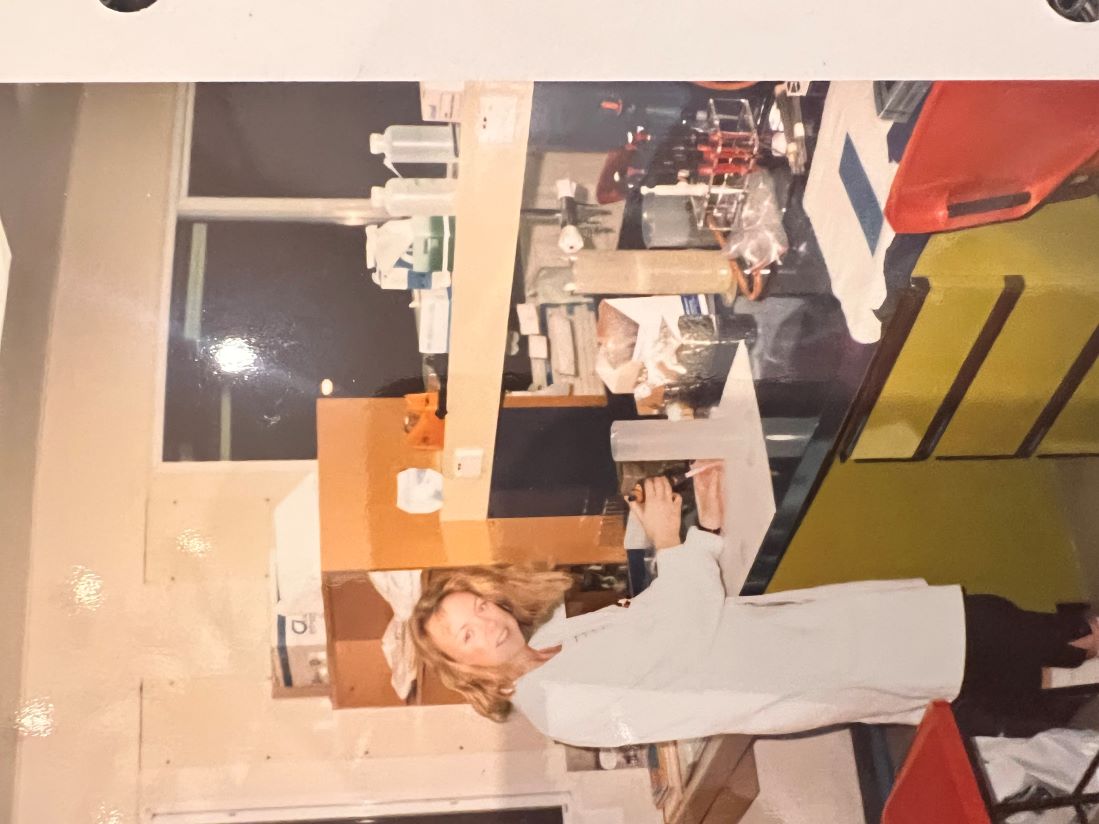
Parts of the experience were daunting. There were very few women in science at that stage, but she buzzed through her workload, including everything from psychology to biology, zoology to genetics, chemistry to mathematics, en route to an honours degree in immunology and microbiology.
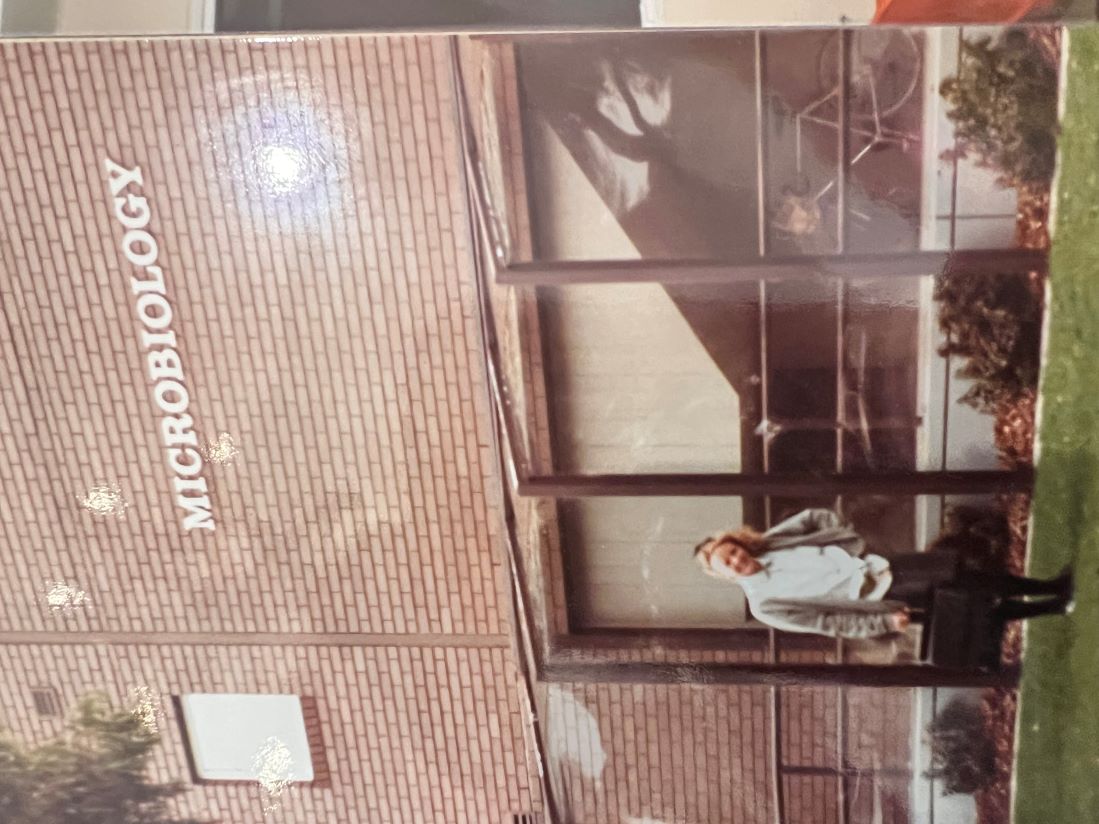
It was a qualification characterised by “incredible rigour” – multiple six-hour practicals a week, and research projects that kept her in a functioning laboratory often until the early hours of the morning. During the day, between lectures, it felt as though she were brushing up against genius level brains. “I look back now after having done so many other degrees and a PhD,” Miller says, “and my most rigorous year was honours in science at Monash University.”
But it was also, she says, a society in its own right, people awakening and connecting, rolling around on the grass between buildings. “People would meet each other and fall in love,” she says. “One of my closest friends is a fellow I did science with at Monash.”
Miller’s work was exceptional, too – even published in a reputable scientific journal – and yet it was during a microbiology lab in her fourth year that a pivotal fork in the road appeared. Monash had just offered her a PhD scholarship in microbiology, and she had said yes, when news broke of an international disaster: Chernobyl.
“We all looked up from our microscopes, because it was on the radio,” she says.
And everyone was talking about the plutonium and the chemical reaction, and I was just thinking about people’s rights, and how this could happen to them, and how they were feeling, and what does it mean for a dialogue about how government would look after them?”
“I wanted to have big conversations about the politics of this and I thought, ‘That’s not what this lab is about’.”
She applied for law school instead, and ended up studying in New South Wales then abroad, but her Monash experience stayed with her always. “I remember people talking about contract law – how an offer plus acceptance plus consideration equals a contract – and everyone was freaking out because it was like science or maths, but it wasn’t like science at all, it was a human-made concept that to a science person was very unscientific,” she says.
After you’ve done science, you can do anything. … It really informed how I write, because I absolutely have such discipline and rigour around what I’m trying to say.”
Miller ultimately worked in law for more than a decade, representing the human rights of young people on the hardscrabble streets of Kings Cross in Sydney. It’s there that her gift for storytelling emerged – in explaining the circumstances of the clients she was defending.
“I saw the way other lawyers did it and I thought ‘No, if you tell the judges a story that actually impacts them, they’re more empathetic’,” she says. “I wouldn’t just say ‘My client has had a difficult childhood…’. I’d say ‘Stevie was born in public housing, with parents who had addiction issues, he was found at three years old in a stolen car, where he had been sexually assaulted… this is the first time he’s before the state, where the state has an opportunity to pay back what he wasn’t offered by the state when it should have intervened.”
Miller represented thousands of such people. In her spare time she also went back to university to do a masters of theatre and film, and ultimately wrote a play based on her experiences with this underclass community – how they try to look after each other but are set up to fail. It went to the Opera House in Sydney, and had a huge cumulative impact.
I remember I thought, ‘There’s 500 people in the theatre every night, who go home and think about this and talk about it, and I’m only affecting one person a day when I go to court. Maybe storytelling is my way of making a change, without being a lawyer’.”
She did both for a while, before being offered a position on the judiciary in Australia, as well as a position as a playwright at the National Theatre in London. Law versus art. Well paid versus poorly paid. Home versus abroad. She chose the latter, taking her husband and children away with her, their unit enjoying a “brilliant bond” on this UK adventure. Two years ago her husband, Robert Beech-Jones, was appointed a justice on the High Court of Australia.
Miller has built strong relationships across an impressive network. One of her best friends is Sam Mostyn, the Governor-General of Australia. And she’s recently begun collaborating with all manner of talented figures in entertainment, from comedian and actor Lena Dunham to American TV writer David E. Kelley and Australian filmmaker Justin Kurzel.
“I feel so lucky,” she says of those partnerships. “You fall by the wayside if you don’t know how to hear someone’s opinion, to allow it to settle within you, and to interrogate it in a thoughtful way that pushes everyone forward. That’s what collaboration is. It’s about not having to be right, but having to engage in a dialogue.”
That’s what draws Miller to the stage most of all – that sense of something magical and immediate and tactile from the performers, while the audience assembles as human beings, existing in space together physically, instead of on screens.
“It’s about sitting shoulder to shoulder with people. And you breathe in the same emotional mist,” she says. “Theatre also is this idea of being transported to different worlds. They are confronting. That’s important to me. That’s what drives me. … for me it’s about humanity.”
For Miller, the most important part of being a playwright is the second syllable of the word, even spelling it out aloud.
“W-R-I-G-H-T,” she says. “It’s about ‘wroughting’ ideas. What you do is you find an idea you’re passionate about, that you don’t understand – that’s got a knot in it that doesn’t make sense, or that’s a hypocrisy – and then you dress that in story, and as the audience engages in the story, they discover the idea themselves. You’re not telling them, you’re inviting them.”
Not telling, but inviting. Sounds familiar. Sounds more than a little bit, in fact, like that professor from her first lecture in the Rotunda at Clayton. Miller won’t tell her audience what to think, but maybe to invite them to think – nudging them, showing them the way, helping them think for themselves.
“Exactly,” she says. “Here’s the map to the library, but it’s not just a map of books. It’s a map of ideas.”