
November
“I would not have gotten anywhere without my professors at Monash”

Once Bachelor of Commerce student Sarah Soboh realised she could combine economics with education, there was no stopping her. At last, she had found the social component to match her technical economic skills. Her passion for policy and the support of her Monash professors has taken her all the way to Harvard University.
“I’m grateful for the journey and I would not have gotten anywhere without the guidance and support of my professors at Monash,” she said.
Sarah started out in civil engineering, as it suited her quantitative skills and inclination toward problem solving. But she lacked a sense of purpose in this field, which led her to switch to a Bachelor of Commerce with a major in economics. She was always interested in policy but it wasn’t until she studied Labour Economics that she truly understood the role economics plays in policy.
The unit “ECC3146 - Community, market, and government” with A/Prof Vai-Lam Mui set her on her path. The course discusses the interaction between the three and how community affects the provision of social insurance and redistribution.
“I did not think my economics skills would be useful in education but in this course, I saw all the potential and opportunity. This is when I seriously started to consider using economics for social policy change. A/Prof Vai-Lam was so generous with me in sharing resources and introducing me to people who might be useful in this field,” she said.
He recommended Sarah apply to the Master of Education Policy and Analysis course at the Harvard Graduate School of Education, and wrote her a recommendation letter which led to her admission. She was also selected to receive the Frank Knox Memorial fellowship, one of the most prestigious fellowships at Harvard.
The one-year Master’s degree is flexible and allows her to explore topics like equity and opportunity, learning how people learn, education-to-workforce transition and many more across several Schools at Harvard. She has particularly enjoyed a unit on social entrepreneurship at Harvard Business School.
“It is truly inspiring to be surrounded by a remarkable community of individuals at Harvard. I am surrounded by the most intelligent people in the field. We have ministers of Education from different countries coming here to speak. Recently the ex-prime minister of New Zealand, Jacinda Ardern, was here to speak on leadership,” she said.
“At one seminar I sat between a US Ambassador and the ex-prime minister of Tunisia. My peers are unbelievably intelligent and accomplished. Some have a lot of experience reforming education systems around the world. It is invaluable being in this kind of environment. I try to bring the Australian perspective and I see it as an important part of leadership to learn from different perspectives.”
Sarah is passionate about social policy, with a particular focus on facilitating access for disadvantaged communities to positions of leadership and promoting social mobility. Once her year at Harvard is over, she hopes to return to Australia to instigate positive change within disadvantaged communities across the country. She is open to working in government, or perhaps revisiting social policy consulting, which she tried before studying overseas. And the idea of starting a social enterprise to solve problems and improve society is very much alive.
“Education economics sits on the intersection between social science and economics. It brings the human aspect to economics which I really like. If you work in education policy it’s important to be able to show the value of education programs with economic tools,” she said.
What would you recommend other Monash students do if they want to get into a top US university like you?
“I think a lot of my Australian peers underestimate their own abilities. And we lack guidance on what steps to take to be accepted into international universities. We often question our suitability for such competitive programs. The faculty at the Monash Business School Department of Economics is internationally renowned, and I would encourage others to chat to the professors, tap into their knowledge and learn about their international experience.”
“It is very important to build meaningful relationships as they can provide invaluable support and communicate your potential in letters of recommendation. Harvard and other top institutions seek to attract holistic cohorts. The Australian voice is often underrepresented, so that’s a reason for other Monash students to apply.”
From Honours at MBUS to a pre-doc at Stanford
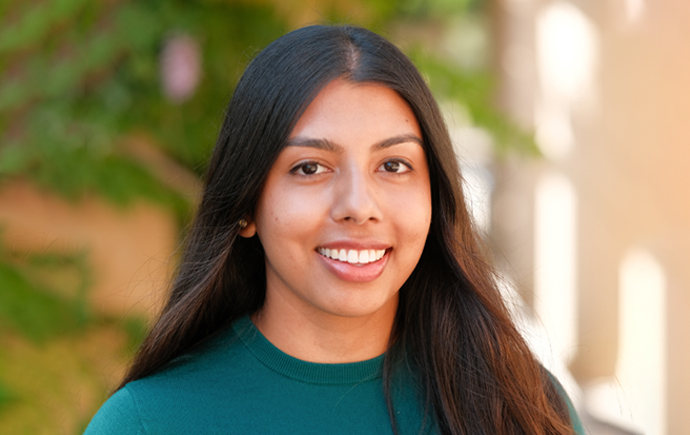
Simone Pandit completed an Honours degree at Monash Business School and worked as a research and teaching assistant before being accepted into the predoctoral research fellow program at Stanford University in California.
It is a two-year program where students interested in pursuing a research career work as research assistants to professors, take classes and attend seminars. Ms Pandit started in early July and she dreams of one day being accepted into a PhD program at a top US university.
“So far, I am really enjoying it here. It’s great to be part of the community of pre-docs and to be in the company of great researchers. I enjoy learning from everybody, from supervisors to peers, and absorbing everything in this environment,” Ms Pandit said.
Ms Pandit’s Honours thesis was in health economics, and focused on the degree of public support for the ethical principle of saving more lives, which was the guiding principle behind many of the public health strategies used during the COVID-19 pandemic. She was supervised by Associate Professor Liang Choon Wang and Senior Lecturer Birendra Rai.
At Stanford she has two supervisors, Associate Professor of Health Policy David Chan and Professor Matthew Gentzkow.
“My Honours year happened during the pandemic which I think influenced my choice of thesis. It has evolved from there,” Ms Pandit said.
“Given my interest in health economics my two supervisors at Stanford are a good fit.”
She also found working as a research and teaching assistant at Monash Business School very helpful.
“Everyone at Monash has been so supportive, (especially) my thesis supervisors Dr Claudio Labanca, who I worked for, and A/Prof Vai-Lam Mui, who wrote an application letter for me. I really enjoyed my time at Monash.”
What were your most valuable learnings?
“All the technical and analytical skills I acquired during my thesis and working as a research assistant. Also data management skills, learning more econometric skills, and how to conduct analysis and fully understand the research process. Teaching also helped me solidify my own knowledge,” she said.
What advice would you give to other students interested in becoming a pre-doctoral research fellow in the US?
“To plan ahead and put in the work to give you an advantage. Study maths if you can, as it generally signals that you want to continue with a PhD down the line, and improve your technical skills as much as you can before you apply,” she says.
What are your future plans?
With pre-doctoral programs becoming more common at the top US universities, many pre-doctoral students go on to apply to a PhD program during their second year - a pathway Ms Pandit is also planning to follow.
“If I can continue on at Stanford that would be great, but I hope to end up at a good program somewhere in the US,” she said.
“I would really like to do something in health or public economics. It’s very competitive so I don’t know if it will happen. We’ll just have to wait and see.”