
Beyond Four Walls
What do you call a school with no walls and no teachers, where the quality of your ideas and your ability to ask interesting questions is more important than your exam results? Welcome to Future School, an exhibition-cum-learning-experience created by Korean architect Hae-Won Shin.
Conceived for her curation of the Korean Pavilion at the 17th Venice Architecture Biennale – the world’s most high-profile and largest architecture exhibition – Future School rips up the rulebook, viewing school as a place where people can gather to share ideas, to discuss openly. It positions architecture as a discipline that doesn’t just build but also connects people from all walks of life, as a nexus for experimentation and the generation of new ideas.
Shin’s experience studying at London’s Architectural Association School of Architecture – known for its experimental and independent spirit – fundamentally affected her worldview, particularly her understanding of education. Her experience of school in Korea – both as a child and young adult, and more recently as a parent – was not positive. Shin saw a system where children were pushed through a restrictive and prescriptive process, placing students under extreme pressure to meet specific standards, and in which failure or difference was not seen as acceptable. “Children don’t have a life – they are forced to be in school. I used to come home at two in the morning every day… their whole education is geared to getting into university, which would lead to a successful job, then a career and so on,” says Shin. “But the way we educate is not going to prepare them for the realities of our time.”
Sexism is still a major issue in Korea, where only 30 per cent of roles in academia go to women. Add to this the fact that, globally, women make up just one in five of all top positions at major architecture firms, and it’s easy to feel that the odds are stacked against female architects, especially those who want to challenge the status quo and ask critical questions about how architecture is approached as a subject.
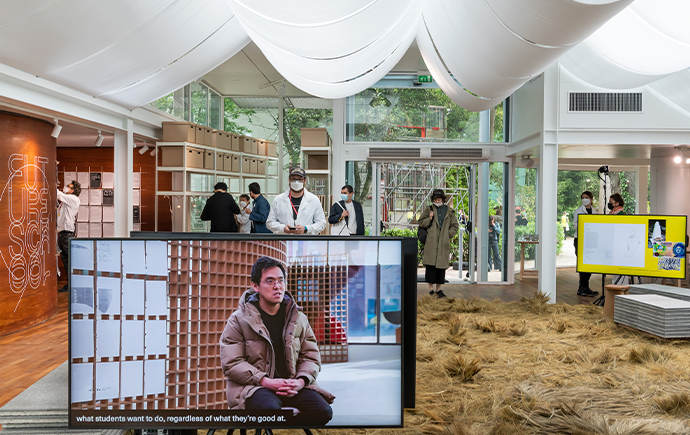
Image: Future School, the Korean Pavilion, 17th International Architecture Exhibition, La Biennale di Venezia, 2021.
Photography: Ugo Carmeni
But Shin’s international experience had opened her eyes to other possibilities. After working in architecture schools for a few years, she decided to try something “crazy”.
Shin self-funded a new, experimental school – a ‘social design school’ open to students who wanted to learn to design spaces without needing the exam grades and entrance requirements of a traditional architecture school. Instead of focusing on a final result, the school’s approach revolved around sharing processes and progress. It was light and playful; “we didn’t want it to become prestigious or institutionalised”. Although the funding quickly ran out, the experience planted the seeds for Future School.
“The idea of unlearning and relearning became key for me,” explains Shin. “I wanted to create a space where it was possible to foster diverse ideas of education and of education in practice, in the face of current and future global challenges like the climate crisis and migration.”
Then, Shin was appointed to curate the Korean Pavilion for the 17th Venice Architecture Biennale in 2020, which was delayed due to COVID-19 and took place in 2021. Her germ of an idea rapidly evolved into something radical: a school unlike any other – a temporary, shifting meeting space both ‘real’ and virtual, in which everyone is learning and teaching at the same time, drawing together a sprawling network of knowledge around the biggest issues confronting the next generation.
Instead of viewing architects solely as the creators of built structures and environments – a role that is increasingly under question as materials become scarce and other professions take over more and more of the building industry – Shin sees architects as people who are able to view the bigger picture and join the dots between theory, research and the reality of everyday life in our cities. This is reflected in the programme – or ‘curriculum’ – she created for Future School. It began with a summer school, which took place before the Biennale was due to open. Exploring the infamous Korean Demilitarised Zone that divides North and South Korea, participants also created a Code of Conduct for the emerging school.
Then COVID-19 hit. By this point, Shin had assembled a curriculum for the Venice Biennale, with more than 50 programs bringing together more than 300 people from all over the planet around the key themes of climate crisis, mass migration and the growth of the diaspora, and the accelerated speed of technological change. They were due to deliver workshops, installations, performances and talks covering issues as diverse as urban heat islands (where temperatures in cities rocket up to astronomical levels due to lack of natural absorbers like plants), the status of Chinese migrants in Seoul, harvesting seaweed, the architecture of city parks, and the potential of architecture to improve the experiences of people living in refugee camps. Shin also commissioned new work from leading Korean choreographer Ahn Eun-me, which would be the school’s ‘official’ dance, as well as works by other Korean artists to furnish the Pavilion.
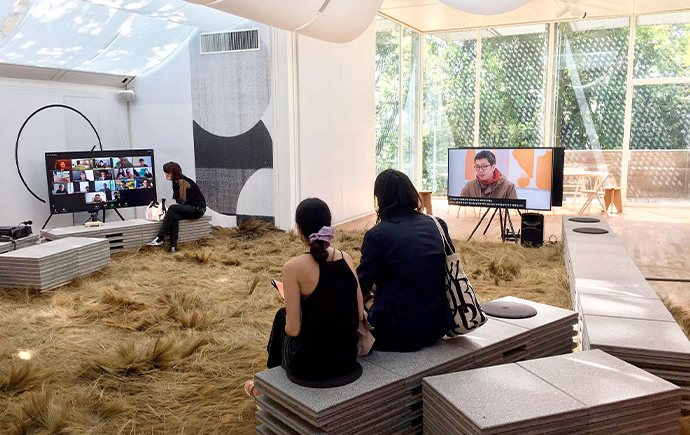
Image: Future School, the Korean Pavilion, 17th International Architecture Exhibition, La Biennale di Venezia, 2021.
Image courtesy Hae-Won Shin.
The plan was to create two collaborative ‘campuses’. One would be in the Korean Pavilion in Venice, where a spatial concept developed with architects Christian Schweitzer and Ryul Song would incorporate domestic spaces and places of rest, welcoming all of the Biennale’s visitors. The other would be in Seoul. The two would be connected by an online architecture, a website that would function as a collaborative space known as Future School Online. But the delays and travel restrictions imposed by COVID-19 gave Future School Online new importance. Shin worked with E Roon Kang and Andrew LeClair, founders of design studio 908A, to create an educational virtual space that enabled collaboration at a deeper level; it would then automatically create PDF publications capturing the activity of the school. The end result was a digital platform that rivalled its major technology company counterparts.
Alongside all of this, Shin developed a hybrid schedule of talks, connecting different participants in Future School via Zoom. She also initiated the Curators Collective, a unique network comprising the curators of the other national pavilions at the Biennale – something that had never been done before.
Everything came together at the 17th Venice Architecture Biennale, which eventually opened in May 2021 and ran until November that same year. But with Future School, there’s a sense of unfinished business, of ideas just begun. Only time will tell, but Shin’s enthusiasm for change and her critical approach to education means it is unlikely that she will be able to let it lie.
Hae-Won Shin is now teaching in Melbourne at Monash University, and already there are discussions for more Future School summer schools. Meanwhile, the Curators Collective is preparing for the next edition of the Venice Architecture Biennale, in 2023. But one thing that Shin is clear on, is that change is only possible through collaboration: “Whatever we do, creating a framework based on care, inclusivity and openness will be so important in creating space for things to generate, and for dialogue and conversation to happen.”
Hae-Won Shin is an architect, educator and curator. She is currently Senior Lecturer at Monash Art, Design and Architecture.
Anna Winston is an architecture and design writer, editor and curator, based in Antwerp, Belgium