
Finding your Groove
Finding your Groove
Interview by Grace Slonim

Image: Callum and Grace beneath Silverscreen 2010,. Photography: Amelia Stanwix.
I couldn’t believe my luck when Callum Morton agreed to supervise my PhD. With an international artistic career spanning over 30 years, his artwork a part of over 15 collections around the world, and having exhibited as the Australian representative at the 52nd Venice Biennale, Callum is a renowned contemporary artist and a pioneer of the anti-monumental form. I was thrilled and eager to commence a multi-year supervision journey with someone of his artistic and professional calibre.
As a first-year fine art student over a decade ago, I had walked past Callum’s 2010 galvanised steel installation, Silverscreen, every day of my studies at Monash University, and I’d driven past his remarkable 2008 installation, Hotel, countless times on the EastLink. Each time I’d marvelled at these works, I wondered how Callum’s distinguished career had all begun. The fog of uncertainty about how one makes a career as an artist in Australia was a mystery to me – a mystery that now propels my doctoral studies.
It wasn’t until very recently that I had the chance to learn about how Callum’s career has evolved. While he describes himself as ‘Mr Doom’, I walked away with a sense of his courage and determination to pursue a career as an artist.
What was the first artistic job you had after university?
Being an artist is a job, just not very well paid most of the time. Every job I have ever had outside my practice was to help give me more time to sustain my practice, which has always been my main preoccupation. So, after art school, I got a studio apartment in a building in a laneway behind Chapel Street in Prahran with other more established artists that included Kerrie Poliness, Melinda Harper and Gary Wilson, and started to make and exhibit work in a gallery they established called Store 5. Being in the studio, whatever kind, was the job.
Have there been times in your career when you’ve had to support your creative practice with other and non-arts related work?
Most artists I know have had other jobs in the world to support their practice. The trick is to find a job that you enjoy, that allows you the most flexibility and pays you a decent wage.
After art school I worked in the book trade for many years before teaching casually at university, which paid better for less hours (though this type of employment was and remains very precarious), so I taught and worked some nights in the bookshop.
In the book trade I would work three to four days a week and then would devote evenings and weekends to my art practice. I was lucky to be around a group of artists that showed at Store 5 who were all very enterprising, and most at a more mature stage of their careers than me. This included artists like Kathy Temin, Constanze Zikos, Tony Clark, John Nixon, Marco Fusinato, Stephen Bram, Angela Brennan, Elizabeth Newman, Gail Hastings and many others.

Image: Kosloff Architecture and Monash Art Projects (MAP), external building skin and entry into Monash Building 17. Monash Public Art Commission 2018. Location: 18 Innovation Walk, Monash University, Clayton Campus. Photography: Andrew Curtis
This experience changed the way I thought about art production and exhibition – it taught me to trust the nagging rogue idea, to try out new things, that I could work quickly and that exhibiting was an important part of ongoing practice. It taught me the value of experimenting. I’m not sure I believe all of it anymore because it didn’t teach me to slow down, but it was an important disruption.
Working around books was very stimulating and reading has always fuelled my practice. It generates lots of ideas for work. Similarly, teaching is equally as stimulating – discussing work with students invariably charges your own thinking and I love seeing students evolve their work.
When I took on the role of Head of Fine Art [at Monash] and embedded myself more deeply in the academy, it did change my practice. I kept working, doing shows and other projects of course, but became particularly interested in large-scale public art projects and the potential of this at-times problematic space.
I started a research lab in Fine Art called MAP (Monash Art Projects), with an ambition to work with the excellent community of artists, thinkers and curators at Monash to apply a critical lens to this field of practice. This has included working with artists like Emily Floyd, Daniel von Sturmer, Brian Martin, Manon van Kouswijk, Brook Andrew and Kathy Temin, among others, all of whom have or are in the process of realising major permanent public projects through MAP, including myself.
It has also included working closely with MUMA (Monash Museum of Art), who have curated a very important suite of public art projects across the Clayton and Caulfield campuses and have been working in this space for over 60 years.
What challenges have you faced in pursuing your artistic career?
Making work is a constant challenge. I feel like I’m often starting again with every work I make. It often feels fugitive and difficult to grasp and can be lost as quickly as it is found. Then sometimes it feels like the easiest thing in the world.
After I did the Venice Biennale I had a number of opportunities in Europe fall over because of the global financial crisis (GFC) and that was disappointing. Failing is a necessary misery, I guess, and I’ve had my fair share of failures to overcome.
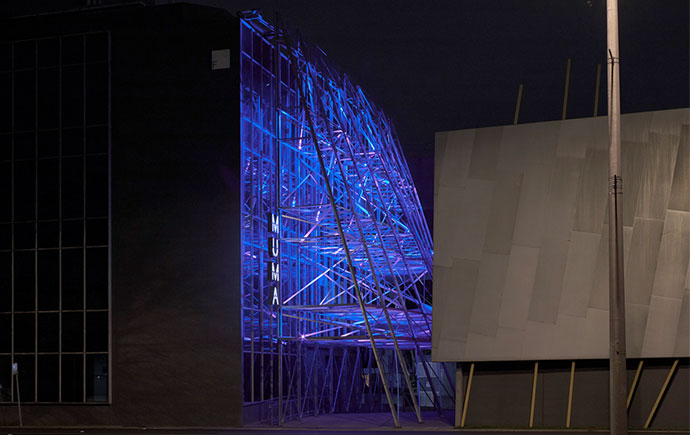
Image: Callum Morton, Silverscreen, 2010, galvanised steel, LED lights. The Marc and Eva Besen Commission, 2010. Location: Monash University Museum of Art, 16 Buildings F & G, Caulfield Campus. Photography: John Brash.
Tell us something you didn’t know about the industry before you worked in it.
I didn’t know how simple it was to start your own platform and make your own publics. I thought that you needed to wait for the knock on the door from someone with the power to offer it to you. I didn’t know how hung up Australian artists are on connecting with international communities and also how fixed international communities are in their view of Australian art. I didn’t know that you could get punished for declaring your politics. I didn’t know how hard it was to get by as an artist in this country (and it’s getting worse). I didn’t know that the secondary market could be so easily manipulated. I didn’t know that series four paints were so bloody expensive.
You’ve been making art and exhibiting since the ‘90s. How has the Australian art landscape changed over this time?
I think art is always in flux but of course the biggest change is the effect that online platforms have had. No one in the art world could see it back then and without question it has had an enormous effect on the subject and form of work being produced, where and how it is produced and the way it circulates.
This revolution has changed everything, both good and bad. Previously marginalised voices are being heard loudly now and the access and inclusion enabled by social media is changing the audience and the institutions.
But while we are seeing a lot of great work, beautiful work, confronting work, work that makes us rethink what we do and how we should live now, there are piles of junk too. Our filters are being reshaped but we need a critical lens to sift through this. I still want to see work that operates on multiple levels, that negotiates complexity.
What’s been a career highlight for you?
Still waiting for it. It’s coming. The Venice Biennale was great.
What excites you the most about the work you do?
I’m not one to walk around all excited, I’m more the doubting Dr Doom type. However, I do like the possibility of whatever work I’m chasing at the moment, even if it’s difficult. I like letting all the connections form around work and allowing them to fester and I really like finding a crystalline idea for a work in the midst of all this. It’s rare.
What’s the best piece of professional wisdom you’ve ever been given?
Howard Arkley told me once you need to sort out the money first, otherwise you’ll never get anything done for all the worry. That’s as true today as it was then in the 1990s. Trust the ideas that keep recurring in your mind over and over, no matter how dumb you think they are. They will form you. Keep your brushes clean. Read the contract closely. Build it slowly, there’s time.
What advice do you have for emerging graduates that you wish you’d known at that stage in your career?
I would suggest that it is important to go to the place your imagination wants to take you and don’t be persuaded otherwise. Simply go there, don’t be timid.
Grace Slonim is a unit coordinator and PhD candidate at Monash Art, Design and Architecture, researching the landscape of Australian arts funding.
Professor Callum Morton is a contemporary artist, Practice Professor in Fine Art at Monash Art, Design and Architecture, Director of Monash Art Projects (MAP) and Chair of Gertrude Contemporary.