
Genevieve Townsend: Beyond the Horizon
BM: Hi Gen. Thank you for speaking with me today. Can you start off by telling me what you studied at Monash and when you graduated?
GT: Hi, thanks for inviting me. I studied a double degree – Bachelor of Arts majoring in sociology and Bachelor of Visual Arts. I started in 2014 and studied part-time for much of my course, so I finished in November 2019.
BM: Did you have access to, and were you interested in, the visual arts during high school?
GT: I enjoyed being creative as a kid and this interest continued through my schooling. I was fortunate to study Studio Arts, Drama and Visual Communications as year 12 subjects. I also found that other subjects, such as Politics, often influenced the subject matter or themes of my artworks. Having said this, I know a Monash graduate who entered the Bachelor of Fine Art and completed their honours without having studied art in high school. I think it’s important to acknowledge that barriers can prevent people from studying art in school, but the opportunity to study fine art at university can remain open if you are willing to build a folio.
BM: What do you remember about your transition from school to university?
GT: I was primarily based at the Caulfield campus and joined a few clubs, which helped me make new friends and feel part of a community. It was a bit surreal to be surrounded by other creatives and finally feel like being artistic wasn’t ‘weird’! I appreciated the progressive and inclusive student culture in the degree, alongside the opportunity to meet students studying other subjects at Monash, and with other interests.
BM: You completed some of your degree overseas. Did this impact your thinking as a young person, and did it influence your career trajectory?
GT: I did a two-month intensive of fine art and art history at the Monash University Prato Centre in Italy during my second year. I was also fortunate to receive a New Colombo Plan Scholarship to study abroad in Fiji and complete internships in Cambodia over a ten-month period. Being able to travel outside Australia was really important to my understanding of what the ‘art world’ is and can be. I learnt about other ways of doing things and had a mirror held up to my own biases through virtue of being distant from my familiar context. I’ve appreciated how the fine art degree at Monash is shifting with both teaching and student interests to focus more on the Asia-Pacific region. While acknowledging the significant role of art histories from the West, there is a necessary movement towards decolonising or Indigenising art histories and pedagogies for teaching in the arts. Studying abroad and being guided by some incredible teachers and artists at Monash, such as Megan Cope, has influenced my worldview and I think will continue to shape my trajectory.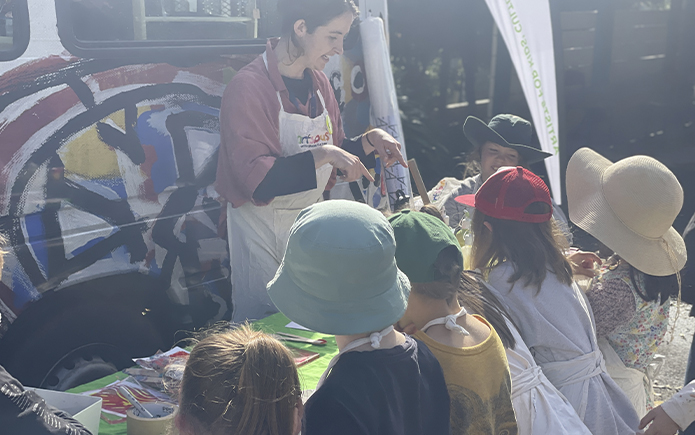
BM: You mentioned earlier that you studied part-time for a lot of your course – were you also working during this period?
GT: I was employed in hospitality during high school and continued to work across entry-level customer service and administration roles while studying. I gained experience in these jobs alongside volunteer positions, which helped me access more career-aligned positions later on. In my last two years of study, I worked as an education facilitator, which became a stepping-stone to my current position as a program manager in the arts. I've always appreciated the concept that “you can't connect the dots looking forward; you can only connect them looking backwards”. In other words, it's only in hindsight that we can see the impact of various jobs and therefore my goal was always to follow curiosity and stay open to a mix of creative and non-arts work opportunities while studying.
BM: Before we get on to your current work, can you tell me a little bit more about the volunteer roles you pursued while studying at Monash? Why do you think volunteering is important?
GT: I got involved with the Amnesty International Monash club and youth-led organisations including Oaktree and the Australian Youth Climate Coalition. I met Mehdi Jaghuri, another Monash student, through my involvement with Amnesty and in 2015 we co-founded Connection Arts Space (CAS) alongside Andrew Duong – another Monash graduate and my now-fiancé! CAS is an artist-led and volunteer-run community arts space in Dandenong, which gave me the chance to gain career-ready skills and put theory into practice. It can be a privilege to have the financial capacity to volunteer in committed roles alongside your studies. Though, no matter how much time you can commit to volunteering, I highly recommend getting involved in the arts, for-purpose and advocacy organisations to broaden your experience, contribute to important grassroots movements and work in the community.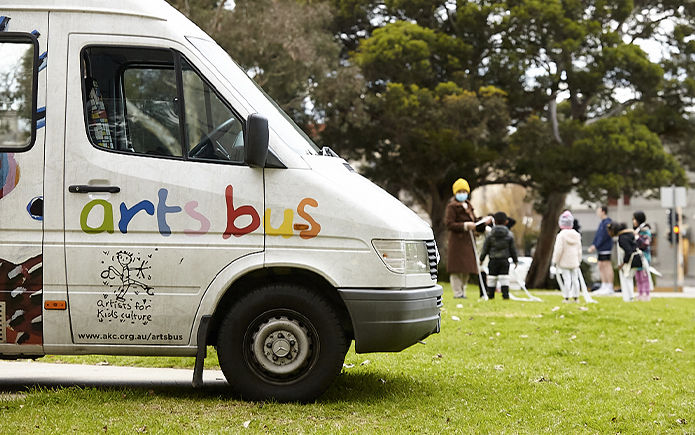
BM: It’s interesting, and it makes sense, that CAS was born out of your work with Amnesty – in general, your career path seems to be evolving around the intersection of arts and social justice. Can you talk a little bit more about CAS, as I understand it is still going strong today?
GT: Yes, Connection Arts Space is still active and has evolved through the pandemic to offer satellite programs and online opportunities that profile artists and bring attention to the creative community in the south eastern suburbs of Melbourne. I was involved in setting up the organisation’s first governing board, which is supporting CAS to work towards ongoing multi-year funding. The managing committee, under the leadership of Larra Juab, have done an incredible job in responding to artists’ needs while balancing the challenges that come with being volunteer-led. I still volunteer casually with CAS alongside my current work because I love meeting all the passionate and interesting people that the organisation attracts! Ultimately, CAS and groups like it are providing a meeting place for people who are interested in prioritising a conversation about equity and representation in the arts.
BM: Tell me about your current work with the artsbus and Artists for Kids Culture (AKC)?
GT: I have the absolute privilege of driving the AKC artsbus, a mobile arts studio, across Victoria to run free and inclusive arts programs with kids and young people. Artists for Kids Culture is the for-purpose organisation behind the artsbus, whose mission is to inspire children to use the arts to challenge themselves, build belief in their own creativity and improve their wellbeing. The AKC grants program – funded through their annual art auction since 1994 – offers financial support for children around Australia aged 5 to 17 years old to participate in artistic and cultural activities. My role with AKC has been to establish and manage the artsbus programs across social housing estates, community centres, schools and public spaces. I work alongside AKC’s ambitious and dedicated director, Kylie Greer, and an incredible team of volunteers and contracted local artists, musicians and producers.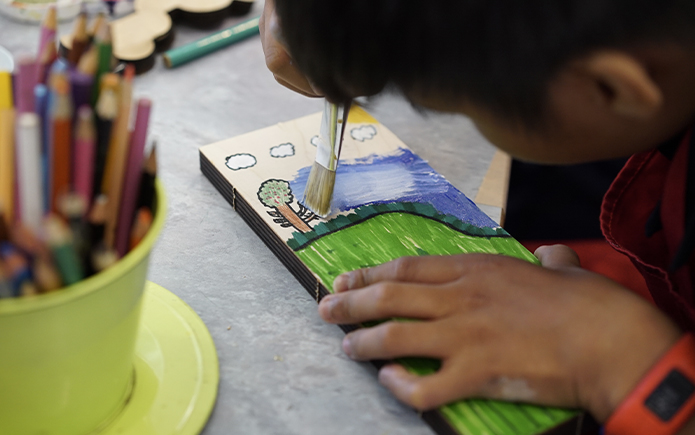
BM: What are some of the biggest challenges you’ve come up against in your work?
GT: AKC launched the artsbus with seed support from local government grants and philanthropic bodies, particularly The Collie Foundation. We continue to apply for grants to scale our projects and be able to pay workshop feature artists at fair industry rates. The nature of arts funding means we can be waiting to hear from several grant bodies at once, which creates some uncertainty for planning. There are also challenges that come with the artsbus being a relatively new and ambitious program. We are often doing projects that are new in their approach or location, and therefore learning as we go about the realistic budget and timeframe for our desired impact. With that said, I think the strength of grassroots arts organisations, including AKC, is the ability to respond and adapt to precarious funding contexts and available resources. Ultimately, our purpose is to support kids to challenge themselves through the arts because this builds resilience and supports greater understanding and connection within our community. As a team, we try to embody these same values and approach challenges by centering creative problem solving, care and collaboration.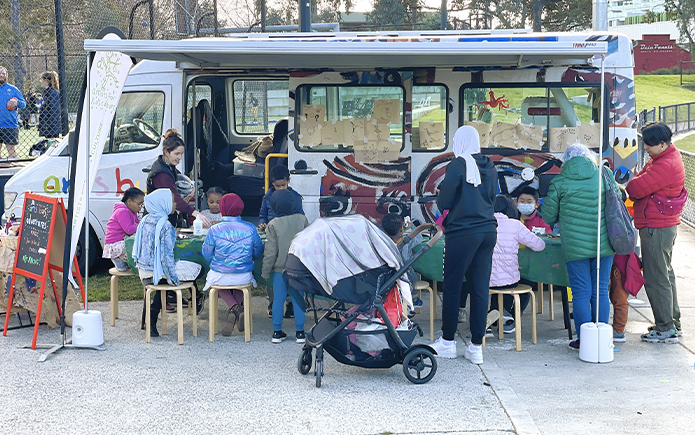
BM: So how can people get involved in Artists for Kids Culture?
GT: The artsbus programs are made possible with casual volunteers who support in the set-up and provide encouragement to kids during programs. Behind the scenes, AKC is led by skilled volunteers who support with marketing, events and fundraising, and oversee the artsbus and grants programs. Prospective volunteers can express interest online and interested supporters can learn more by signing up to the AKC newsletter or attending the AKC Art Auction.
The AKC artsbus is a resource to make art accessible for kids and young people who might otherwise miss out. Artists, arts workers and community members can contact AKC to discuss ideas for collaborating on arts projects and workshops, or to talk about bringing the artsbus to a community event. For more info, head to akc.org.au.
BM: What would your advice be for someone considering studying fine art?
You should consider studying fine art if you are curious to learn about the world through creative expressions and have a desire to bring rigour to your own arts practice. In my experience, a fine art course does not spoon feed you a set of knowledge; rather, it invites you to develop your practice through experimentation, peer feedback and reflection.
Once you have started studying, my main advice is to remain open to seeing the arts from diverse perspectives. There are opportunities to become involved across commercial galleries, public institutions, artist-led projects and community events. Learn about your own position and values through listening to other voices, particularly those that have been underrepresented and may be calling for change in the art world. Wherever your interests land, you will want to find a community of people who understand your approach and inspire you. For me, this is a group of friends who I now share an art studio with, in Noble Park (Garage 35 Art Studio).
Studying fine art enables you to practise being disciplined in a way that prepares you for the reality of making art outside of university. For many of my artist friends, our practice lives alongside a mixture of arts and non-arts related jobs. Australia’s social and political context often deprioritises creative expressions, especially those that exist outside of commercial contexts. Hence, it becomes important to learn how to advocate for your own approach to art making and support artists around you. At the end of a fine art course, stay connected to the creative community by attending exhibitions, seeking mentorship and ultimately connecting to the curiosity that led you to study fine art in the first place.