
Roberta Joy Rich: Beyond the Horizon

Image: Portrait of Roberta Joy Rich. Photography courtesy the artist.
BM: Hi Roberta! Thanks for joining us. Can you start by telling us a little bit about yourself and your practice?
RR: Sure. I’m a multi-disciplinary artist working predominantly with video, installation, print media and various other mediums that may be determined by the research of a project or its conceptual concerns. I strongly identify with my Southern African identity and being part of a diaspora community within this ‘nation state’. There are many similarities between the nation states of Australia and South Africa. A lot of my arts practice engages with concepts and politics of place, and how this relates to representation, power, authenticity, histories both visible and invisible and their relationships to one’s phenomenology.
BM: Let’s rewind to your final year of high school. Was studying fine art at university always on the cards for you?
RR: Yes. And to be honest, I was extremely naïve. My parents were not afforded the opportunity to go to university due to the classist and racist segregation policies of the Apartheid regime, so they were thrilled that I wanted to go to university (but this was also somewhat non-negotiable, ha!). I had only applied for two courses and nothing else. In hindsight, it was not a very smart move, but my passion was to be creative. I don’t come from a ‘fine art’ family or privilege like that, but ‘art’ was what I was most passionate about. I am very thankful my parents supported this, especially because of the context and being a daughter of migrant parents.
BM: What do you recall most about your time as an undergraduate at art school?
RR: I grew up on Wathaurong Country, so the transition to Wurundjeri and Boonwurrung Country was pretty epic. Experiencing a new place, expanding my mind and undergoing a journey of understanding what art is and its function, while being very distracted navigating all of this. I remember kind of failing academically, but now I have a better understanding as to why that was and how much this was tied to a Eurocentric pedagogy. I couldn’t authentically connect with my practice at that time. It wasn’t until late in my degree that this changed when I met lecturers Dr Fiona MacDonald and the late Damiano Bertoli.
BM: In what ways did lecturers like Fiona and Damiano influence your development as an artist? Do you recall any specific examples?
At a crucial time for my development, Fiona directed me to relevant academics, artists and practices that aligned with my values, research and conceptual concerns. As simple as that sounds, it was critical for both my studio and theory practice.
I had only spent limited time with Damiano for a Conceptual Practice class over one semester, but I remember it distinctly not only because it was fun, it also challenged me in a unique way that I found refreshing. The class explored the choices artists make in their work and what informs this, as well as exploring the various capacities of humour in art making – perhaps he was loosening up the institution from the seriousness of it all, or maybe just bringing his humorous nature to the space.
BM: You mentioned Eurocentrism and its impact on academic achievement – universities have historically been sites where knowledge production is framed by coloniality and Western schools of thought. I’m interested to hear more about how your art practice – one that is deeply embedded in the politics of place and deals specifically with constructions of race and gender identity – was negotiated within the university setting?
RR: It was hard and I imagine it will continue to be, but I am hopeful for young art students of colour because things are developing and changing. I remember at the beginning of my honours year, the look of surprise Fiona gave me when she recommended a particular artist to me – like, “How do you not know about this artist and their work”. It was such an obvious connection but no one else had made that conclusion, nor myself, because of the lack of cultural capacity of the institution. I think this also relates to a cultural capacity within the geography and state of a settler nation like Australia.
The current focus of platforming First Nations artists and artists of colour (which is extremely important) wasn’t something that was widely happening when I was in art school – but there have been Bla(c)k artists and people for generations doing the hard work so that I can be the artist I am today. There is still a lot of work to do within art institutions and organisations, which is obviously tied to the coloniality of this nation-state, beyond the university ivory tower conversation and the optics of power. In saying all this, it has been encouraging to hear and see developments that show the necessary work is slowly taking place.
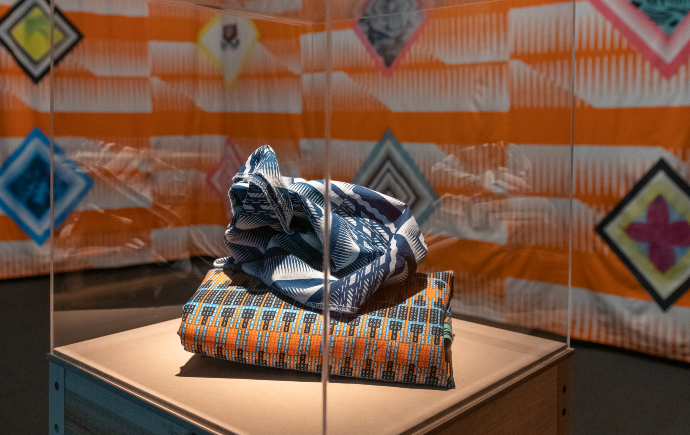
Image: Roberta Joy Rich and Spacecraft Studios with Zhenya Alvaranga, Claris Ncube, Nita Okoko, Robyn Rich, Tab Sejoe, Phillipa Smith, Vikki Steeneveld and Naomi Velaphi, Auntie’s Curtain, 2022, screen printed textile, 4.5 x 9m, installation view (detail), ‘And she was wearing trousers: a call to our heroines’, curated by 118 Roberta Joy Rich and Naomi Velaphi, Artshouse, 2022. Photography: Jody Haines.
BM: Your journey at Monash involved three consecutive degrees – what drew you to undertake honours, and then go on to the master’s program?
RR: As I mentioned before, I was kind of failing – not entirely, but my marks varied. There was a lot of effort and thinking on my part, but I had not quite landed in a place for this to reflect in my marks. Towards the end of third year, I really started to find that place and wanted to push myself academically, and my practice further. I was also low key freaking out about my future – I’d just finished three years of art school and didn’t have a job to show for it, as my parents were expecting. Over the summer, I read bell hooks’ Ain’t I a Woman? (1981) and there it was – I began to find my place. In my honours year, I focused and honed in critically and creatively, so much so that I was awarded an Australian Postgraduate Award scholarship to do my Master of Fine Art (MFA). Reflecting now a decade later, it was a wild and amazing time – I was so young, 22 going on 23, and beginning an MFA. Along with a lot of hard work and determination, I had great encouragement from friends, some of whom were also artists. That was really important while at university – to have some sort of like-minded and supportive community.
Doing an MFA enabled concentrated time to expand my critical practice and thinking, as well as an opportunity to deepen my knowledge of relevant concepts and conduct research with peer practitioners and professionals. I travelled to South Africa as part of my research project that examined concepts of ‘race’ and ‘authenticity’. My final studio outcome and paper were examined by Tony Birch and the late Virginia Fraser. Receiving feedback from both of these amazing practitioners influenced ongoing projects and concerns to come.
BM: Can you tell me a bit more about your travel to South Africa? Was this part of a residency?
RR: My time in South Africa began as self-directed research travel that was intrinsic to my studio practice and my thesis. Since it was self-directed, it was upon me to visit the institutions, organisations and people I desired to connect with.
This came with its own challenges, but after spending significant time there it was clear to me that I wanted to keep learning and understanding concepts around positionality and relationship to place. Though an ‘Australian’ citizen and uninvited guest, I am also a diaspora woman with a multiplicity of identities and historicities relating to Southern African First Nations, and a potjiekos of Asian and African displaced and enslaved peoples, including more recent histories of my family surviving the Apartheid regime. People need to understand who they are and where they have come from in order to engage in meaningful conversations about most things, in my opinion.
There are many parallel colonial histories and politics in both sites that I explore in my practice. I’m interested in the relationship of histories to concepts of identity, power and memory, and hope to work towards an arts practice that can challenge ongoing colonial constructs.
BM: And you’ve been back a number of times since?
RR: Yes. After my MFA I was privileged to be awarded an ArtStart grant from the Australia Council for the Arts that enabled me to complete a residency in Johannesburg in 2016, and then subsequently the Freedom Foundation Travel Grant enabling another two residencies in Johannesburg and Cape Town. The works created during these residencies were exhibited across Johannesburg, Cape Town, and South Africa’s Klein Karoo Nasionale Kunstefees and led to exhibitions across Narrm (Melbourne), Gadigal and Dharug countries (Sydney and its greater western regions), Tarntanyangga (Adelaide) and Meanjin (Brisbane).
These experiences have been invaluable for my conceptual and studio development, but also for my networks. The relationships I have formed over years are important for community building. A long-term goal of mine is to connect diaspora African artists with African artists and organisations on the continent, to extend and contribute to critical conversations and thinking across continents towards Bla(c)k discourse, opportunities, empowerment and connection. My project and exhibition And she was wearing trousers: a call to our heroines is a testament to the time I have spent in South Africa and is the first physical iteration of this goal.
BM: You have mentioned ‘failure’ a couple of times, both in an academic sense and in relation to familial expectations around linear career progression. Failure can feel really rotten at the time, but the experience itself can also be a valuable teacher. What are some of the challenges/setbacks you’ve had to navigate as an artist since graduating?
RR: I think it's important to think about failure as redirection. Since graduating, I’ve applied for many opportunities and been rejected and, like many artists, continue to be rejected.
I’ve learned from experience to become a bit more strategic in what I apply for, and I continue to unlearn previously taught standards, advocating for my worth as my career has progressed. I started to look at organisations that offered artist fees, were open to the work I was creating, and were more accessible than the sought-after spaces everyone was scrambling for. I think this is also tied to my interest in going to South Africa while most people were interested in European residencies or other places. The irony of it all is the redirection has come back to me, so as cheesy as it sounds it's important to be truthful with yourself and your practice – the challenges will continue, but they evolve just as your successes will.
BM: You have amassed a very robust exhibition history across various galleries, museums and art centres. When did you first start showing your work publicly and how did these early opportunities come about?
RR: I have been exhibiting work in Narrm publicly since 2009. Technically, my first exhibition was a group show in Italy as part of Monash’s Prato program. In the last decade, I have exhibited locally, internationally and interstate. Early opportunities came about from being at Monash and the relationships I had with peer artists. I also started initiating my own projects to create opportunities and spaces for the dialogues and experiences I was interested in. This is a lot of hard work, especially if you do not have partner support. Obviously, the quality of your practice and the work you do is important in order to build further opportunities, but so are the relationships you form and maintain within the community.
BM: What have been some of your more recent career milestones?
RR: My solo exhibition The Purple Shall Govern at Footscray Community Arts in partnership with the Australian Centre for Contemporary Art (ACCA) as part of their Who’s Afraid of Public Space? project and its accompanying public program. Following this, my project and exhibition And she was wearing trousers: a call to our heroines with my collaborator and co-curator Naomi Velaphi was another privilege and highlight I was blessed to experience in 2022. The exhibition at Arts House included provocative work from local and international artists who identify with Africa’s Southern region.
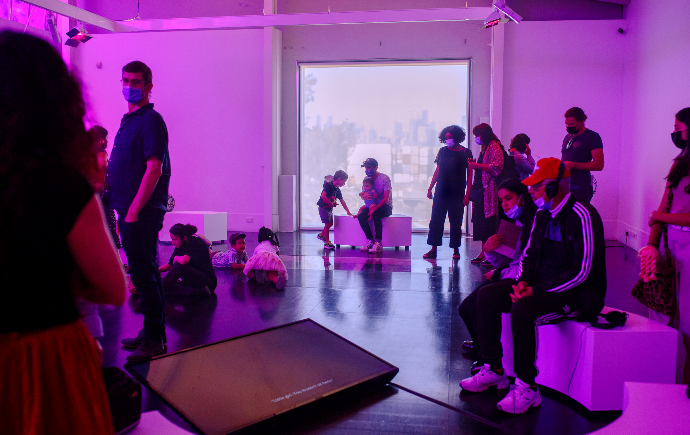
Image: The Purple Shall Govern, Footscray Community Arts, 2022. Photography: Jody Haines.
In 2021, I was awarded a creative development grant from the Ian Potter Cultural Trust and the Australian Centre for the Moving Image (ACMI) to produce a new moving image work, which is still underway. Exhibiting my first international solo exhibition in Johannesburg with Bubblegum Club (2016), and subsequently showing those works at Blak Dot Gallery (2017), as well as presenting my work in Cape Town at Gallery MOMO in their annual video exhibition Transmissions (2018), have also been amazing career achievements.
BM: Can you give me a little bit more background on The Purple Shall Govern?
RR: I was inspired by an anti-Apartheid protest in Cape Town in 1989 known as the ‘Purple Rain’ protest. The exhibition explores conditions of power in public spaces, reflecting on the systematic forces of colonial oppression endured by First Nations and Black peoples, who have historically been denied access. More specifically, looking at the settler nations of Australia and South Africa, I presented new sound, video and installation works that engaged with and re-framed various archives, in the hope of challenging and affirming an experience of public space.
BM: You secured grants from both Creative Victoria and the Australia Council for the Arts for this project. How important has this type of support been to your career development?
RR: The reality is that I’ve had to work extremely hard and I continue to as a Woman of Colour. Grants are very competitive and should not be relied upon, but if your project is ambitious and not possible without grants, there are ways you can continue to push the project and apply again until you are successful. However, in saying that, you may not ever get the grant that you want and this can lead to other unexpected places. I was recently rejected from an opportunity and another came knocking at my door – Counterflows ten month artist lab program led by Urban Theatre Projects and Arts House will see me travel to the Sharjah Biennial this month.
Receiving state and federal grants meant that The Purple Shall Govern at Footscray Community Arts was able to be the ambitious project I envisaged. I was able to pay collaborators appropriately, pay myself appropriately (see NAVA’s campaign for the advocacy work being developed in this space) and deliver the physical body of work without having to worry too much about limitations of materials. I was able to afford assistance, consultation and construction to create an exhibition and a program I am very proud of. Had I not received such support, the project would have gone ahead, but it would have looked different, and I wouldn’t have had the same learning opportunities.
BM: Do you engage in other work alongside your job as an artist?
RR: Yes. I work part time for a specialist school as an art teacher with youth in custody, and I do casual academic teaching and workshops as well.
I have always worked a part-time job – not always related to the arts – that has, thankfully, provided sustenance and the flexibility to allow me to continue developing my artistic practice. If you find a gig that works for you try to hold onto it, but if it ain't conducive to your compass there’s no point forcing it. It can be a difficult balance. The work I do to support my practice is extremely challenging but also gives me great joy and allows me to think about my art practice in ways that if I worked exclusively within the ‘arts bubble’, may not eventuate.
BM: If you could time travel back to 2009 and talk to your undergraduate self, what would you say?
RR: You’re doing the most and what you are doing is so worthwhile beyond your current comprehension. Keep doing you and don't worry or compare yourself to others – you will continue to do this but you really have to try not to, because by living your best life and working in the way that works for you, great things will continue to come your way.