
Researchers transform historical Warracknabeal Courthouse into thriving arts hub
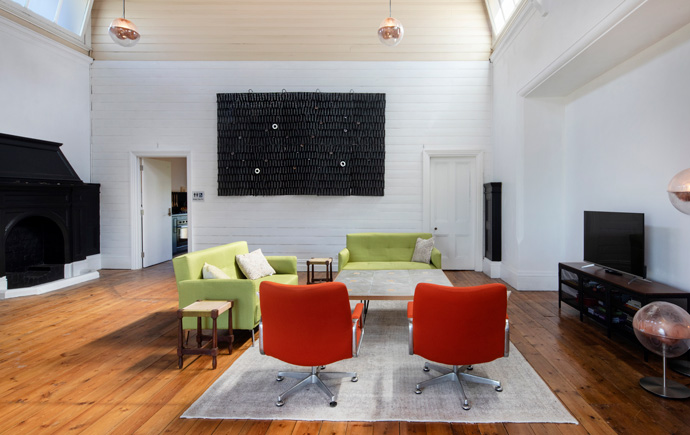
The historical Warracknabeal Courthouse sat empty and unused for 50 years, that was until it was transformed into a thriving community arts hub.

The historical courthouse has been transformed into a thriving creative space. Image: Rebecca Selleck
The Warracknabeal Courthouse Project started in 2018, led by Monash Art Design & Architecture (MADA) and project partners, Working Heritage and Creative Victoria. The goal was to develop a creative future for the building and surrounding areas. By 2019 the MADA team and Working Heritage were working within the local community to devise an artist residence, studio and accommodation at the site. Then COVID-19 hit, creating unforeseen issues and new opportunities.
Jason Crow, Charity Edwards, Matthew Bird and Tom Morgan are part of the MADA Warracknabeal Courthouse project team. Jason Crow is a senior lecturer and HDR coordinator in the Department of Architecture. His research focuses on the history of craft in relation to the history of materiality, and the manner in which it influences technological production today. Charity Edwards is a lecturer of architecture, planning and design. Her research centres on the growing urbanisation of remote and wilderness spaces.
Both Jason and Charity are a part of The Afterlives of Cities research collective, which brings together expertise in architecture, cosmologies, digital fabrication, speculative fiction, and art installation to recover futures in space. The research collective questions how we ethically imagine and enact a future for ourselves and others.
“When we got hit by the pandemic, the project ended up extending a year more than it was going to.... But this actually allowed us to have more time in between lockdowns to be up in the region. A number of other projects have developed in response to experiences that we had there” Charity reflected.
“We saw gaps that we had some expertise around, and could bring together different sources of funding from the state government, industry and local government, to start to address some of these challenges.”
While the courthouse was initially devised as an Artist’s residency for international and domestic artists, Jason and Charity realised that the space had the potential to give back to the Warracknabeal community.
“It seemed fairly straightforward at the beginning, but the more time that we spent up there and spoke with the community, we realised there were all these people who were in the community already operating as artists, but who didn't identify as artists,” Charity said.
“They would be tinkerers, or they would have hobbies, and they have these incredible creative skills. It led us to understand that there was this older generation, which had extraordinary creative skills”.
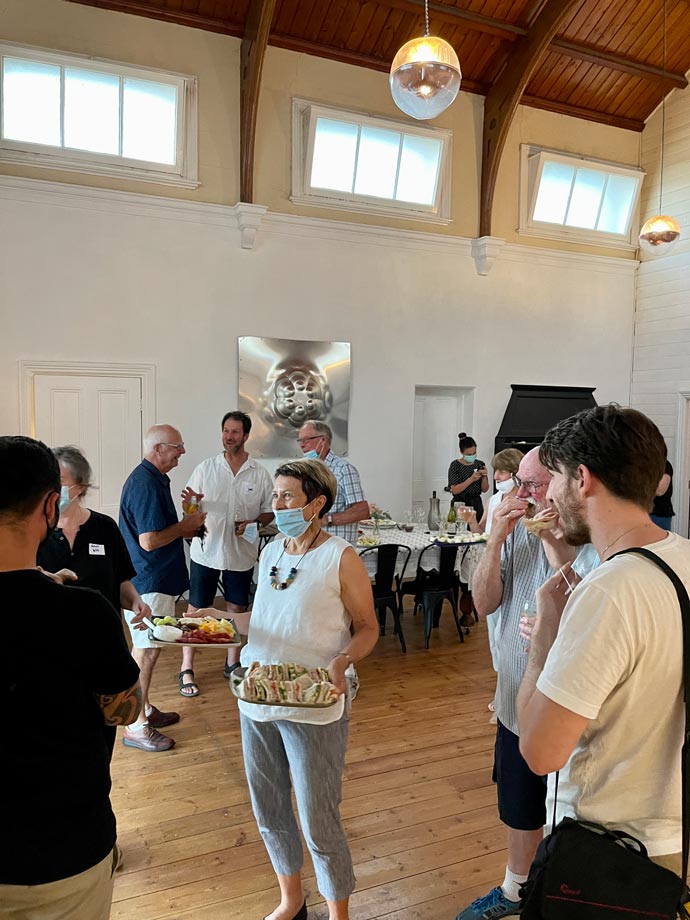
As they got to know the community Jason and Charity discovered that there was a pre-existing bank of creative knowledge, embedded within Warracknabeal and other small country towns. The issue was that there was not adequate access to infrastructure and technology for older and younger generations to experiment and learn new creative skills.
In response to these issues, the team developed Creative Circuit, a makerspace pilot project, that would supply technology, equipment and know how to bring together the community to play and learn together.
“The series of projects started to address gaps that were coming from the perspectives of different stakeholders within the community. Part of it was us getting to know the community, but also the community getting to know us, and working with these various stakeholders to help us understand what they have in place and what they need,” Jason explained.
Warracknabeal sits within the picturesque Wimmera Mallee, famous for the Silo Art Trail and beautiful country towns. As they worked on the courthouse project Charity and Jason realised that the region was missing valuable creative and technological infrastructure. This led to a new phase in the project, the creation of the The Wonder Cabinette.
The Wonder Cabinette is a mobilised art studio, which takes the form of a goldfish shaped caravan. The caravan will be used by artists to travel the Wimmera Mallee, providing a creative space for the most remote of places.
“It's this bizarre thing that attracts attention to itself, but it also functions as a technology platform that provides the technical expertise and skill building that the community wants.,“ Jason said.
“But at the same time it's a platform for artists, who will go out into the landscape and to show back to the community what they sometimes forget is there. These fascinating places and the environment that can be offered by the little towns themselves.”
The Wonder Cabinet can operate off the grid, allowing artists and community members to travel and engage in artistic practice across the region.
“So what we're hoping to be able to do is have the Wonder Cabinette travel to a series of small towns in which other small artists' spaces are opening up, and to highlight the manner in which the courthouse acts as a hub to both advertise and draw people out to these creative practices throughout the region.” Jason explained.
The Cabinette will aim to develop and cultivate creative knowledge throughout the Wimmera Mallee. Historically regional areas have lacked adequate funding for the arts, an issue that the transportable Cabinette will address.
“While we might see this as a trend of artists-in-residency programs heading out into these regions, it's not so much a trend but rather something that's been historically very well supported in urban areas, and in bigger towns,” Charity reflected.
“Now we are starting to head further and further out to allow these places, that have this latent creativity in them, to tap into it and to start to see themselves as creators.”
Both the Warracknabeal Courthouse project and the Wonder Cabinette have revealed the tremendous artistry and creative potential hidden within these country towns.
“It's just about strengthening and supporting in many ways what's already there,” Charity said.
The Wonder Cabinet project is part of phase two of the Warracknabeal Courthouse Project, which is slated for completion at the end of 2023.
If you are interested in visiting the Wimmera Mallee, click here for more information.