
Monash Architecture experts help design Indonesia’s new water sensitive capital city
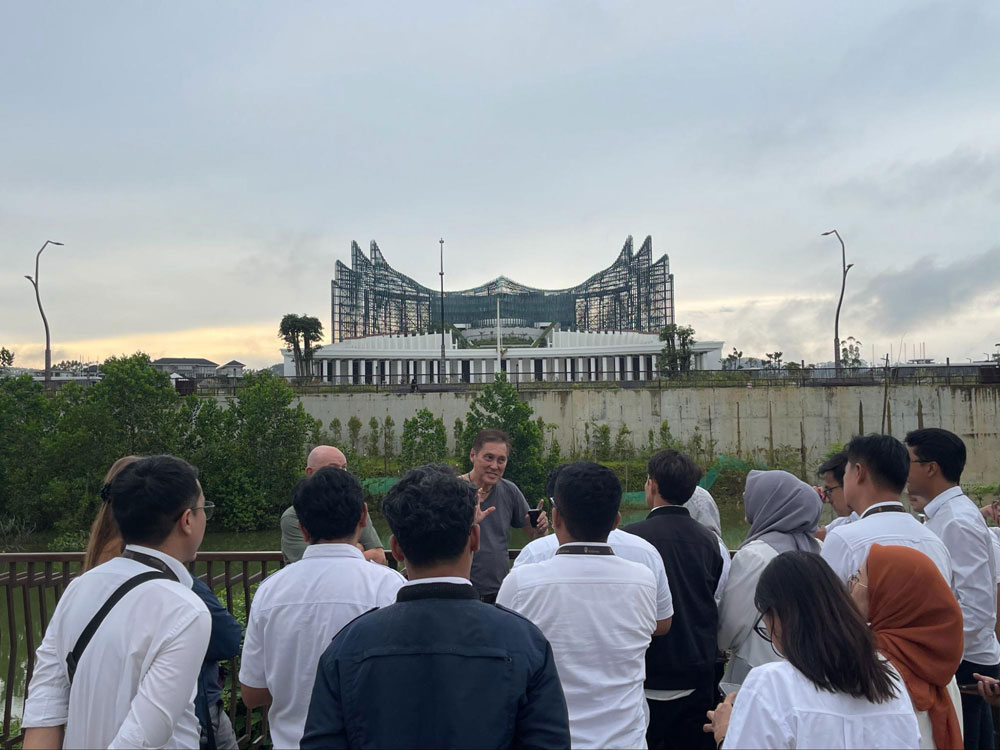
Professor Tony Wong from the Informal Cities Lab with government officials outside the new capital Nusantara.
Monash Art, Design & Architecture (MADA) experts from the Informal Cities Lab are supporting Indonesia to design and plan its new capital city, as Jakarta faces mounting environmental challenges. The new capital, Nusantara, is being developed as a sustainable city in response to Jakarta’s ongoing issues with flooding, land subsidence, and traffic congestion.
MADA and the Asian Development Bank (ADB) have launched a water-sensitive urban design training in Nusantara for members of the Indonesian government’s Nusantara Capital Authority (NCA), who are leading the new capital’s development. The program, supported by the Australian Department of Foreign Affairs and Trade (DFAT) through its Sustainable Infrastructure Assistance Program (Phase 2) managed by ADB, will run until October 2025.
Delivered by Professor Tony Wong, Professor Diego Ramírez-Lovering, Professor Peter Breen and Dr Brendan Josey, the training combines field mentoring, workshops, and online modules to design a city resilient to water crises and climate change. It will equip 30 future leaders from the NCA with the skills to build and manage a sustainable “sponge city,” in line with the Indonesian government’s ambitions. The 12 training modules cover urban planning, environmental management, and infrastructure design, with participants drawn from key NCA departments and the Ministry of Public Works.
Professor Ramírez-Lovering said the planning of a new city requires careful consideration of how human, natural, and built environments work together.
“Our ambition is to create the skills, know-how, and interconnections between agencies needed to design a sustainable, sponge city that future proofs Nusantara to respond to pollution, drought, flooding, and heat.”
Professor Wong said water-sensitive principles have been successfully adopted in Australian and global cities to manage flooding, drought, and pollution.
“Water sensitive cities is an Australian concept, underpinned by interdisciplinary research at Monash University since the early 1990s,” he said. “It has helped transform cities in Australia and overseas in terms of infrastructure design, water policy, and governance, and inspired programs such as China’s sponge cities and Singapore’s Active, Beautiful, Clean Waters Program.”
Water-sensitive or sponge cities use green infrastructure that mimics natural processes of water filtration, drainage, retention, and storage. Wetlands, swales, retention ponds, and pervious pavements help clean rainwater, reduce flooding, and limit environmental contamination.
This initiative underscores MADA’s commitment to architecture and design that addresses climate change and fosters sustainable urban communities, drawing on the Informal Cities Lab’s expertise in adaptive, water-sensitive solutions for vulnerable Asia-Pacific communities. It also reflects the ADB’s ongoing partnership with Australia and Monash University to provide strategic expertise and strengthen institutional capacity in support of Nusantara’s development.