
Rebecca Mallaby wins prestigious Australian Institute of Architecture Prize

Rebecca Mallaby with Glenn Murcutt. Photography by Maclay Heriot.
2023 Monash University Master of Architecture graduate, Rebecca Mallaby, has been awarded the 2025 BlueScope Glenn Murcutt Student Prize by the Australian Institute of Architects (AIA) for her innovative design Common Space. This prize recognises exceptional architectural student work that demonstrates excellence in response to place, technology, and Australian culture.
Common Space: A Groundbreaking Design
Rebecca’s winning design, Common Space, addresses Australia’s housing crisis through an innovative modular co-living model that balances affordability with human connection. Responding to both the social isolation epidemic and evolving housing needs, her design redefines communal living with intimate shared spaces that foster strong neighbourly connections without compromising on privacy or social amenity.
"I've always been passionate about addressing the housing crisis," says Rebecca. "While there's focus on urban sprawl in the outer suburbs, there’s an urgent need to densify the middle ring."
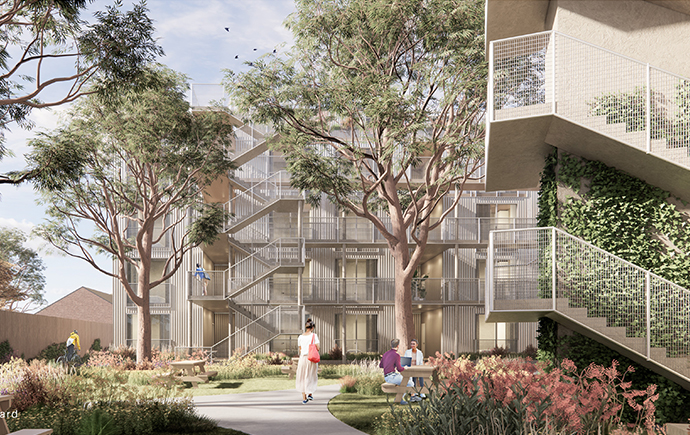
A render of Rebecca's winning project, The Common Space.
Her design revolves around the question: how can we densify housing without sacrificing important amenities? By reimagining the typical Australian suburban home, Rebecca identified which spaces could be shared based on their level of privacy and frequency of use, leading to more efficient communal arrangements.
"Community is expressed from a micro to macro level," Rebecca explains.
Spaces like the study are reimagined as co-working areas, backyards become communal courtyards, and garages are transformed into storage lockers, bicycle parking, and car-sharing allotments—promoting cycling over cars to reduce emissions.

A render of Rebecca's winning project, The Common Space.
Rebecca tested her approach by designing three apartment variations, each with different combinations of shared and private spaces. One design features shared guest rooms, another a shared kitchen space while maintaining private living areas, and a third features all communal facilities shared with equal private amenity.
The AIA jury praised the design's sensitivity to the site, including the retention of mature trees and its response to the surrounding architecture and parkland. Sustainable materials like Cross Laminated Timber (CLT) and ashcrete, along with passive design principles—such as cross-ventilation, optimal orientation, and energy efficiency—were key components of the project.
Head of Architecture at Monash Art, Design and Architecture (MADA), Associate Professor Kathy Waghorn says;
“We are so pleased that Rebecca’s excellent work has been celebrated by our industry colleagues through this esteemed prize. At Monash Architecture we are fully engaged, through our teaching and research, in addressing the critical issues of housing and the future of our cities in the climate crisis. Rebecca’s in-depth, thoughtful and highly skilled work provides an excellent example of how our studio teaching engages with these issues.”
Reflections on the Win
Rebecca was thrilled to accept her award at the AIA National Conference, where she had the opportunity to meet industry leaders and learn from their projects.
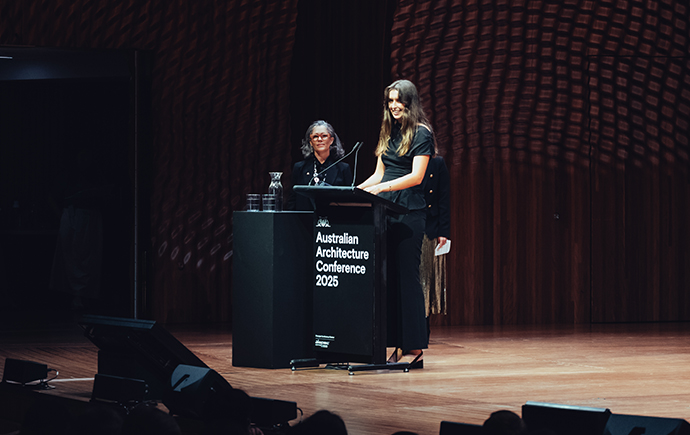
Rebecca receiving her award and delivering her speech at the Sydney Opera House. Photography from the AIA.
"The highlight was meeting Glenn Murcutt in person, whose work has been such an inspiration throughout my studies," says Rebecca. "It was a life-changing moment to meet someone who has shaped and inspired the Australian architectural landscape."
Her project was part of her final-year Architecture Studio, "Last Mile Housing," led by tutor Andrej Vodstrcil, who helped ignite Rebecca's passion for social housing.
"This experience has inspired me to explore new, innovative housing typologies, which are currently limited in Australia," she adds.
"I hope my project encourages people to consider densifying homes in ways that offer affordable housing without compromising on quality."
Now an Architect Graduate at Carr, Rebecca continues to explore ways to design apartments that incorporate the same amenities as standalone houses. One highlight of her work has been designing a boutique apartment in Kew that integrates landscaping with internal spaces, as well as a small tower in Melbourne’s CBD, which maximises amenity in a small footprint.
"The challenge is creating as much amenity as possible in a small space, including a café, end-of-trip facilities, and a landscaped courtyard," she says.
Looking to the Future
For Rebecca, architecture is all about creativity and its direct impact on people's lives.
"We start with pen and paper, move to digital designs, and then see the concept become a real building that people live or work in," she says. "It’s that transformation that excites me."
Reflecting on her future, Rebecca is eager to continue designing housing that densifies without losing essential amenities.
"My goal is to develop innovative housing models that challenge the current housing crisis in Australia, creating sustainable, community-oriented solutions. Thoughtful design should not only be a luxury but a human right,” she concludes.