
Mapping Country: Dr Jahkarli Romanis wins 2026 Mollie Holman Award
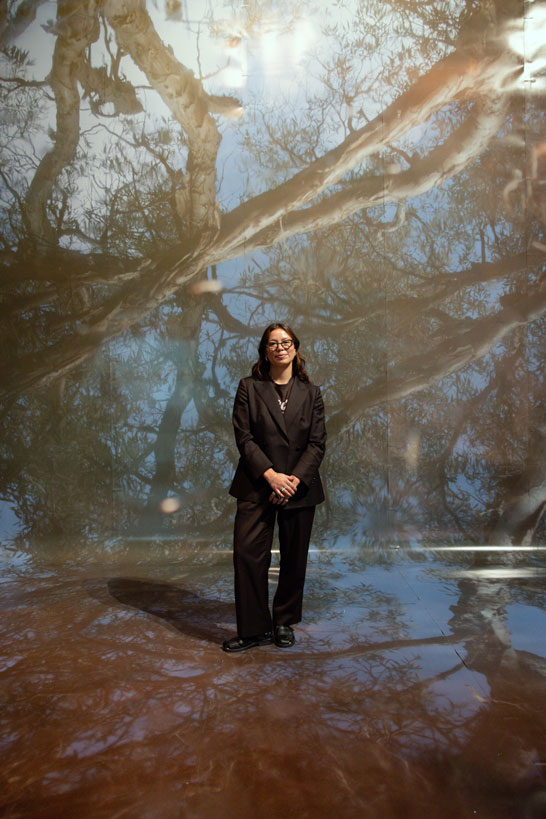 Image: Portrait of Jahkarli Felicitas Romanis (Pitta Pitta) with her work Channels, 2025 on display FUTURE COUNTRY: Country Road x NGV First Nations Commissionsfrom 20 March –13 September at The Ian Potter Centre: NGV Australia, Melbourne. Photo: Joshua Scott.
 For Pitta Pitta woman Dr Jahkarli Romanis, the Australian landscape is far more than a set of digital coordinates. It is a repository of memory, a site of colonial tension and a profound connection to her Ancestors. As a recipient of the 2026 Mollie Holman Award, Dr Romanis is thrilled and honoured to be recognised for her work that challenges viewers to consider Australian history and land through the lens of Indigenous Knowledges.
Established in 1998 to honour pioneering physiologist Emeritus Professor Mollie Holman AO, this award is among the highest academic honours Monash University bestows. Awarded to a maximum of 10 doctoral students per year, it recognises researchers of the highest order for exceptional thesis excellence and significant contributions to their field.
Re-examining narratives of Country
A proud Pitta Pitta woman, artist and emerging researcher, Dr Romanis is re-examining narratives surrounding Indigenous representation. Based in Wurundjeri Country, she undertook a practice-led PhD within the Wominjeka Djeembana Indigenous Research Lab at Monash Art, Design and Architecture (MADA).
Her thesis, titled Disconnected to Country: Mapping Archives Through Arts Practice, revolves around creating artworks while being critical of two specific archives: the Tindale Genealogical Collection and Google Earth. The Tindale collection, held at the South Australian Museum is an anthropological archive that documented Aboriginal people in the 1930s and 40s from a perspective that framed them as part of a "dying race."
"I saw original documents about my great-grandmother," Dr Romanis says of her visit to the South Australian Museum. "It was a deeply personal and emotional experience. Working with family stories and archives has been both an honour and a privilege, as it’s allowed me to deepen my connection to my matrilineal heritage in meaningful ways."
Critiquing the digital gaze
While Google Earth is a modern mapping technology, Dr Romanis critiques it as an archive of Country. She notes that mapping technologies often present as neutral or objective tools while ignoring Indigenous connections to Place and Country. Her research dismantles colonial myths such as "terra nullius" and emphasises the importance of recognising the diverse narratives tied to Country and Ancestors.
By identifying the moments where digital mapping "breaks down," Dr Romanis finds a metaphor for the flaws in colonial perspectives. Her practice, which spans photography, moving image and spoken word, seeks to give these unacknowledged stories visibility. She hopes to make people critically evaluate the technologies and archives they engage with every day.
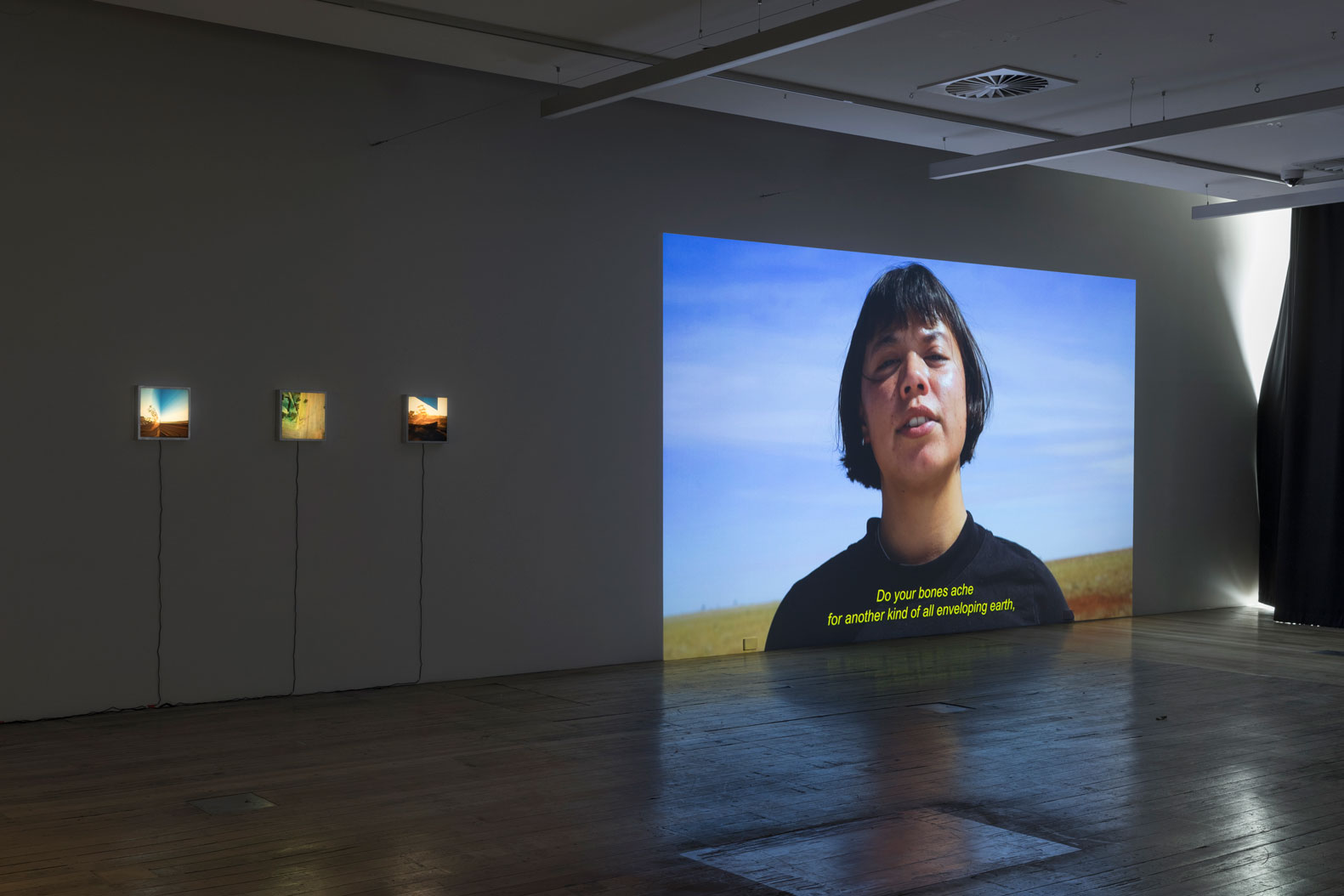 Image: (Dis)connected to Country: Mapping Archives Through Arts Practice at MADA Gallery 2025. Photo by Andrew Curtis.
 Overcoming challenges through community
The path to doctoral excellence was not without its hurdles. Over the five-year journey, Dr Romanis navigated significant personal challenges, often feeling as though she was her own greatest barrier. The deeply sensitive nature of the research required immense emotional labour as she reconciled family histories with inherently colonial archives.
She attributes much of her success to the guidance of her supervisors and mentors, Dr Peta Clancy, Dr Kirsten Lyttle and Professor Melissa Miles. This supportive environment allowed her to navigate the "problematic histories" of the archives while ensuring her work remained grounded in community.
"Having a strong support network of Indigenous researchers and practitioners is essential," she notes. "I’ve been fortunate to have a positive experience at Monash, particularly due to having peers of Indigenous artists and researchers at Monash.
A growing legacy of excellence
Dr Romanis’s practice has garnered significant national acclaim, winning the Multimedia Category at the 2025 Telstra National Aboriginal and Torres Strait Islander Art Awards (NATSIAA). Her work has been showcased at major festivals and galleries including the PHOTO International Festival of Photography, Ars Electronica. She is currently featured with mentor and artist Professor Brook Garru Andrew in a major commission for the National Gallery of Victoria (NGV) as part of the 2026 Country Road x First Nations Commissions.
Her impact continues with her selection for Primavera 2026: Young Artists at the Museum of Contemporary Art (MCA) in Sydney alongside fellow MADA artists Callum McGrath and Rudi Williams. Curated by Antares Wells, this exhibition focuses on archive and memory, providing a vital platform for her continued exploration of Indigenous storytelling.
Inspiring the next generation
As a lecturer at MADA, Dr Romanis encourages her students to build a critical lens and stay invested in their education. For Indigenous students considering a PhD, she emphasises the necessity of a strong support network.
"Being supported by peers who understand your cultural context can help you produce your best work," she says. "Be grounded in your strength as young Aboriginal people. We all have important stories to offer."