
Monash Artist Nicholas Mangan selected for Lyon Biennale
Acclaimed artist and Monash Fine Art educator, Associate Professor Nick Mangan has been selected to present new work at the 18th Lyon Biennale of Contemporary Art (2026), one of the most influential recurring exhibitions on the global contemporary art calendar.
Held every two years since 1991, the Lyon Biennale is among Europe's leading platforms for contemporary art. This year's edition, To pass from one dream to another, brings together artists from around the world to explore transition, exchange and the unconscious. Mangan's inclusion places him alongside a distinguished international cohort and marks a significant milestone in a practice built on unpacking the hidden systems that connect nature, value and power.
A feather currency and a curator’s eye
Mangan was invited into the Biennale by curator Catherine Nichols, who travelled to Australia in search of artists engaging with the Asia-Pacific region. It was a photograph on his studio wall that caught her eye: a Tevau, a coil of tiny feathers, deep red and glossy, once used as a form of currency and dowry in the Solomon Islands. Made from the plumage of the scarlet honeyeater, using thousands of birds' worth of feathers woven over generations, it is artwork, wealth and living memory. That image became the seed of The Current, the new film Mangan will present in Lyon.
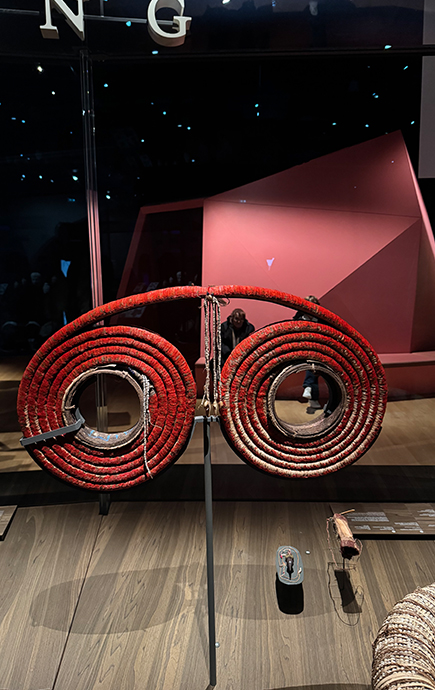
Image: Tevau on display at Musée des Confluences, Lyon, France. Image by: Nicholas Mangan.
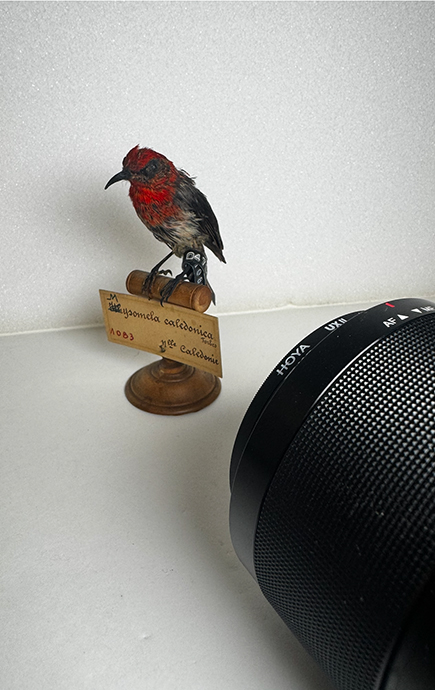
Image: Taxidermied Myzomela red feathered bird at Musée des Confluence archives, Lyon, France. Image by: Nicholas Mangan.
"It involves nature and questions of value all in one," Mangan says. "What is seen under capitalism as free nature means that certain natural resources don't have value. Questioning this concept, I've been looking at carbon credits, thinking of debt in relation to carbon. There's a limit before earth becomes uninhabitable."
To make the work, Mangan spent a day filming a single taxidermied honeyeater held in museum archives, The result is a meditation on exchange, extinction and the strange afterlife of objects.
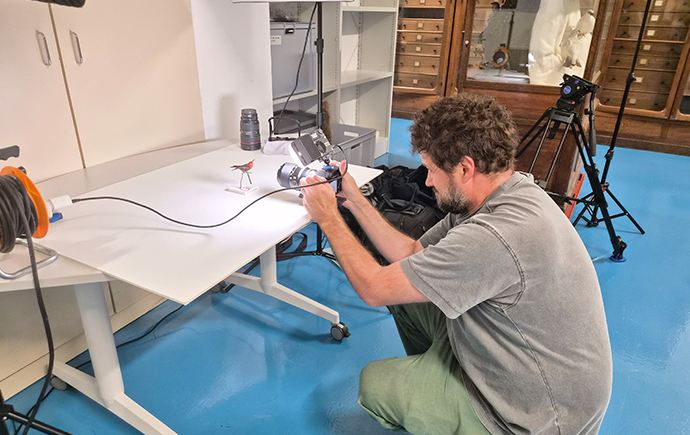
Image: Nick Mangan photographing taxidermied Myzomela red feather bird at Musée des Confluence archives in Lyon, France.
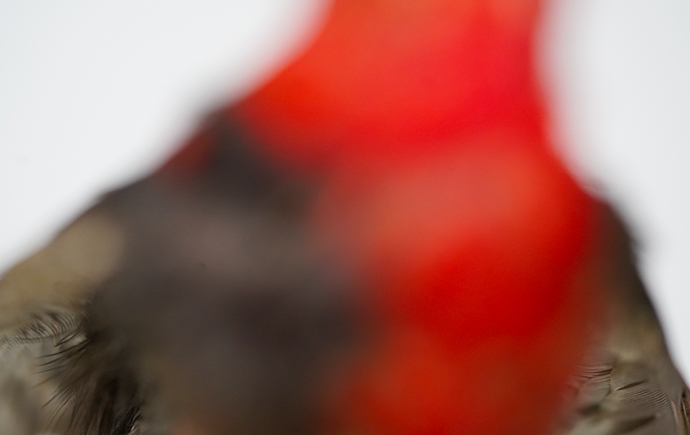
Image: The Current, Colour, silent infinte loop 2026.
Image by: Nicholas Mangan.
"I’m drawn to the idea of animating this dead bird, almost like resuscitating it," he says. "What does it mean to work with these dead objects in a museum? Although it is dead, there is something about at least symbolically capturing and releasing the bird. An after-image is stored in your mind's eye."
That after image in the flickering black, red and white of the film, is central to how Mangan wants audiences to experience the work, which responds to the Biennale's theme, To pass from one dream to another.
"A dream can also be an unrealised possibility of what is," he explains. "I hope the film inspires curiosity and further considerations, a momentary rupture in daily modalities. It helps create a space for setting off different neurons."
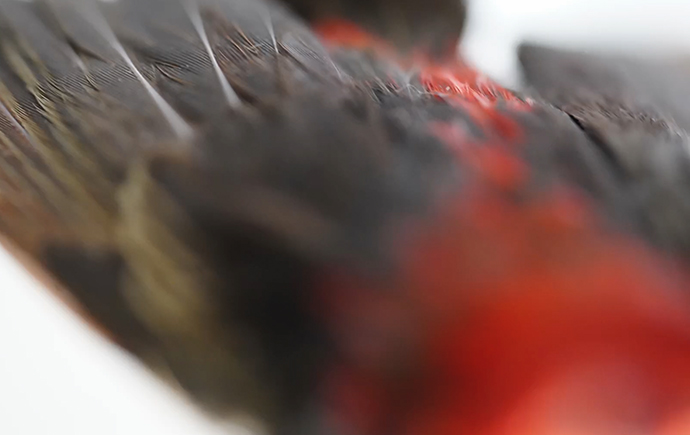
Image: The Current, Colour, Silent infinite loop 2026. Image by: Nicholas Mangan.
Early exposure to natural resources
Mangan's fascination with resource, value and consequence has deep roots. He grew up in Geelong, a town shaped by heavy industry, where his grandfather worked at a local quarry and phosphate ships from Nauru would sail into Corio Bay.
"Growing up in a post-industrial town affected my psyche," he says. "I was always afraid of the Shell refinery, with the flame, I was afraid it would explode."
That early unease has shaped his lifelong practice. Across film, sculpture, photography and installation, Mangan has traced the human fallout of extraction from the strip-mined island of Nauru to the Panguna copper mine in Bougainville, always following the friction between ideology and the natural world.
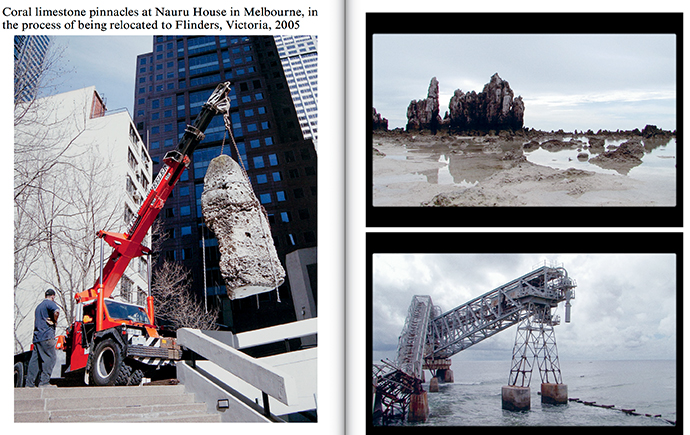
Image: Coral limestone mining and pinnacles featured in A World Undone, Lenz Press 2024, Image by Hamish McIntosh.
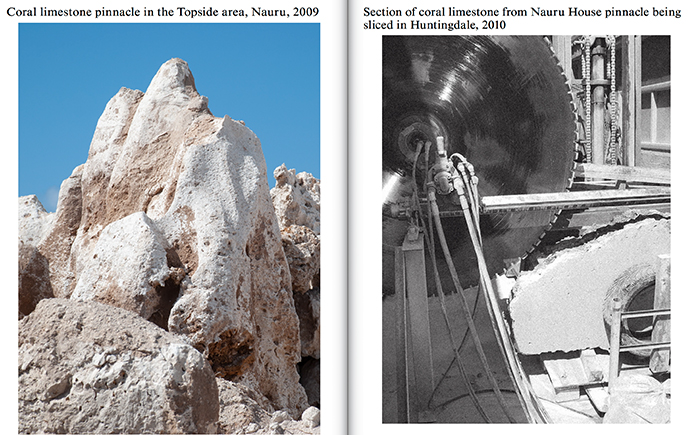
Image: Coral limestone pinnacles and cutting featured in A World Undone, Lenz Press 2024, Image by Hamish McIntosh.
From research to teaching
Mangan completed his PhD at Monash University in 2015 and has spent nine years leading the Bachelor of Fine Art Honours program in the Department of Fine Art, where he now works as an Associate Professor and Higher Degree by Research (HDR) supervisor.
"I love working with alert students who are open to being challenged, and who feed off each other to create a dynamic learning environment," he says. "Teaching is the best way to learn. You come across problems you can work with the students to problem solve”Monash, he says, gave him the grounding to turn instinct into rigorous research. "I have dyslexia, and I was worried about it, but my PhD supervisors helped me focus and build a unique rigorous research practice."
"I never ever imagined I would end up publishing a book" he adds, referring to Limits to Growth, a publication surveying four of his most significant works and A World Undone, published to accompany his survey exhibition at the Museum of Contemporary Art Australia.
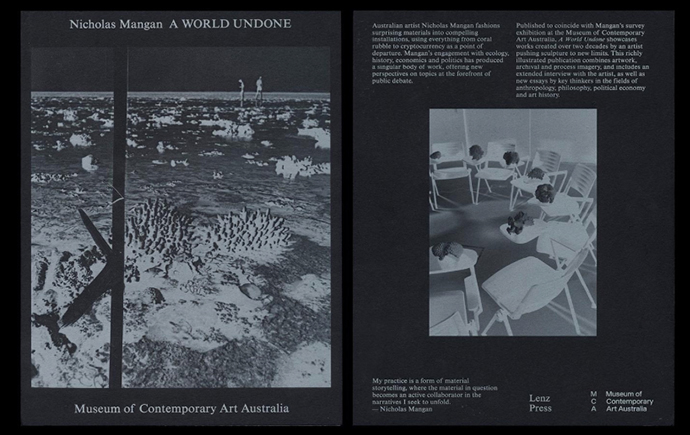
Image: A World Undone, by Nicholas Mangan and the Museum of Contemporary Art, Lenz Press 2024. Image by Hamish McIntosh.
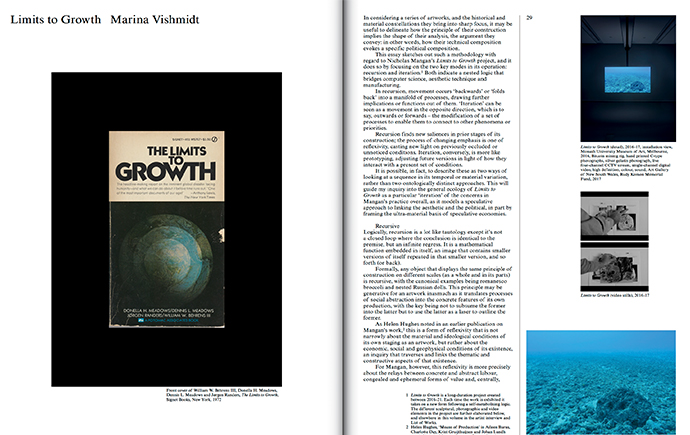
Image: The Limits to Growth featured in A World Undone, Lenz Press 2024. Image by Hamish McIntosh.
His advice for emerging artists is characteristically direct: "Follow your curiosity. Even when you have doubts, try to remember what makes you tick, what makes you excited or angry and engage with that. It's hard work, but it can be really rewarding."
As The Current prepares to make its own crossing from a Monash studio to the museums of Lyon, it carries with it the same restless question that has driven Mangan's practice from the start: what do we owe the systems, and the species, that keep us alive?
Nicholas Mangan's work will be presented as part of the 2026 Lyon Biennale, running 19 September to 13 December 2026.