
Monash University Professor Brian Martin awarded ARC Future Fellowship
Professor Brian Martin, Bundjalung, Kamilaroi and Muruwari man and Director of Wominjeka Djeembana Indigenous Research Lab at Monash Art, Design and Architecture (MADA), has been awarded a prestigious Australian Research Council (ARC) Future Fellowship. This four-year award is reserved for Australia's most outstanding researchers, backing the work most likely to shape the nation's future.
Connecting with Country
His project, Connecting with Country: Indigenous Creative Practice Research, sets out to build genuine Indigenous pathways into the cultural sector, through a framework grounded in connecting with Country. The practice-led research aims to build Indigenous pathways in the cultural sector through a Connecting with Country framework. Investigating the intersections between practice-led research and Indigenous ways of knowing, the project expects to generate new knowledge about that agency of Indigenous mark making and how the cultural sector can build ethical relationships with Indigenous knowledges, cultures and creative practice.
It builds on Professor Martin's research and practice career and two recently completed projects: Protocols for Indigenous-led Creative Practice, which measured the impact of the Australian and International Indigenous Design Charters used by creative practitioners engaging with Indigenous communities and knowledge, and More than a Guulany (tree): Aboriginal Knowledge Systems.
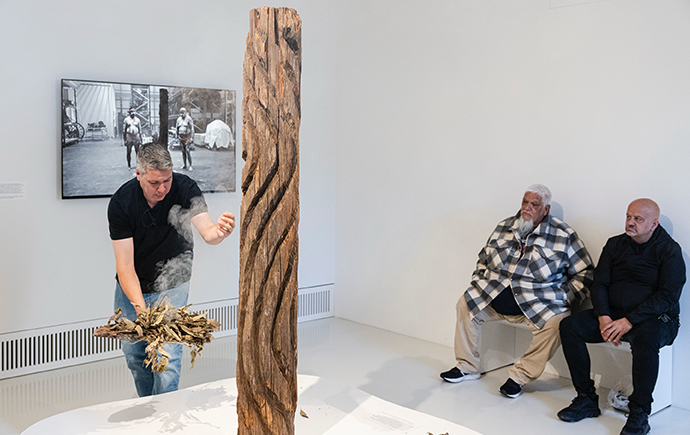
Image: Wayne Griffiths, Elder Greg Bulingha Griffiths and Professor Brian Martin at smoking ceremony with dhulu, Museum De Kulturen, Basel. Image by: Omar Lemke.
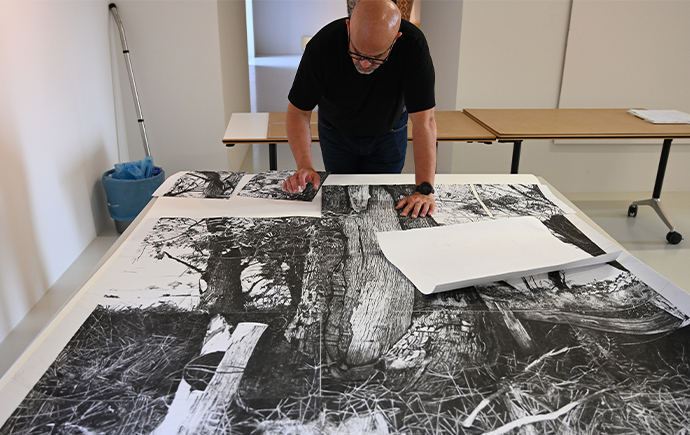
Image: Brian Martin preparing drawing for exhibition at Museum De Kulturen, Basel. Image by: Omar Lemke.
This Fellowship delves into how mark making in Indigenous creative and cultural practices articulate complex systems of Indigenous knowledge through a Connecting with Country framework. By demonstrating how Country is more than land or property and has subjective agency, this fellowship aims to reconfigure how the cultural sector and in particular, museums can be reimagined.
The impact is designed to be felt well beyond the page. Professor Martin's research will advance the development of new knowledge and methodologies for Connecting with Country and model holistic approaches to exhibition making and museum practice to meet the current demands in the cultural sector for decolonisation and Indigenisation ones that reflect the lived experience of Indigenous peoples, rather than working around it. It will also empower the next generation of Indigenous researchers in practice-led methods, and strengthen the standing of Indigenous artists, communities and knowledge holders as leaders across the cultural sector, both in Australia and abroad.
Reflecting on the recognition, Professor Martin said:
"This Fellowship provides the opportunity to build real pathways for Indigenous knowledge holders and practitioners within the cultural sector, not just make space for us within it. Connecting with Country is not a framework we apply from the outside; it is about learning to be in reciprocal relationships with Country, and this reconfigures how museums and galleries do their work. I am looking forward to seeing where this takes us, and what opportunities emerge."
A career shaping the field from the inside
Alongside his research, Professor Martin has spent over thirty years building an art practice defined by conceptual, performative engagement with Country across a range of mediums. He has exhibited nationally and internationally, and is represented by William Mora Galleries.
His work centres on the reclamation of Country as a living, active subject with its own agency, directly rejecting the passive, colonial view of the Western "landscape." Through his Countryscapes, Martin employs the methodology of ‘methexis’ to explore the deep, participatory and reciprocal relationship between humanity and Country, using fragmented compositions to capture the tactile memory of physical connection to place. It is a practice that has always been inseparable from his research, each shaping how he approaches the other.
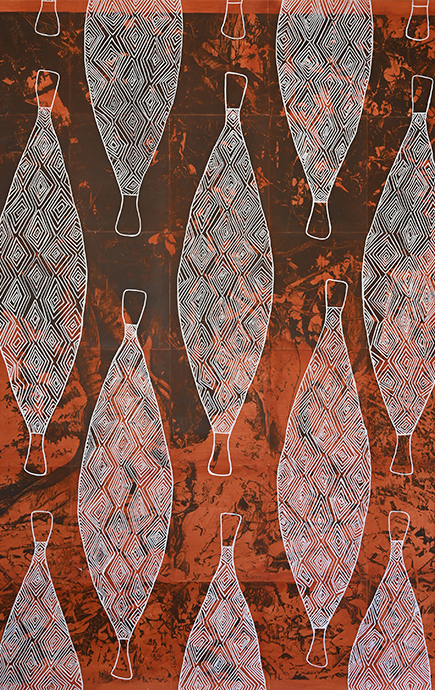
Image: Baw-li-tharra-Burrlin-Methexical-Countryscape Lanjia Saura #2, by Brian Martin.
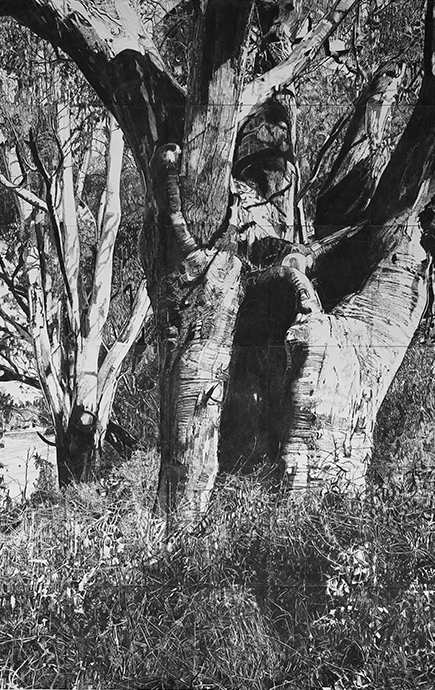
Image: Methexical Countryscape Kamilaroi #12, by Brian Martin.
A return, not a retrieval
That connection runs through More than a Guulany (tree): Aboriginal Knowledge Systems, an ARC-funded study into the significance of trees in south-east Australian Aboriginal cultures, a project led by Professor Martin and Professor Brook Andrew. During a 2022 research trip, Professor Martin, alongside Professor N'arweet Carolyn Briggs AM and Dr Kimberley Moulton, came across a Kamilaroi dhulu (tree), a sacred carved tree and ancestral being of Kamilaroi peoples, held in Switzerland's Museum der Kulturen Basel for 84 years.
What followed was a years-long collaboration between Professor Martin, Kamilaroi Elders and the Basel museum, built around genuine cultural exchange rather than simple reclamation, culminating in the dhulu's welcome home to Country in early 2025. Professor Martin has described the process as a "return rather than a retrieval," a model of relational exchange that now sits at the heart of Connecting with Country.
Professor Martin's Fellowship lands at a pivotal moment for the sector, aligning with the ambitions of the National Cultural Policy to put First Nations stories at the centre of Australia's arts and culture. It's a fitting recognition of a body of work grounded in real institutional change, and a sign of the impact still to come.
Professor Martin’s latest exhibition ngiyama mirrim baany yulendj: reawakening deep water knowledge runs from 18 September 2026 to 11 April 2027 at Bunjilaka Aboriginal Cultural Centre, the Melbourne Museum. This exhibition is co-curated with Professor N’arwe’t Carolyn Briggs AM, Dr Laura Harper, Dr Ana Lara Heyns, Associate Professor Marilu Melo Zurita and Associate Professor Catherine Murphy and is a major outcome of their ARC Linkage project Repairing memory & place: An Indigenous-led approach to urban water design.