
Co-designing cosmetics: Where Design and Pharmaceutical Science meet
Co-designing cosmetics: Where Design and Pharmaceutical Science meet
In a Monash University first, 230 students from two entirely different disciplines, the Bachelor of Design and the Bachelor of Pharmaceutical Science, worked side by side for ten weeks, pairing scientific formulation with sustainable packaging design.
The elective Beyond Skin Deep: Co-designing Sustainable Cosmetics/Skincare Packaging challenged cross-faculty teams to co-design original skincare brands tailored to specific needs and target markets, before presenting to industry professionals at a final expo. The studio was led by Design Studio leaders Melinda Coombes and Dr David Trickey (Monash Art, Design and Architecture) (MADA), alongside Cosmetic Hub leader Dr Laurence Orlando (Pharmacy and Pharmaceutical Science).
"Co-design is central to how we teach at MADA, and for the first time, our Bachelor of Design students teamed up directly with the Bachelor of Pharmaceutical Science students in a dedicated co-design studio," says Coombes. "They took complex collection briefs and translated scientific parameters into tangible, user-centred solutions. It gave them firsthand experience of what strategic design looks like in practice"
"Exposing students to this level of collaboration and industry feedback creates direct pathways to employment," adds Dr Orlando. "It mirrors the multidisciplinary team environments they'll enter after graduation."
How the studio worked
The studio brought together students from across the Bachelor of Design streams including communication, industrial and spatial design, with their pharmaceutical counterparts. Both student cohorts explored target demographics and defined product constraints. Pharmaceutical Science students developed tailored product ranges and formula constraints while design students applied co-design findings to question assumptions, explore new opportunities for markets, and develop customised packaging outcomes. This process integrated AI visualisation techniques to help transform early 2D sketches and reference materials into 3D packaging prototypes, promotional materials, in-store displays, digital assets, and more.
Co-design workshops began at Caulfield campus using exercises to build user empathy, then moved into hybrid sessions with team presentations that tested students' ability to navigate real-world constraints, including light-sensitive active ingredients, airless dispenser mechanisms, and reef-safe formulations.
"Pharmaceutical science students hadn't engaged with co-design before, so we worked explicitly on techniques to encourage the productive giving and receiving of design feedback," says Coombes. "Design students learned to back their ideas with robust research-driven reasoning rather than personal preference."
Two student teams illustrate the breadth of what the studio produced.
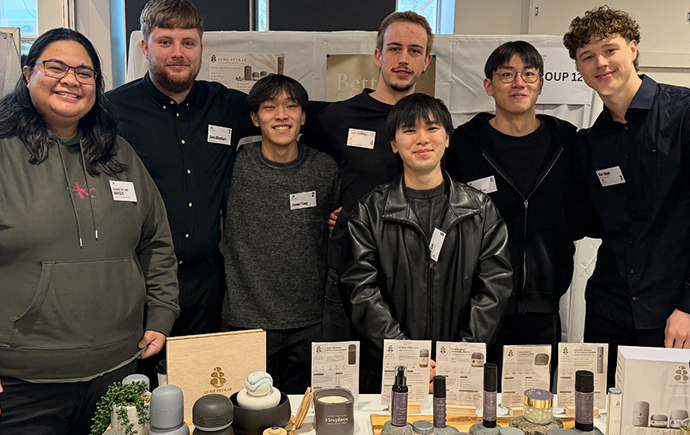
Image: Lumé Petrae team L-R: Isabella De Leon, Sam Bloxham, Daniel Tang, Josh Verhagen, Eric Lee, Walter Poon, Ben Wolff. Credit Zixing Mun.
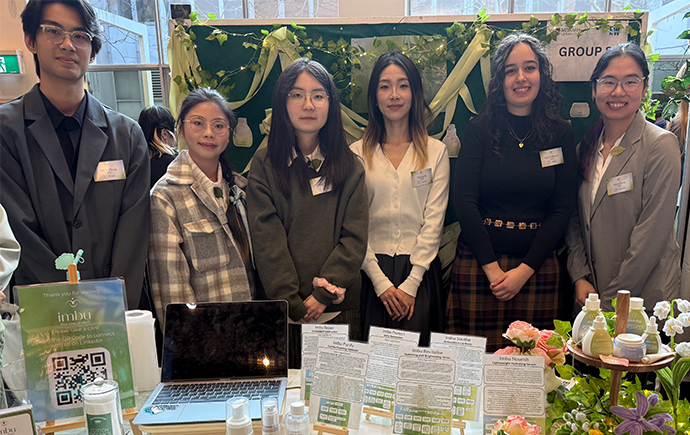
Image: Imbu team L-R: Xihua Zheng, Qiwen Zheng, Yanting Huang, Xinyang Shi, Ruby Guttmann, Alice Zhang. Credit: Zixing Mun.
Case study 1: Lumé Petrae
Industrial Design student Isabella De Leon worked as the sole designer alongside six Pharmaceutical Science and Engineering students to create Lumé Petrae, an anti-ageing, gender neutral skincare collection for people aged 40 and above.
"Lumé represents lightening and brightening; Petrae is Latin for stone, connecting to the brand's focus on skin barrier strength," De Leon explains. "The design reflects the peaceful look of stacked stones in a zen garden." Her prototypes feature grey stone-textured exteriors and replaceable glass inserts, once emptied, the jars can be repurposed rather than discarded.

Image: Isabella De Leon, Lumé Petrae product range.

Image: Isabella De Leon, Lumé Petrae Toner primary packaging design.
The sustainability focus extended to the packaging mechanics themselves. Each product houses a refillable glass jar inside a reusable exterior shell, so once contents run out, users replace only the jar rather than discarding the whole product."I enjoyed 3D-printing models that pulled apart to demonstrate how the refill mechanism worked. De Leon says. Working with pharmaceutical science and engineering students gave me great insight into their technical processes, while allowing me to share how we approach design problem-solving."
"Without Isabella's design expertise, our clinical formulations wouldn't have translated into such a refined, sustainable product," says Pharmaceutical Science and Engineering student Eric Lee. "Operating as the 'client' showed me how much design depth and technical precision it takes to connect a brand with a real audience."
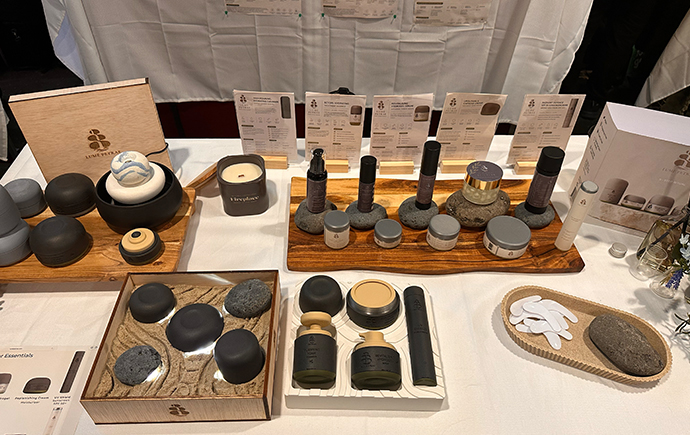
Image: Isabella De Leon, Lumé Petrae product prototypes.
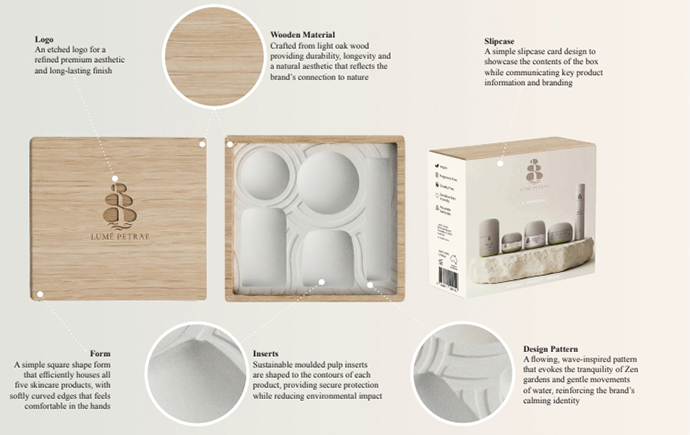
Image: Isabella De Leon, Lumé Petrae secondary packaging design.
Reflecting on the experience, De Leon sees real value in the cross-faculty format. "It's a great insight into how pharmaceutical science studentswork, and it was fun teaching them a few things about design in return."
Case study 2: Imbu
Communication Design student Ruby Guttmann was the sole designer on a project introducing green tea as a botanical ingredient to the Australian market, bridging traditional Asian ingredients with local formulations.
"The Pharmaceutical Science students came to us with an idea for their product, but it was our job to take a step back and look at how that idea would sit within the cosmetics industry and with their target audience," Guttmann says.
The resulting brand, Imbu, builds its entire visual identity around cool colour palettes, graphic leaf motifs and teapot-inspired bottle forms to create a calming, refined aesthetic. Guttmann is proudest of the labelling system that features temporary paper stickers, adhered with minimal glue, guiding new users through their routine before being peeled away. "I saw that as an opportunity to create something new, unexpected and more sustainable."

Image: Ruby Guttmann, Imbu brand

Image: Ruby Guttmann, Imbu poster
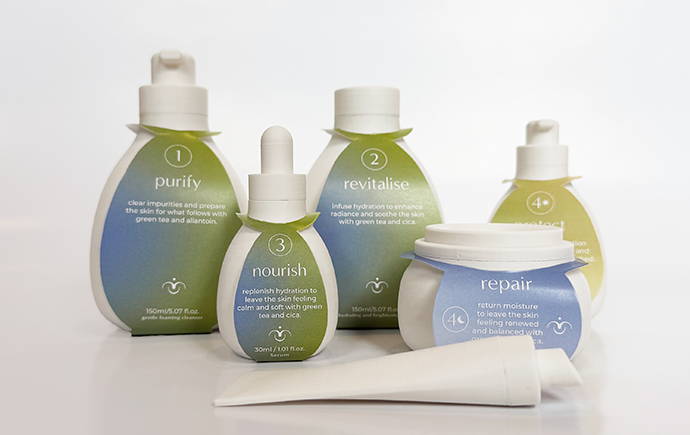
Image: Ruby Guttmann, Imbu primary packaging design.

Image: Ruby Guttmann, Imbu secondary packaging design.
For Pharmaceutical Science student Alice Zhang, the payoff came at the Cosmetics Expo, where the finished product went head-to-head with industry expectations. "The packaging made our product look store-ready, so at the expo, industry partners could see we understood every aspect of a cosmetic product, inside the bottle and out."
Guttmann credits her pharmacy team's openness for the strength of the final outcome. "Their trust in me meant they were open to unexpected thinking and visuals, which ultimately allowed us to create a unique brand and packaging outcome." Zhang felt that trust flow both ways: "Working with Ruby was a highlight, she turned our ideas into something tangible and brought market knowledge that shaped our formulations, teaching me to focus on what really matters."
Reflecting on the studio's value, she's unequivocal: "Learning to collaborate with non-designers is essential. It's a much truer reflection of industry and it pushes you to navigate real challenges in a supportive environment."
Industry connection and expo
The semester culminated in a cosmetics expo organised by Pharmaceutical Sciences, where student teams presented brand identities, 3D-printed physical prototypes, web layouts and promotional posters to representatives from the cosmetics industry including Aesop and MECCA.
At the expo, De Leon found herself explaining her design decisions directly to industry professionals. "It felt like pitching our idea to them in a real boardroom meeting," she says. "It was great being able to explain the reasoning behind the design choices. The representatives loved the physical prototypes as much as everyone else did."
For Guttmann, the expo was a milestone in its own right. "I felt incredibly privileged to have my design work in front of real industry stakeholders," she says.
Professor Gene Bawden, Head of MADA's Design Department, says the studio reflects an ongoing commitment to co-design and industry grounded practice at MADA.
"As emerging technologies change the industry, human skills matter more than ever. Skills like collaboration, communication, and the ability to stand in a room and defend an idea to people who think differently to you. That's what this studio teaches, and it's what will set our design graduates apart."