
Community resources
Community resources
What is autoimmune encephalitis?
Autoimmune encephalitis is a group of neurological and neuroinflammatory conditions where the body's immune system mistakenly attacks healthy brain cells, leading to brain inflammation and swelling. The condition causes significant disability for the person and a high burden for caregivers.
Neurologic symptoms can include -
- memory/cognitive issues,
- seizures (fits),
- problems with speech
- mobility and function issues
Psychiatric symptoms can include -
- an altered perception of reality (psychosis),
- false beliefs (or delusions),
- seeing or hearing things that others do not see or hear (hallucinations),
- aggression, and compulsive / repetitive behaviours.
Webinars

Living with Autoimmune Encephalitis
This little-known inflammatory brain condition is often misdiagnosed. Amanda Wells, Amber Cason and Michelle M discuss what it's like to live with or care for someone with AE, and navigate the health system. They're joined by neuroimmunologist Associate Professor Mastura Monif, who leads the Autoimmune Encephalitis Consortium Project. A panel for Brain Awareness Week 2025.

Autoimmune Encephalitis (including Sero-negative) and Treatments.
Dr. Mastura Monif gives an outstanding overview of Autoimmune Encephalitis and the treatments used in this group of diseases. With patients and caregiver in mind, she uses easy to follow language and helpful visuals a layperson can follow and outlines what occurs in the disease.
Plain language summaries
Perhaps the biggest challenge of autoimmune encephalitis, especially when symptoms first appear, is the many forms it can take. These summaries condense some of our research, published in peer-reviewed academic journals, the gold standard for evidence-based medicine. You may want to share these with family, friends and other people you interact with, or your GP or healthcare professional team. If there's a paper on our publications page that you think would benefit from a plain language summary, please email us.
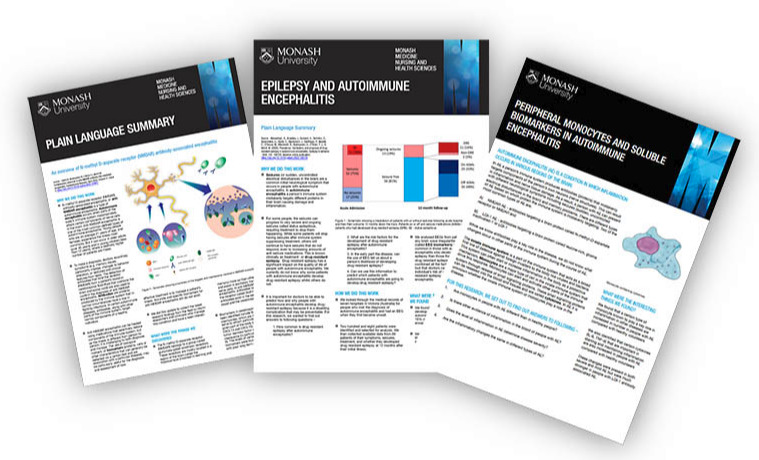
- NMDAR encephalitis is believed to be the most common form of AE. Here's what we know.
An overview of N-methyl D-asparate receptor (NMDAR) antibody-associated encephalitis (PDF, 0.97 MB) - Can brain waves confirm whether someone has a particular AE subtype, and the likely course of their disease?
Using Electroencephalogram for quicker diagnosis and prediction of the likely course for patients with Autoimmune Encephalitis (PDF, 0.82 MB) - How AE affects thought processes such as attention, understanding, judgement and memory.
Cognition in autoimmune encephalitis - summary (PDF, 0.79 MB) - We're exploring why some people with AE develop drug-resistant epilepsy while others don't.
Epilepsy and autoimmune encephalitis (PDF, 0.86 MB) - Antibodies are vital for diagnosing AE, but some types don't show up in a blood test.
Rare & seronegative autoimmune encephalitis (PDF, 0.79 MB) - AE is not a mental health condition. In emergency departments, it's often mistaken for other conditions.
Psychiatric manifestations of autoimmune encephalitis (PDF, 0.97 MB) - What's happening in the immune systems of people with AE?
Peripheral monocytes and soluble biomarkers in autoimmune encephalitis (PDF, 4.61 MB)
Other resources
-