
4th European Conference on Preconception Health and Care
13 November 2019
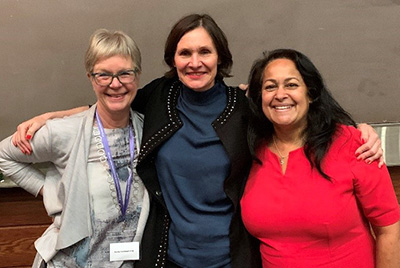
L–R: Karin Hammarberg with Conference President Professor Hanne Kristine Hegaard and Professor Joyce Harper from the UK
Dr Karin Hammarberg discussed the disconnect between the ideal biological age at which to have a baby and the increasing age of parents at conception during a keynote address she was invited to deliver at the 4th European conference on Preconception Health and Care.
The conference, themed ‘Having Children in the Future’, was held in Copenhagen, Denmark, 26-27 September, 2019, and gathered around 200 experts who presented their work relating to preconception health and care, and strategies to improve these.
Optimal parental health before conception is emerging as a new frontier for public health, and research shows that the health of both parents before conception affects the health of offspring at birth and into adulthood. Potentially modifiable factors linked to reduced fertility and poorer health outcomes for babies include parental age, obesity, smoking, alcohol consumption, poor diet, and exposure to environmental toxins.
Family building: a dream or a nightmare for young people?
In Dr Hammarberg’s presentation, titled ‘Family building: a dream or a nightmare for young people’, she cited evidence which revealed that, almost universally, young people want and expect to become parents.
“People do dream about having a baby,” says Dr Hammarberg, who recently became a member of an international consortium for fertility and preconception health education, led by Professor Joyce Harper, Professor of Reproductive Science at the Institute for Women's Health, University College London, UK,
“Yet, research indicates that the proportion of childless people who have reached the end of their reproductive years is increasing,” she says.
Hammarberg says that barriers to conception include a lack of awareness about the impact of age and health behaviours on fertility and pregnancy, not finding a partner to have children with, or having a partner who is not ‘ready’ to commit to the relationship.
“Today, there is a big gap between the ideal biological age and the ideal social age of conception,” she says.
Even though parental age is the most important factor in improving the chance of conceiving, research shows that “most people underestimate the age at which fertility starts to decline,” says Dr Hammarberg.
Dr Hammarberg reinforced the need to build awareness about the importance of fertility and preconception health optimisation, by “including fertility protection and reproductive life planning in sexual education, primary health professionals asking people about parenthood goals, and public awareness campaigns.”
In addition, “we need health professionals to provide people with realistic information about what is possible with assisted reproductive technologies (ART).”
Keynote addresses by fellow experts
Soren Ziebe, Professor in Clinical Embryology, Rigshospitalet, Copenhagen, Denmark discussed the ever-increasing reliance on ART to conceive; currently 10% of Danish children are born as a result of ARTs and outlined his views about preventive strategies to reduce.
Judith Stephenson, Professor, Institute for Women's Health, University College London, UK, described the preconception period as the new window of opportunity to influence not only pregnancy outcomes, but also future maternal and child health, and prevention of chronic conditions. Professor Stephenson is co-author on the three-part series of papers on preconception health published in Lancet in 2018.
Professor Joyce Harper reported on a key outcome of a conference hosted by the British Fertility Society (BFS), which is the creation of a website to educate children, young adults, parents, adults, teachers and health professionals about human fertility and how to protect it.
Dr Maria Ekstrand, Postdoctoral research fellow, Department of Women´s and Children´s Health, Uppsala University, Sweden, presented findings from studies conducted in Sweden relating to reproductive life planning (RLP) to avoid unplanned pregnancy.
Nicholas Macklon, Professor of Obstetrics and Gynaecology, University of Southampton, UK, presented existing evidence about the environmental and developmental determinants of ovarian function, while Dr Niels Jorgensen, Consultant and Chief Andrologist, Department of Growth and Reproduction, Rigshospitalet, Copenhagen, Denmark, discussed the associations between semen quality and men’s age, fecundity and offspring health.
Eric Steegers, Professor of Obstetrics and Gynecology, Erasmus MC, Rotterdam, The Netherlands, showed that suboptimal embryonic growth and development and the formation of the placenta in the first trimester of pregnancy have consequences for fetal and maternal health during and after pregnancy, explaining that a main risk factor for embryonic development is social disadvantage and poverty.
The 5th European Conference on Preconception Health and Care will be hosted by University College London, UK, in 2021.