
Professor Jane Fisher in Conversation: Leadership in Global Mental Health
19 May 2026
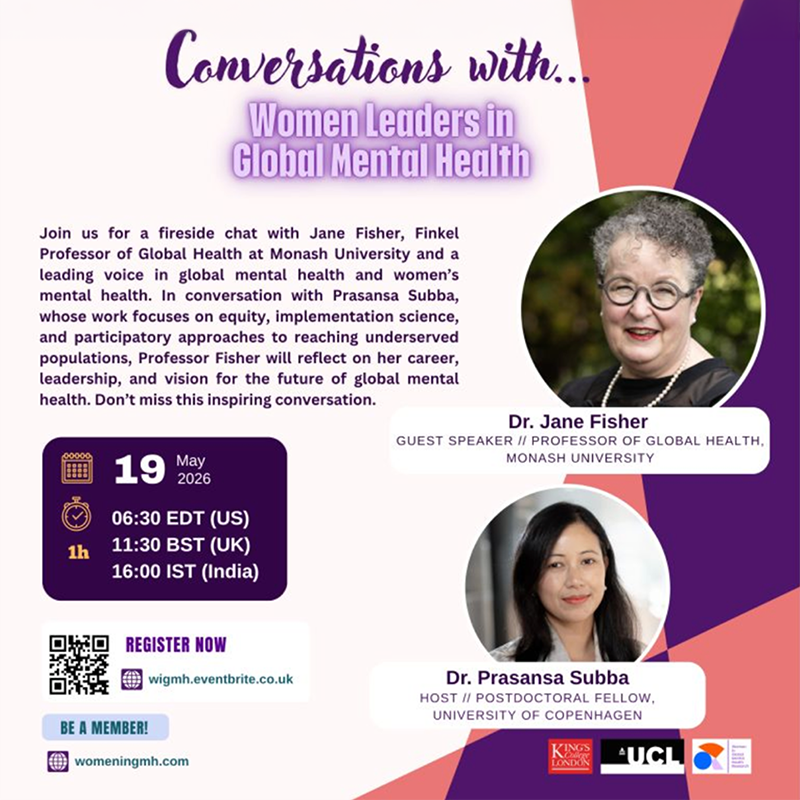 Professor Jane Fisher brought both candour and clarity to a recent Women Leaders in Global Mental Health Network conversation, tracing the personal and professional experiences that have shaped her work. In discussion with Dr Prasansa Subba, she reflected on inequality, research, and the responsibilities of leadership in global mental health.
Professor Fisher traced her story back to early childhood, visiting grandparents on a farm in Zimbabwe (formerly Rhodesia), where she noticed as a very young child that the care available to African families was strikingly different from what her own family received. That early awareness of inequality would prove formative. As a child of migration, she later moved from England to Australia, and then across multiple cities as her father changed jobs, which was an experience that left her accustomed to being "othered," to knowing what it means to be on the outside.
Her pathway into mental health was shaped largely by circumstance. Having finished school before the age of 17, she did not meet the entry requirements for medicine and was instead encouraged to study psychology. Her first role, in a large psychiatric hospital, involved working with people who were acutely unwell. During this time, she became increasingly concerned by how little attention was paid to the social and personal circumstances underlying patients’ conditions. These early experiences and concerns have shaped and defined her career.
Jane completed her PhD in her mid-thirties while raising children, at a time when part-time scholarships were not available. She credited her supervisor, Professor Jill Asbury with playing a pivotal role as her supervisor and mentor and a postdoctoral fellowship provided an important foundation for her development as a researcher. The years that followed were marked by funding pressures, publication rejections, and periods of self-doubt, and she spoke candidly about considering a return to full-time clinical practice. She remained committed to research for its broader impact, and a talent enhancement fellowship at Monash University enabled her to move into a research-only role, where she supervised students, and engaged in a wide range of preventive population health and equity focused research. She established the Global and Women’s Health Unit in 2011.
Women’s mental health research
Jane emphasised that mental health must be understood in the context of structural inequities. For women in particular, factors such as poverty, gender-based violence, unequal access to education and employment, and the burden of unpaid labour are central drivers of health outcomes, not the result of biological vulnerability. She also reflected on the ways women were often characterised or dismissed in clinical settings, and her ongoing commitment to challenging these narratives.
One of her significant contributions to the field is What Were We Thinking? A program based prevention initiative for first-time parents integrated into primary maternal and child health services. Delivered as a program for both partners, it combines practical guidance on infant care with support for navigating changes in relationships and responsibilities. A cluster randomised controlled trial demonstrated significantly lower rates of depression and anxiety, alongside increased parenting confidence at six months postpartum, with benefits sustained at eighteen months. The program continues to reach families online and is growing in reach internationally. It has been adapted for communities in Chile, translated into Catalan, and developed in Amharic for Melbourne's Ethiopian community, with further work underway in Vietnam.
Climate change and mental health
Jane also discussed recent work on the mental health impacts of climate-related disasters, including research following the 2019–20 Australian bushfires. She highlighted related work led by her PhD students in communities affected by earthquakes in Nepal, China, and Pakistan. As awareness of climate change grows, she noted, understanding its intersection with mental health is becoming increasingly important across all areas of research.
Asked about leadership, Jane noted that it was not something she initially set out to pursue, but rather developed over time through taking opportunities as they arose. She emphasised the importance of being willing to step beyond one’s comfort zone and to learn through experience. “Leadership is both a responsibility and a platform”, she noted and an opportunity to address inequity and to support the success of others, noting that kindness is a strength, not a limitation in effective leadership.
Advice for early career researchers
In response to audience questions, Jane offered practical advice to researchers navigating uncertainty and burnout. She encouraged aligning research with the priorities of health systems and governments, and developing the skills to communicate evidence beyond academic audiences. For women in the Global South, she recommended approaching a career in global mental health as a long-term endeavour; building equitable partnerships and avoiding extractive research models. She reflected on her experience in Vietnam, where she was encouraged not simply to identify problems, but to remain engaged in developing solutions collaboratively. Jane has led a major program of policy-relevant research in early child development in Vietnam for 30 years, working with governments and community-level collaborators.
The session provided an opportunity to hear from one of the field’s most experienced voices, and a reminder, offered with a smile, that the “P” in PhD stands for persistence.
The event was presented by Women in Global Mental Health in partnership with King’s College London, University College London. The series highlights the experiences of women shaping global mental health research.