
Symposium enables women’s health knowledge sharing in Japan
9 October 2019
In August 2019, a delegation of doctors, midwives, university lecturers and students from Japan learnt about the latest in the prevention of women’s health problems, research methods, and online resources for health promotion, while attending a women’s health professional development symposium at Monash’s School of Public Health and Preventive Medicine.
Now in its ninth year, the annual symposium is jointly hosted by the School’s Global and Women’s Health Unit, and Japan’s Fumi Horiguchi Women’s Health Research Institute.
Gendered approach
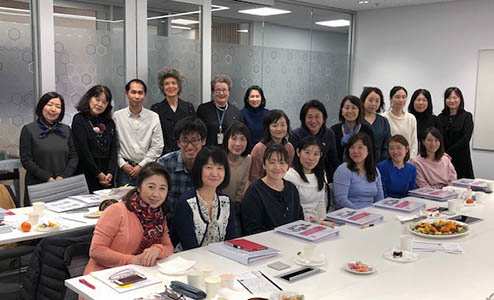 Monash University’s head of Global and Women’s Health, Professor Jane Fisher, says that the significance of a gender-informed approach to research and the clinical treatment of conditions is becoming clearer.
“Research that specialises in understanding the social determinants of women’s health, in particular gender-based risks, has been increasing worldwide including in Japan. This has improved the recognition of the adverse health effects of violence against women and of restrictive gender stereotypes,” says Prof Fisher.
“This research has led to better health promotion, and prevention and treatment of health problems that are specific to women, or where patterns of risk and protective factors are different for women than for men.”
In this respect, Prof Fisher say the symposium offers “the opportunity for specific learning in the area of women’s health.”
The delegates appreciate the opportunity to visit services where these practices are embedded, like Jean Hailes for Women’s Health, Victoria’s Domestic Violence Resource Centre, the Royal Women’s Hospitals Health Information Service and Masada Private Hospital Early Parenting Centre.
Knowledge sharing
Research Fellow Dr Tomoko Honda, who coordinates the annual symposium, says that facilitating knowledge transfer is a core component of its success.
“Helping our delegates to embed key learnings in to programs in Japan is a meaningful way for our Unit to scale up proven concepts and programs internationally,” says Professor Fisher.
Dr Mari Takahashi, who is a midwife, professor at the Faculty of Health Care and Nursing of Juntendo University, and long-time participant says that through the symposium, she has had the opportunity to establish programs back home in Japan.
After learning about the Monash University developed parenting program, What Were We Thinking (WWWT), Dr Takahashi has secured funding to develop the Japanese version of WWWT – with special support from Prof Fisher and Dr Heather Rowe. WWWT has also been covered in the Japanese Journal of Perinatal Mental Health, and the program has been presented at relevant conferences and training seminars in Japan.
Medical doctor and associate professor of Tokyo Women’s Medical University, Dr Jinko Yokota – who has also been a long-time attendee at the symposium – says that the Fumi Horiguchi Women’s Health Institute was established following learning about the organisational model of Jean Hailes. Dr Yokota also published an article on premenstrual syndrome in Tokyo Women’s Medical University Journal after acquiring profound knowledge on the subject at Monash.
Broadcast writer, part-time women’s studies lecturer, and director of Tokyo non-profit organisation ‘Freebee’, Ms Yumi Okura, has attended five of the symposiums including this year. Ms Okura has delivered lectures in communities, women’s colleges and medical associations relating to information covered at the women’s health symposiums including: domestic violence and gender, prevention of sexual violence, and antenatal women’s health.
“We value these important relationships we have established through the annual symposium and acknowledge the commitment of the many individuals in taking key learnings to be shared in some capacity at home in Japan,” concludes Prof Fisher.