
New model reshapes how implementation science tackles inequity
A new model designed to help organisations deliver programs and innovations in ways that are equitable, community‑driven and grounded in real‑world evidence has been launched today.
The Model of Equitable Transdisciplinary Implementation Science (METIS) responds to a long‑recognised gap in implementation science: most evidence‑based programs work well for the majority, but can still fail for a large proportion of people, which is often those experiencing inequities and who need support the most.
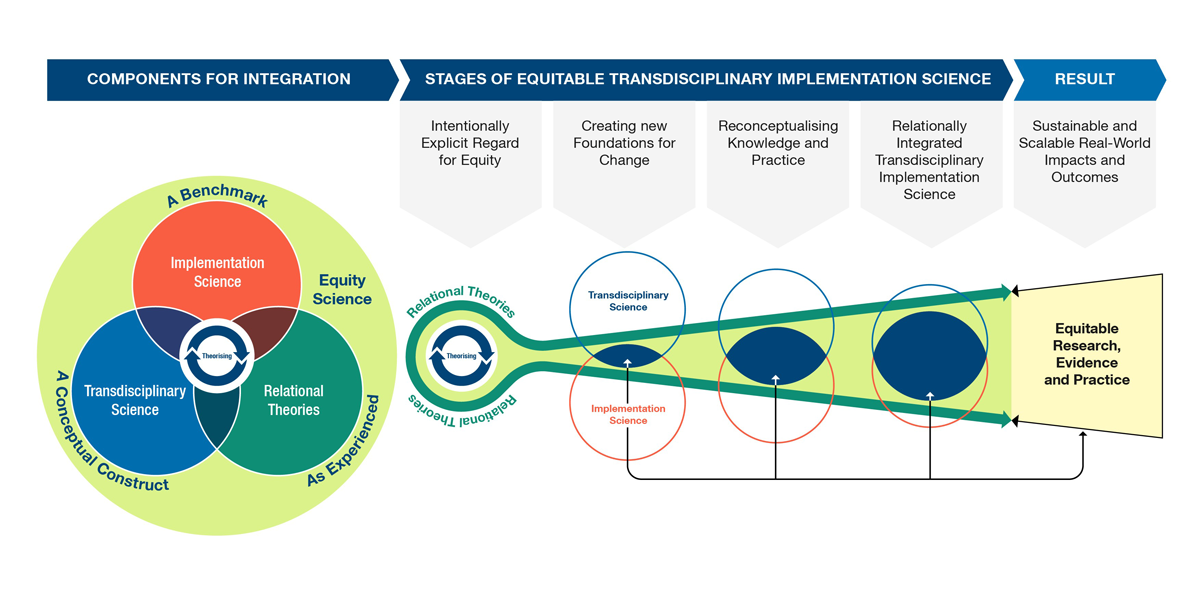
Led by Dr Mandy O’Connor and Dr Heather Morris from Monash University’s Health and Social Care Unit (HSCU), Advancing knowledge(s) and action with equity: Introducing the Model of Equitable Transdisciplinary Implementation Science (METIS) was published this month in the Journal of Health Equity.
“This model is for use in the real world, driven by the needs of communities and we are thrilled to see it published,” Dr O’Connor said.
She said the model, designed for those working in health, social care and education settings, aimed to reduce the equity gap by incorporating evidence outside the standard Western, Eurocentric academic literature – incorporating community-generated knowledge or Lived Experience Expertise, multiple disciplines and relational practices such as deep listening, trust-building and reflection on values and biases.
The model also aligns with First Nations’ epistemologies, explicitly connecting with Indigenous knowledge systems, and relational ways of being.
“If we’re just using evidence from Western perspectives, we’re missing critical pieces,” Dr O’Connor said. “We know our strategies won’t necessarily work for those marginalised communities and we need to do better for them.”
“There isn’t just one truth. The Western Eurocentric idea is we follow scientific principles and will get to the one silver bullet that works for everybody, and that’s just not the way humans are,” Dr Morris added.
METIS brings together three essential components: implementation science, transdisciplinary science, and relational theories, within a broader equity science framework. It guides practitioners through staged processes that make equity explicit, measurable and actionable.
The researchers emphasised that many practitioners already worked in relational, equity‑aware ways – METIS simply makes these practices visible, teachable, and transferable.
“People are already doing a lot of this intuitively, METIS helps break it down and call it out explicitly,” Dr Morris said.
The team will begin sharing METIS internationally, including upcoming engagements in Ireland, and the Netherlands, with plans for future workshops and real‑world testing.
“I’m excited to see how it lands. I want this to create a buzz in the sector,” Dr Morris said.
Ultimately, METIS aims to support organisations across health, education and social care to design programs that genuinely meet the needs of people who have historically been overlooked.
“If we want to address inequities, we have to do things differently. METIS helps us do that,” Dr O’Connor said.
METIS is a product of a larger body of research – Strengthening implementation practice and research with equity (SEMPRE) – led by HSCU Head of Unit Professor Helen Skouteris. Prof Skouteris recently received a Level 3 NHMRC Investigator Grant to continue building on this groundbreaking equity-focused work, of which testing the METIS model will be a feature.
Key features of METIS
- Integrates three sciences: implementation, transdisciplinary, relational
- Centres equity as benchmark, concept and lived experience
- Uses staged processes to make equity practical
- Supports Indigenous and non‑Western ways of knowing
- Provides real‑world examples and guidance
- Designed for health, education and social care sectors
AUGUST, 2026