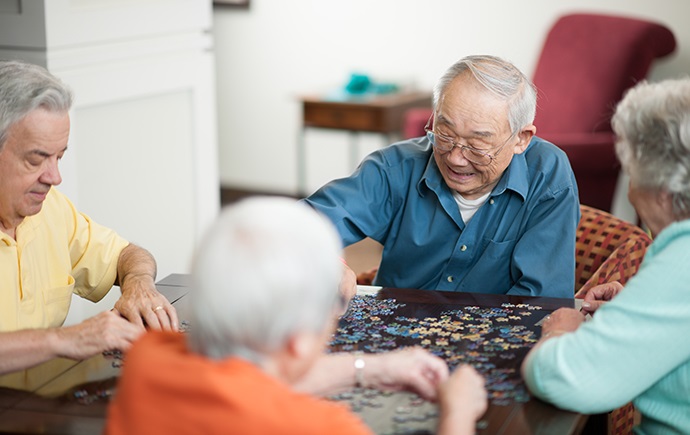
We undertake research grounded in ageing and dementia care settings to improve the health, wellbeing, and quality of life of older people, as well as the systems that shape how care is delivered. Working in partnership with aged care providers, practitioners, older people, families, and communities, we identify and respond to priority challenges, and co‑design, implement and evaluate practical solutions that work in real‑world settings.
Our Vision
To support the delivery of high‑quality, safe ageing and dementia care by bridging the gap between evidence and practice through meaningful partnerships between research and care. We aim to ensure that evidence informs practice, while the realities of care delivery and system‑level influences shape and strengthen the evidence base for meaningful and sustained change.
Our Approach
As embedded academics, we work alongside aged care organisations to respond directly to sector needs. By translating research into practice – and learning from practice to inform research – we support sustainable improvement and innovation across ageing and dementia care.
The Research Team
ViewClose
Meet our Aged Care and Health Services research teamView
Our Research
ViewClose
Living Well Together: a holistic model of careView
Living Well Together is an innovative, industry-initiated model of care developed in partnership with BaptistCare and researchers from Monash University, including Dr Marta Woolford. This model was co-designed using a participatory action research approach to transform how care is provided to residents in BaptistCare residential aged care (RAC) homes, ensuring it meets the diverse needs of all residents, including those with physical and cognitive impairments.
A Collaborative Effort
The development of Living Well Together involved extensive collaboration and research. The team visited eight BaptistCare homes, conducting interviews, focus groups, and surveys with residents, families, staff, and volunteers to gather valuable insights and lived experiences. These efforts, combined with RAC environmental assessments and academic research on best care practices, shaped the model's foundation.
Five Domains of Care
Living Well Together is built on five key domains:
Person-Centred Care:
Dementia-Friendly Environments
Integration and Coordination of Care
Clinical Care
Workforce and Training
Implementation and Impact
In July 2023, Living Well Together was implemented at two BaptistCare RAC homes. To ensure the model meets the needs of residents and staff, Dr Marta Woolford conducted an evaluation at these pilot sites. The evaluation showed positive impacts with residents engaging more meaningfully in activities in the home and staff feeling more confident and knowledgeable in their roles.
Looking Ahead
Following the successful evaluation, the Living Well Together Model of Care has been rolled out to the remaining 14 BaptistCare RAC homes in Victoria throughout 2024-2025. This expansion will further enhance the quality of care and support provided to all residents, fostering a community where everyone can live well together.
Continuity of Carer: Supporting Engagement Program at Regis Aged CareView
Dr Marta Woolford and Professor Helen Skouteris have worked with Regis Aged Care to develop the Supporting Engagement Program for their Continuity of Carer Model.
A Holistic Approach
This program adopts a whole-of-home approach, integrating staff training, environmental modifications, and engagement strategies to create a person-centred care program. By involving all staff roles and enhancing living spaces, the program fosters meaningful connections and promotes dignity, choice, and independence among residents.
Measuring Impact
Leveraging the initial work with Regis, Dr Marta Woolford was awarded a Dementia Australia Research Foundation (DARF) Post-doctoral Fellowship to do an extensive evaluation of the program. She will measure key outcomes such as residents' quality of life, fall rates, use of restraints, and independence in daily activities, alongside evaluating the implementation process, with the ultimate goal of building a road-map for program sustainability.
Ensuring Sustainability
To identify what works best in implementing the program, Dr Woolford will conduct interviews and case studies. These insights will help refine our strategies and ensure the program's sustainability.
A new Dementia Model of Care for Mercy Health residential aged care homesView
HSCU (Dr Marta Woolford) has partnered with Mercy Health to develop, implement, and evaluate an innovative dementia model of care for their residential aged care (RAC) homes.
A Legacy of Care
For nearly two decades, Mercy Health has been dedicated to providing exceptional RAC services to older Australians, with 30 homes across the country. However, ensuring consistent, high-quality care across diverse locations—spanning different states and both rural and metropolitan areas—presents unique challenges.
A Strategic Partnership
Mercy Health partnered with Dr Marta Woolford and Professor Helen Skouteris to create a new dementia model of care that is co-designed with Mercy Health staff. This model is grounded in evidence-based best practices and aims to enhance workforce and environmental capacity, ensuring high-quality care for residents living with dementia.
Innovative Approach
Dr Woolford and Professor Skouteris will work with Mercy Health Aged Care staff, residents and families to develop, pilot-test, and evaluate the new model in three RAC homes. Additionally, the team will craft an implementation plan that leverages frameworks from implementation science and the socio-ecological model. This plan will ensure the successful roll-out and sustainability of the dementia model of care across all Mercy Health RAC homes.
BaptistCare Researcher-in-Residence Dr Melissa Savaglio is embedded within their national organisation to lead and support the development, implementation, evaluation and scale-up of various health and social care innovations driven by a Living Lab approach, underpinned by implementation science.
Quality of Life
This research aims to improve health outcomes for communities and individuals experiencing vulnerability and disadvantage across the lifespan, with a specific focus on enhancing the quality of life of older adults across BaptistCare’s aged care services: residential aged care; retirement living; and home care. The focus of this research is to establish and embed a Living Lab, where research and innovation are integrated in practice across BaptistCare’s aged care services.
Implementation Science – Living Lab
Core components of the Living Lab approach include:
Co-Creation: BaptistCare’s clients, residents, staff and broader community members actively participate in identifying research priorities, developing innovative solutions and driving the research
Real-World Environment: Research and innovations are tested and refined in real-life settings to ensure practicality, relevance, and scalability
Continuous Learning: Research is agile, flexible, directly informs practice, and contributes to continuous improvement
Integrated: Research is embedded within the day-to-day operations across all areas of BaptistCare
Continuous Growth and Support
The Living Lab serves as a platform for continuous learning, innovation, reflective practice, and quality improvement, enabling BaptistCare to evaluate, refine, and scale models of care, programs, and technologies in real-world settings. The Living Lab seeks to close the research to translation practice gap, enhance quality of care, and ultimately achieve improved outcomes for older adults.
Ann MacRae’s PhD project focuses on the development of an intervention to apply trauma-informed care (TIC) within Residential Aged Care, using an Intervention Mapping framework to guide its design.
Meeting a need
Although the strengthened Aged Care Quality Standards include trauma-aware and healing-informed approaches, there is currently no model or framework specifically guiding the application of trauma-informed care within the Residential Aged Care sector. Furthermore, aged care organisations have not been provided with guidance on how to implement trauma-informed care in practice. Ann’s PhD aims to address this gap.
Partnership and co-design
A series of studies have been conducted to inform the needs assessment for the intervention. These include two reviews, a qualitative study with project partner Regis Aged Care, mapping the Aged Care Quality Standards to a trauma-informed care framework, and a sector-wide mixed-methods survey. Findings from these studies will inform recommendations for the proposed intervention. Strategies for practice and implementation will be co-designed in partnership with Regis Aged Care in 2026.
Industry leading
The research outputs are projected to produce a blueprint for Regis Aged Care, and the wider sector, to integrate trauma-informed care into organisational practice. This will be the first initiative of its kind within a Residential Aged Care setting globally, with potential benefits to aged care staff, residents, their families, and the broader aged care sector.