
Women's health across the reproductive years
- CRE HiPP
- HiPPP Portal
- A socio-ecological approach to weight stigma in preconception, pregnancy, and postpartum
- Reframing understanding of preconception lifestyle health: A socioecological approach
- Body image and disordered eating during reproductive years
CRE HiPP
Directed by Professor Helen Skouteris, HSCU leads the Centre of Research Excellence in Health in Preconception and Pregnancy (CRE HiPP), funded from 2020-2025.
CRE HiPP aims to create evidence-based knowledge and support for women before and during pregnancy, to improve the health of women and the next generation by:
- Generating new knowledge across preconception and pregnancy in relation to diet and physical activity behaviours across the research pipeline from co-design to economic evaluation;
- Translating new knowledge into policy and practice;
- Developing a multidisciplinary research workforce; and
- Leveraging extensive existing collaborations.
Using a systems approach, CRE HiPP reaches women through workplaces, community health, fertility services, maternity services, and primary care. We have a specific aim to develop culturally appropriate adaptations to our work.
For more information on CRE HiPP, please visit our website: hipp.org.au
HiPPP Portal
An example of our work in CRE HiPP includes the Health in Preconception, Pregnancy, and Postpartum Workplace Portal (HiPPP Portal), led by Dr Briony Hill, along with Professor Helen Skouteris, Ms Seonad Madden, Dr Claire Blewitt, and Dr Mandy O’Connor.
The HiPPP Portal has been co-developed at MacKillop Family Services and is also being co-developed at the University of Tasmania, in collaboration with Professor Andrew Hills and Dr Kiran Ahuja.
The HiPPP Workplace Portal provides a “one stop shop” for people and families to source evidence-based information about health, wellbeing and maternity/parental leave policies and practices during these reproductive life phases and is tailored to each workplace to suit the needs of their employees.

HiPPP Portal
Watch the HiPPP Portal launch by MacKillop Family Services CEO Robyn Miller to learn more about this initiative.
We have developed an Implementation Guide that can be used by other organisations to develop and implement a HiPPP Portal.
Our publications relating to the HiPPP Portal include:
- Madden SK, Ahuja KDK, Blewitt C, Hill B, Hills AP, Skouteris H. Understanding the pathway between work and health outcomes for women during the preconception, pregnancy, and postpartum periods through the framing of maternal obesity. Obesity Reviews. 2023 Sep 1:e13637. doi: 10.1111/obr.13637.
- Blewitt C, Savaglio M, Madden SK, Meechan D, O'Connor A, Skouteris H, Hill B. Using Intervention Mapping to Develop a Workplace Digital Health Intervention for Preconception, Pregnant, and Postpartum Women: The Health in Planning, Pregnancy and Postpartum (HiPPP) Portal. International Journal of Environmental Research and Public Health. 2022 Nov 16;19(22):15078. doi: 10.3390/ijerph192215078.
- Madden SK, Blewitt C, Hill B, O'Connor A, Meechan D, Skouteris H. 'It's just the nature of the work': Barriers and enablers to the health and well-being of preconception, pregnant and postpartum working women in a community service organisation. Health and Social Care in the Community. 2022 Nov;30(6):e6475-e6486. doi: 10.1111/hsc.14093.
- Madden SK, Blewitt CA, Ahuja KDK, Skouteris H, Bailey CM, Hills AP, Hill B. Workplace Healthy Lifestyle Determinants and Wellbeing Needs across the Preconception and Pregnancy Periods: A Qualitative Study Informed by the COM-B Model. International Journal of Environmental Research and Public Health. 2021 Apr 14;18(8):4154. doi: 10.3390/ijerph18084154.
- Madden SK, Cordon EL, Bailey C, Skouteris H, Ahuja K, Hills AP, Hill B. The effect of workplace lifestyle programmes on diet, physical activity, and weight-related outcomes for working women: A systematic review using the TIDieR checklist. Obesity Reviews. 2020 Oct;21(10):e13027. doi: 10.1111/obr.13027.
- Madden SK, Skouteris H, Bailey C, Hills AP, Ahuja KDK, Hill B. Women in the Workplace: Promoting Healthy Lifestyles and Mitigating Weight Gain during the Preconception, Pregnancy, and Postpartum Periods. International Journal of Environmental Research and Public Health. 2020 Jan 28;17(3):821. doi: 10.3390/ijerph17030821.
In addition to CRE HiPP, funding for this project was provided by the Australian Government’s Medical Research Future Fund (MRFF) Boosting Preventive Health Research Program, administered through The Australian Prevention Partnership Centre (TAPPC).
A socio-ecological approach to weight stigma in preconception, pregnancy, and postpartum
This ARC Discovery Project (2022-2025) is led by Dr Briony Hill (CIA) and Professor Helen Skouteris (CIB) in HSCU in collaboration with Professor Lucie Rychetnik (University of Sydney), Professor Matthew Fuller-Tyszkiewicz (Deakin University), Associate Professor Jacqueline Boyle (Eastern Health Clinical School), Dr Angela Incollingo Rodriguez (Worcester Polytechnic University, USA), Dr Divya Ramachandran (Monash University) and Jane Martin (Cancer Council Victoria).
The overall aim of this project is to develop guidance for the translation of weight stigma evidence into preconception, pregnancy, and postpartum obesity-related policy. It focuses on the socio-ecological factors that perpetuate weight stigma in women across the reproductive life phase, that is, in women planning a pregnancy, in women who are pregnant and in mothers who have given birth within a 24-month period.
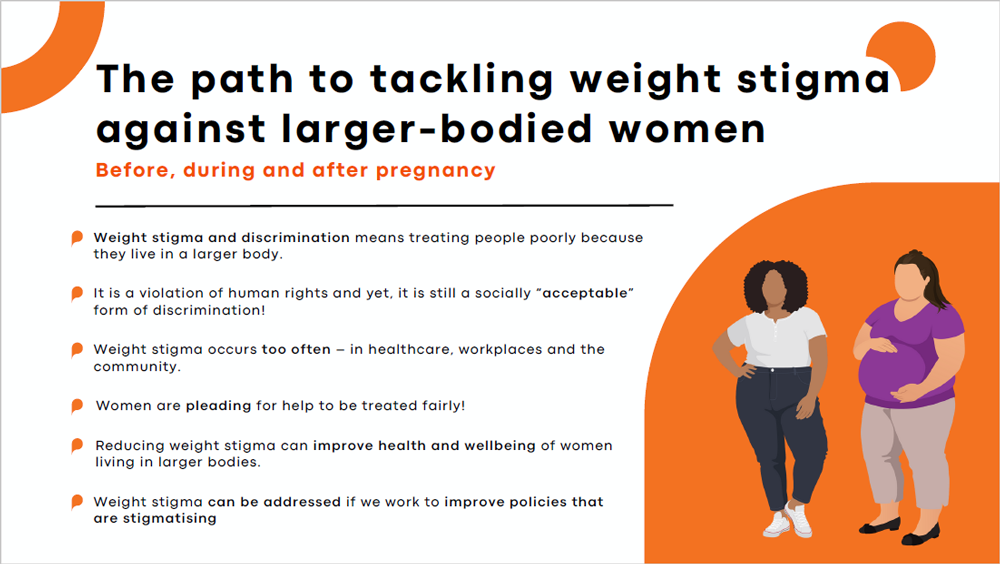
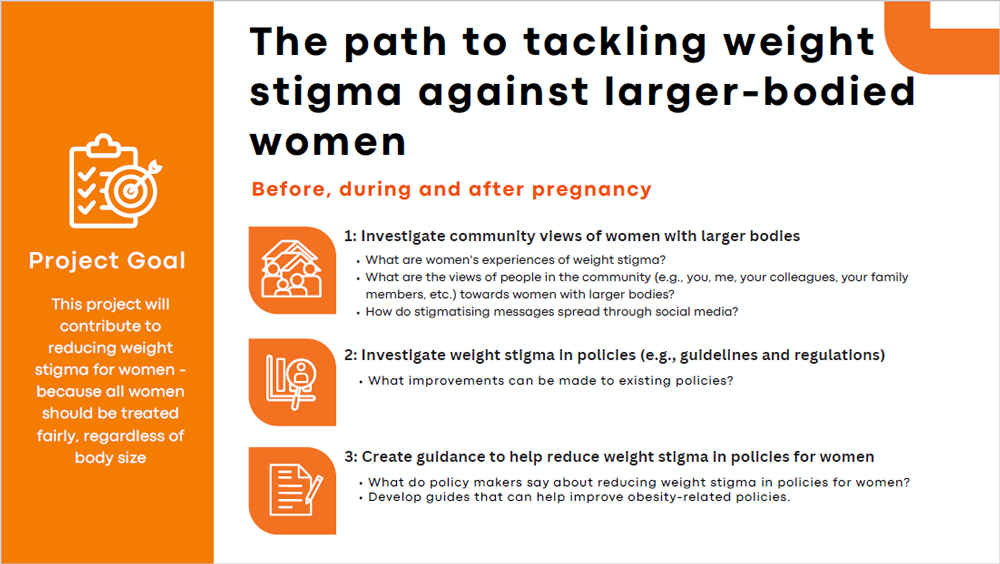
PhD students Haimanot Hailu and Michelle Dever are completing core elements of this program of work focusing on societal perspectives and women’s perspectives, respectively (see step 1 in infographic, above).
Key publications that informed the development of this research include:
- Hill B, Bergmeier H, Incollingo Rodriguez AC, Barlow FK, Chung A, Ramachandran D, Savaglio M, Skouteris H. Weight stigma and obesity-related policies: A systematic review of the state of the literature. Obesity Reviews. 2021 Nov;22(11):e13333. doi: 10.1111/obr.13333.
- Hill B, Incollingo Rodriguez AC. Weight Stigma across the Preconception, Pregnancy, and Postpartum Periods: A Narrative Review and Conceptual Model. Seminars in Reproductive Medicine. 2020 Nov;38(6):414-422. doi: 10.1055/s-0041-1723775.
- Hill B. Expanding our understanding and use of the ecological systems theory model for the prevention of maternal obesity: A new socioecological framework. Obesity Reviews. 2021 Mar;22(3):e13147. doi: 10.1111/obr.13147.
Reframing understanding of preconception lifestyle health: A socioecological approach
This project is funded by an ARC Discovery Early Career Researcher Award (DECRA; 2023-2025), awarded to Dr Briony Hill.
The aim of this project is to reframe our understanding of preconception lifestyle health in women. From the current narrative of blaming women for their health to one that implicates broader societal perspectives to support women to optimise their diet and physical behaviours before pregnancy.
This project will generate new knowledge and conceptual and theoretical understanding that will enable women and those in the ecological environment, to be empowered to eliminate weight stigma in the preconception period.
This project draws upon a strong program of existing research in the preconception field, including CRE HiPP (described above), an NHMRC Early Career Fellowship completed by Dr Hill, and the ARC Discovery Project on weight stigma (described above; see Figure).
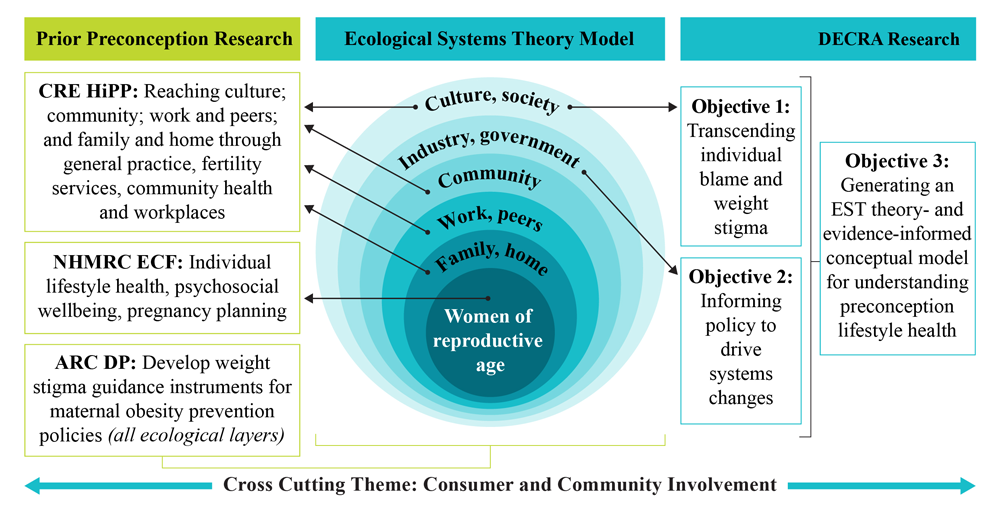
PhD student, Chloe Tran is working within this project to transcend individual blame and weight stigma in the preconception period by focusing on the healthcare setting.
Key publications relating to this research include:
- Jayawickrama RS, Hill B, O'Connor M, Flint SW, Hemmingsson E, Lawrence BJ. Assessing explicit weight bias among Australian health care students: Suitability of the Beliefs About Obese Persons Scale (BAOP) and the Antifat Attitudes Questionnaire (AFA). Stigma and Health. Advance online publication 2023 Oct 1. doi: 10.1037/sah0000484.
- Kandel P, Lim S, Pirotta S, Skouteris H, Moran LJ, Hill B. Enablers and barriers to women's lifestyle behavior change during the preconception period: A systematic review. Obesity Reviews. 2021 Jul;22(7):e13235. doi: 10.1111/obr.13235.
- Hill B, Hall J, Skouteris H, Currie S. Defining preconception: exploring the concept of a preconception population. BMC Pregnancy and Childbirth. 2020 May 7;20(1):280. doi: 10.1186/s12884-020-02973-1.
- Yazdizadeh B, Walker R, Skouteris H, Olander EK, Hill B. Interventions improving health professionals' practice for addressing patients' weight management behaviours: systematic review of reviews. Health Promotion International. 2021 Mar 12;36(1):165-177. doi: 10.1093/heapro/daaa039.
Body image and disordered eating during reproductive years
Pregnancy and postpartum present unique opportunities that increase women’s risk of developing body dissatisfaction and disordered eating. They are also important perinatal screening priorities as they may be experienced by women of any body weight or size, yet are typically excluded from gestational weight and health behaviour intervention research and care.
The body image and disordered eating during reproductive years project highlights the often-overlooked role that body image and its associated psychosocial factors can play in steering women’s health outcomes during pregnancy and postpartum.
It also investigates factors involved in the development, relapse or maintenance of disordered eating behaviours during reproductive years, with the aim of advancing evidence that will better support clinicians and women to navigate the complex psychological, emotional and physiological factors involved in enhancing birthing outcomes for mothers and their babies.
Led by Dr Heidi Bergmeier and Professor Helen Skouteris, the project builds on seminal research in the field, including conceptual models of body dissatisfaction and other psychosocial factors of excessive gestational weight gain, exclusive breastfeeding, postpartum weight retention, and the development of the Pregnancy Figure Rating Scale (PRFS) – a measure of discrepancies between current and ideal shape during pregnancy, that is now used by researchers internationally – and the Body Image in Pregnancy Scale (BIPS-G) – translated and validated for use in Germany.
Key publications relating to this project include:
- Bergmeier H, Hill B, Haycraft E, Blewitt C, Lim S, Meyer C, Skouteris H. Maternal body dissatisfaction in pregnancy, postpartum and early parenting: An overlooked factor implicated in maternal and childhood obesity risk. Appetite. 2020 Apr 1;147:104525. doi: 10.1016/j.appet.2019.104525. Impact Factor: 3.501.
- Watson B, Fuller-Tyszkiewicz M, Broadbent J, Skouteris H. Development and validation of a tailored measure of body image for pregnant women. Psychol Assess. 2017 Nov;29(11):1363-1375. doi: 10.1037/pas0000441.
- Skouteris H, Carr R, Wertheim EH, Paxton SJ, Duncombe D. A prospective study of factors that lead to body dissatisfaction during pregnancy. Body Image. 2005 Dec;2(4):347-61. doi: 10.1016/j.bodyim.2005.09.002.