
Chloe Gration: Beyond the Horizon

Image: Chloe Gration at a recent Jobs Victoria forum. Photography 104 courtesy Chloe Gration.
BM: Hello Chloe. Thanks so much for chatting with us today. You’ve recently graduated from Monash – can you start by telling me what you studied?
CG: Hey there! I graduated from Monash with a Bachelor of Collaborative Design (Co-Design) in 2021. I was one of the first people to graduate with this degree, which feels pretty special. It’s exciting to be part of the growing social movement of co-design.
BM: What is meant by ‘co-design’ and why is it so important in government and industry? It’s interesting that you describe it as a ‘social movement’ as opposed to, say, a ‘discipline’...
CG: The ‘co’ in co-design stands for community and collaboration. It involves the people most affected by a design or decision working together to improve outcomes. It’s about bringing together people with lived experience and those with professional expertise. What sets co-design apart from other approaches, such as human-centred design, is the emphasis on developing relationships, building capability and sharing power. That’s why co-design is more than a discipline, it’s a social movement.
In recent years, governments and industry have started to see the value of co-design. We know that, unfortunately, many of our existing services and systems are failing the people that they’re supposed to serve. If we want to produce better outcomes, we need to do things differently. Co-design is one way that governments and industry can partner with people and communities to improve service outcomes and transform systems.
BM: Right, so can you tell me about some of the different ways that co-design is facilitated?
CG: Traditionally, designers and professionals developed products and services with some user research and testing. With a co-design approach, the role of the designer shifts from ‘expert’ to facilitator and coach. Rather than designing for people, we’re designing with people. We bring together diverse groups and create the conditions for successful collaboration. This includes everything from making the space (both physical and metaphorical), designing materials and facilitating activities to encouraging participation and creative thinking. Co-design is new and unfamiliar to many people. It’s up to designers to guide people through this process, grow their confidence and build capability.
BM: When you left high school, did you know exactly what you wanted to do next? Or did you come to co-design via another field?
CG: In high school, I really enjoyed visual arts and knew that I wanted to do something creative. I thought that meant I was going to become a graphic designer. However, when I came to the Monash Open Day, I learnt about industrial design and was really taken by it. I was so impressed by the range of student projects on display. Everything from furniture and lighting design to children’s toys, medical devices and even an archaeologist's toolkit!
I later discovered that I could design not only products but also services. I’d never really thought much about service design and had no idea that it could be a job. Services, by their nature, are largely invisible and so too are service designers. I was fascinated by the hidden services that shape our lives, including access to healthcare, education, transport and legal services. I started thinking more about who has the power to make decisions about these services. I realised that the people and communities most impacted by design decisions often had very little input.
When Monash Art, Design and Architecture introduced a new major in co-design, I knew this was an area that I wanted to explore. Around this same time, the Royal Commission into Victoria’s Mental Health System released its final report. Nearly a third of the Royal Commission’s recommendations called for co-design (or co-production) with people with lived experience. It was an ideal opportunity to combine my interest in co-design with my passion for mental health reform.
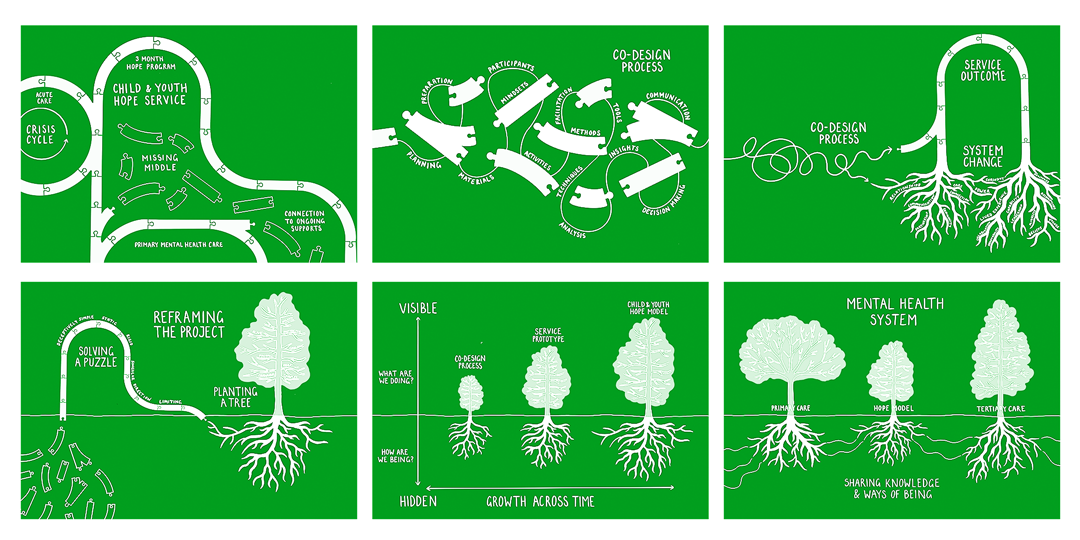
Image: Chloe Grations worked with Orygen to co-design the new Child and Youth HOPE service, receiving the Outstanding Project: Collaborative Design award as part of MADA Now 2021. Illustrations courtesy Chloe Gration.
BM: Can you talk a bit more about your work in the co-design and mental health space?
CG: For my final year project, I worked with the mental health organisation Orygen on the co-design of a new service aimed at preventing youth suicide. I helped to facilitate a series of workshops with young people with lived experience, as well as carers and mental health clinicians. Through these workshops, we developed future journeys and principles for a new service model.
Throughout the project, I thought a lot about the relationship between co-design, service outcomes and system change. I felt the tension between the need for rapid service delivery and more significant long-term system reforms. I wondered whether we should be designing for the current system or aspiring towards deeper change. Over time, I recognised that we need to do both. Not only were we designing a new service together, but we also had an opportunity to start creating real system change through shifting mindsets, sharing power and forming new relationships.
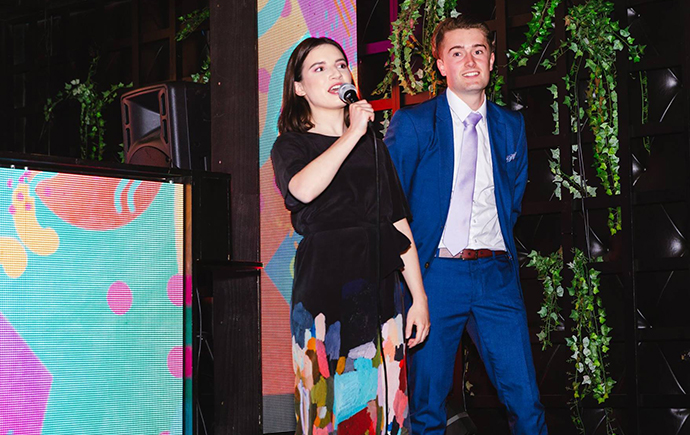
Image: Chloe Gration welcoming guests to MADA Ball 2018. Photography courtesy Chloe Gration.
BM: In your second year of university, you founded the MADA Student Society – affectionately known as MADASS! Can you tell me a bit about the organisation and what motivated you to start it?
CG: When I started at Monash, I was really eager to meet new people and get involved in student life. I was surprised to discover that Monash Art, Design and Architecture was the only faculty that didn’t have a student society. I wanted to create an organisation that could foster a sense of community and connection across the faculty. I talked about the idea with some friends and, the next year, we decided to make it happen!
In the society’s first year, we grew from a small group of friends to a dedicated committee and recruited over 100 members. We hosted lots of great social events, including the first annual MADA Ball. That night, an international student and close friend of mine came up and told me that “MADASS feels like family”. It was from there that we got our motto: ‘a family of creatives’.
Since then, MADASS has grown so much, with hundreds of new members. The society continues to organise fantastic social and professional events, including industry panels and networking nights. It makes me so happy that MADASS is still going strong and supporting students.
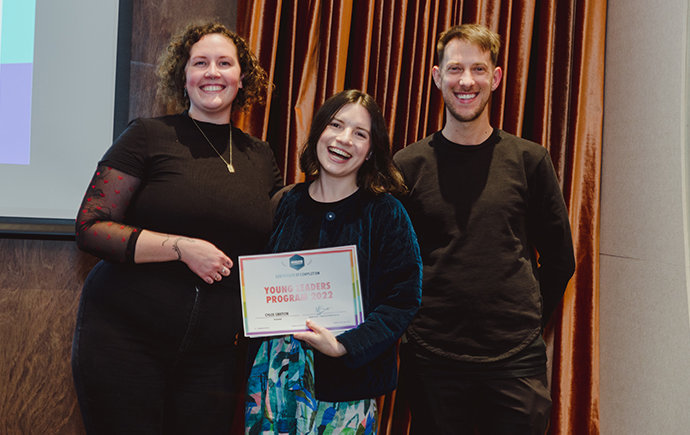
Image: Chloe Gration with Minus18’s Meg-an Windred and Micah Scott. Photography courtesy Chloe Gration.
BM: That’s incredible! Reflecting on your study and career path to date, a common thread is your focus on building community and connection. Can you tell me about your involvement with Minus18?
CG: Minus18 is an organisation that hosts events for LGBTQIA+ young people. I first got involved after hearing the CEO Micah Scott (who’s also an Art, Design and Architre alum) speak at an event for Design Fringe. I was blown away by Micah’s story and incredible commitment to championing LGBTQIA+ youth. Afterwards, he mentioned that Minus18 was recruiting for a new leadership program. I decided to apply and it was one of the best decisions I’ve ever made. I love creating events and spaces (both in-person and online) where LGBTQIA+ young people can feel a sense of belonging, connection and pride!
BM: You’re currently working as a service designer at Jobs Victoria. What does a service designer do in this context?
CG: Jobs Victoria is a government agency that supports people looking for work and connects employers with the staff they need. As a service designer, my role is to understand the needs of the different people using our services so that we can help them to achieve their goals, create positive experiences and deliver outcomes.
In a practical sense, what that looks like is doing design research activities, such as interviews, to uncover the needs, motivations and pain points for people using our services. I then take my learnings and develop artefacts – such as personas, journey maps and service blueprints – to communicate and share with teams across our organisation. I also make recommendations to our technology delivery teams and am involved throughout the development of new digital products, including prototyping and testing. Across all the work that I do, I advocate for the people who use our services, especially those most marginalised and disadvantaged. It’s what motivates and drives me in this role.
BM: What projects are you involved in right now?
CG: I’m working on a project to redesign Jobs Victoria’s digital platforms to adapt to the changing employment environment. Over the past few years, we’ve seen massive changes, with very high unemployment during the peak of the pandemic and now record low unemployment. Many employers are struggling to attract staff and we’re seeing workforce shortages across key sectors, such as healthcare and community services. Meanwhile, certain regions and groups are still experiencing persistently high unemployment and disadvantage. The challenge for Jobs Victoria is how to create products and services to address these specific needs, while also being flexible enough to adapt and respond to future changes.
BM: Finally, any advice for someone thinking about a career in co-design?
If you care about people and communities, want to tackle complex challenges and create social change, co-design is for you. We need more co-designers. If you want to learn more, the book Beyond Sticky Notes (2020) by Kelly Ann McKercher is a great place to start. The co-design community is small but growing, and incredibly welcoming. Feel free to reach out to me if you’d like to chat about all things co-design!