
Material Waste
Erin Hallyburton

llustration: Portrait of Erin Hallyburton by Antra Svarcs.
My sculptural practice seeks to produce new conceptions of the body and space in contemporary art through the application of a fat critical lens. Operating from the perspective of fat embodiment, my artworks test the material limits of the body, and examine how these limits manifest in specific sites.
In 2021, I completed a Bachelor of Fine Art (Honours) at Monash Art, Design and Architecture, where I am now undertaking my master’s degree. My honours research centred around the site of Caulfield Fish & Chips, examining how the histories of and associations with this cuisine influence conceptions of the body. Class, colonisation, immigrant experience and fatness coalesce in the sunflower oil waste that forms the material basis of the resulting body of work.
I collected the waste oil from the store on a monthly basis. Within my practice, the oil functions as a material record of the site’s operations – not only does it absorb physical traces of the ingredients fried within it, it is also an index for the social and economic interactions performed within the space. It speaks to exchanges of revenue and the proliferation of professional, social and intimate relationships among the family who own and run the shop and the customers, suppliers and people like myself, who collects and repurposes the waste oil. While not immediately legible in my artworks, the oil also connects to stories of working class identity, British nationalism, colonisation and migrant experiences in contemporary Australia.
The works made from the oil came together in a sculptural installation entitled Greasy Paper Torn Open with Eager Hands, Salt Licked, Fingers Sucked (2021), first exhibited as part of the Monash graduate exhibition MADA Now. The installation comprised a series of distinct yet conceptually linked elements, each representing a specific exploration into the materiality of fat and theoretical notions of fatness.
The first component is a series of low cylindrical works, split open to reveal a textured interior. The cylinders are pale, mostly creamy brown, and white where the surface is rough from their rupture. The broken fragment is surrounded by splinters and lies motionless next to the central form, indicating a past event or outburst of energy. This suggests an internal force pushing outwards, evoking the renaissance notion that a sculptor merely figures forth the form already within a block of marble – yet here the form erupts of its own volition.
This component is made from soap, a material I formed by combining the sunflower oil waste with water and caustic soda. The mixture produced heat and thickened in response to agitation and the coupling of its resistant chemical components. There is a tension embedded in this material that I am drawn to – repellent forces bound together by a powerful alkaline. The volatility inherent to this work also reflects physical forces at work on a larger scale. It resembles minerals, marble or sandstone, chipped away at and dissolved over time. The solubility of the material and its intended use – to clean and wash away – relates it back to the body and the logic of decay. Gravity draws fat and skin towards the earth over time.
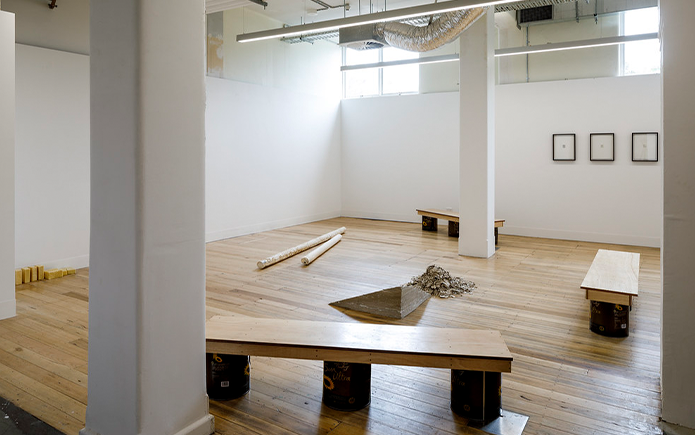
Erin's installation at MADA Now 2021.
A grey, triangular wedge installed in the centre of the room is made by laminating together layers of clay, tallow and vegetable shortening. This process is borrowed from a croissant making technique, wherein bakers place a thick sheet of butter between two sheets of pastry before rolling, folding, resting and repeating. When applied to clay and shortening, this created a marbled effect. Sliced open with wire, the stack recalls a geological strata or stack of damp newspapers. The form builds upon the tradition of corner works, which began in modernist sculpture and have persisted in the contemporary moment, such as with Robert Morris’ Untitled (Corner Piece) (1964) and Joseph Beuys’ Fat Corner (1968). Here, however, the form does not rely on the corner as a support structure, reclaiming its autonomy from the gallery space and breaking with its architecture to become a body. Controlled and angular, the form also challenges presupposed ideas of fat as soft and malleable.
A third component comprises a trio of benches constructed from the empty cans used to collect the waste oil from Caulfield Fish & Chips, and Marine Ply. The benches function in a multiplicity of ways within my work. Their arrangement suggests the interior of the store and the architecture of civic space, situating the viewer at the threshold of the public/private dichotomy. They also intend to upend sociocultural and aesthetic associations tied to contemporary art and takeaway food, and those who partake in their production and consumption. Another role they play in my work is unsettling implicit expectations that sculptural work is viewed from a standing position. Providing seating within a gallery context is an important accessibility accommodation for fat people or anyone who would find it more comfortable to sit rather than stand. When the body of the viewer is held and supported, it can allow them to spend more time with the work.
Following MADA Now, I was invited to participate in Hatched: National Graduate Show 2022 at the Perth Institute for Contemporary Arts (PICA). I exhibited a new iteration of Greasy Paper Torn Open with Eager Hands, Salt Licked, Fingers Sucked alongside works by more than 20 emerging artists from around Australia. As a result of this exhibition, I was awarded the Schenberg Art Fellowship by PICA in partnership with the University of Western Australia. Balancing my art practice, full time study and work over the past few years has been extremely challenging and this prize will support me to invest more time and energy into my art making. It will allow me to take the important step of developing an artist website, and to exhibit my work independently by covering the costs of materials, artwork transport and exhibition fees.
The Bachelor of Fine Art (Honours) program at Monash allowed me to develop the tools I need to pursue a career as an artist. I was able to create my own body of work from start to finish, with the support of a practicing artist, Alicia Francovich, who mentored me and helped prepare me for the realities of life as an artist. Being part of the dynamic research culture of this program and writing the mini exegesis to accompany my artwork allowed me to explore art theory relevant and interesting to me, deepening the rigour of my practice. It prepared me for the master’s program, where I am continuing to explore the potential of artistic practice to reveal the bias and discrimination that fat people face, as well as the richness of fatness and fat embodiment.
Erin Hallyburton is an artist, writer and Master of Fine Art student at Monash Art, Design and Architecture, where she completed a Bachelor of Fine Art (Honours) in 2021.